

In the illustration a woman’s hair blows in the wind, obscuring her face. At first glance, the strategic shades of black and gray make the image look like a computer graphic, but it’s hand drawn with pencil.
That creativity is one aspect of Jasmine Irene Martin that her older sister, Antonia Patterson, would like people to remember her for.
“I don’t want people to judge her by her death, because that’s not who she was,” Antonia said. “She was sunny, a good athlete, a really talented artist, extremely loyal. Anyone can become an addict; I don’t care who they are or who they think they are. When you look at an addict, that’s someone’s child.”
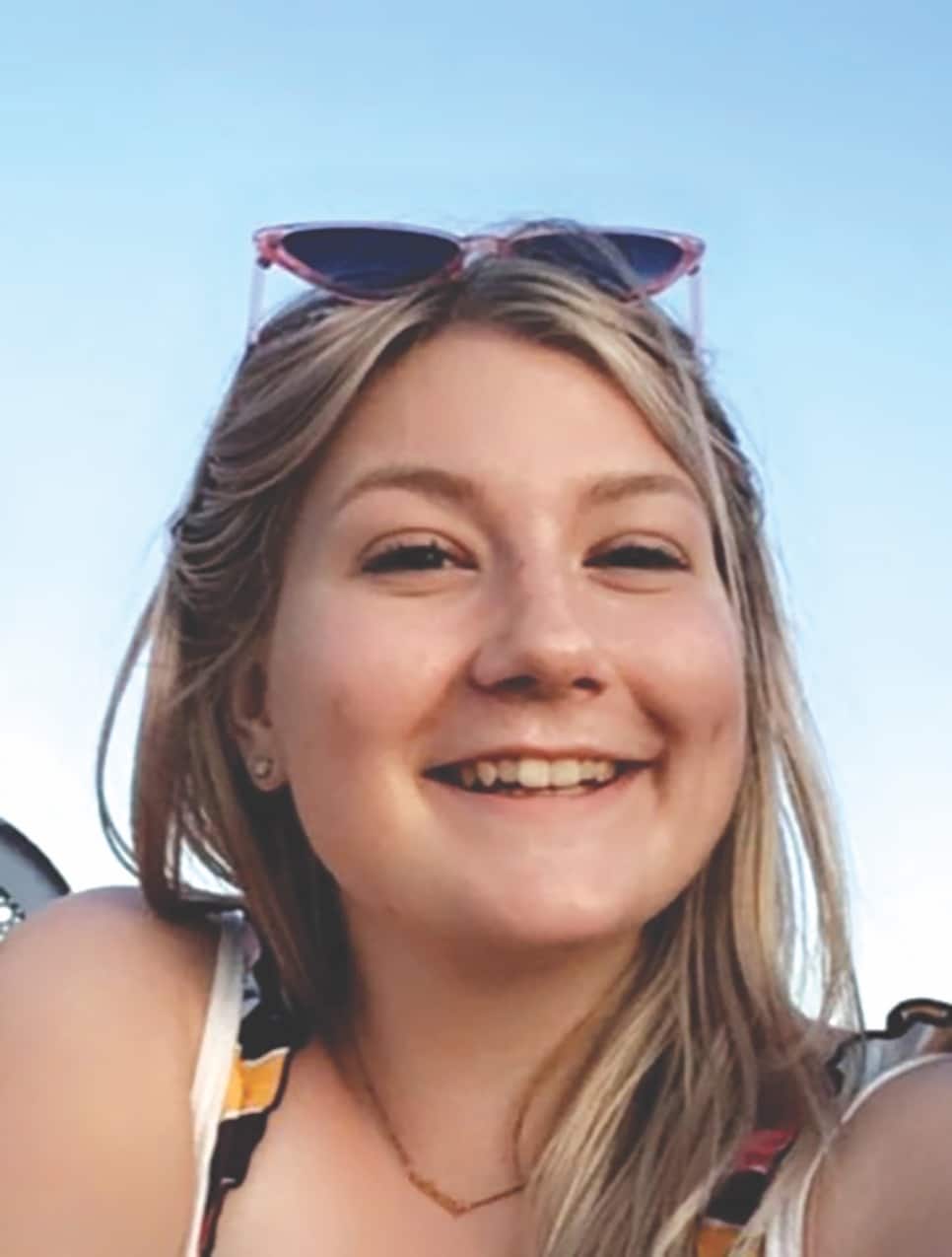
Jasmine was Tish Washburn and Tony Martin’s child, the middle of four girls, including Antonia, Jordan and Stormie.
Jasmine was a 2019 graduate of Priest River Lamanna High School who enjoyed school, playing softball, basketball and soccer. She was voted softball All League her senior year. As a child she was described as bossy, funny and extremely loyal to her loved ones.
Tish found Jasmine, 23, dead in her trailer from a fentanyl overdose on March 31, 2024. Jasmine was living in the trailer on the Washburn’s property in Priest River, Idaho, working on her sobriety.
Nationally, drug overdose deaths decreased by 10%, with more than 11,000 fewer deaths than the year before, as of April 2024. But that trend obscures rising rates in some Western states and the District of Columbia. In Washington the death rate is up 14%, 42% in Alaska, 22% in Oregon and 18% in Nevada. Deaths climbed by almost 1,300 total in those states, according to preliminary data produced by the Centers for Disease Control and Prevention (CDC). According to Washington Department of Health spokesperson John Doyle, Washington experienced a sharp increase in deaths from synthetic opioid overdoses in 2020, 2021 and 2022. It appears the numbers plateaued in 2023.
“Preliminary 2024 data have generally remained at a similar level as 2023, with a drop in the late summer/early fall,” Doyle wrote in an email. “However, the 2024 data is still coming in to DOH and these counts will change.”
Early data from 2024 shows there were 3,066 drug overdose deaths in Washington with 2,239 of those involving a synthetic opioid. In 2023 there were 3,450 overdose deaths, with 2,642 involving a synthetic opioid.
Number of deaths attributed to drug overdoses in Pend Oreille County:
2020: 2 total
2021: 4 total, 2 involving fentanyl
2022: 4 total, 1 involving fentanyl
2023: 4 total, 3 involving fentanyl
2024: 6 total, 4 involving fentanyl
Number of deaths attributed to drug overdoses in Bonner County:
2020: 4 total, 2 involving fentanyl
2021: 1, no fentanyl involved
2022: 3, 2 involving fentanyl
2023: 2, both involving fentanyl
2024: 5, 2 involving fentanyl
‘And then she met a boy’
To Jasmine’s family and friends, there was never any indication in high school that she used drugs recreationally or even, “partied.”
“She excelled at everything,” Tish said. “I never thought her life would go the direction it did, or that I would have to worry about her like that.”
Jasmine earned her Certified Nursing Assistant license after graduation and was doing freelance tattoo design jobs now and then. She was leaning towards getting an arts or nursing degree.
“And then she met a boy,” Tish said.
According to Tish and Antonia, this boy was local and several years older than Jasmine with a reputation for selling drugs.
“He told her that fentanyl was just like smoking pot,” Tish said.
Fentanyl is a potent synthetic opioid that can be prescribed by a physician, but over the last decade is more commonly found in illegal drug supply.
Illicitly manufactured fentanyl is developed in laboratories in various forms: pills; liquid, such as nasal sprays or eye drops; powder; and small candies. Illegally manufactured fentanyl is often mixed with other substances, including but not limited to cocaine or methamphetamine.
“Pharmaceuticals are federally regulated by the FDA [Food and Drug Administration], so when you get pills from your pharmacy, there is a specific amount of ingredients in all those pills that follow strict processing rules”, said Priest River Police Chief Drew McLain
“Fentanyl that is made and sold on the streets is like someone making chocolate chip cookies and putting one or two chips in one cookie and 20 in another. There is no uniform distribution. So when someone uses it, they have no idea what kind of dose they are getting. It could get them high or kill them.”
Tish, a recovered drug addict of 16 years, first noticed something wrong with Jasmine when she came to visit in late 2019, and she kept nodding off mid-conversation. She told her mother she had been trying dabs, a concentrated form of cannabis that involves inhaling vaporized oil.
“I had done my fair share of partying when I was young, and I knew it wasn’t that,” Tish said.
Both Antonia and Tish agree that the change in Jasmine seemed to have happened overnight. Antonia was living in Coeur d’Alene in the early 2020s and newly married. She didn’t see her family as often as she would have liked, but she remained close to them. She knew something was “off” about Jasmine, but she couldn’t pinpoint what it was, and Jasmine avoided conversations about the change in her demeanor.
Neighbors on common ground
In 2023 the state experienced 264 deaths related to opioid overdoses, according to the Idaho Department of Health and Welfare (data has not come in yet for 2024). The number of items testing positive for fentanyl at forensics labs statewide is down 32.4% from last year to date, according to data from Idaho State Police. In March 2025, there were 105 items submitted to the labs in Coeur d'Alene, Meridian and Pocatello that tested positive for fentanyl or fentanyl analogues, which are similar in chemical composition to the drug.
“Because we’re neighbors, we see that overlap,” McLain said. “People in Pend Oreille and Bonner counties know each other, they work together, there are family members on both sides of the border.”
In March, Priest River Police officer Scott Kennedy was off duty getting a milkshake at McDonald’s in Newport. The staff knew Kennedy was a cop and told him a man was having an opioid overdose in his car in the parking lot. McLain said Kennedy gave the man Narcan, saving his life. Narcan, also known as naloxone, is a medication used to reverse opioid overdoses.
“We’ve pulled over Idahoans and people from Washington traveling in Idaho for speeding or on a different warrant, and you see used Narcan dispensers in the back of their car or see burnt tinfoil squares,” McLain said. “Some of them know they have a problem, they know they might die, but they can’t stop using. That’s how strong it is.”
‘It was easier to get drugs than it was to stay clean’
It was January 2023, Jasmine’s birthday month. Antonia and Jordan took Jasmine to Cole’s Bakery in Spokane for a treat. Then the sisters drove around, talking and listening to music, mostly Mac Miller and singing along to the Black Eyed Peas, ‘My Humps.’
Then Antonia and Jordan told Jasmine they were worried about her. She was isolating herself from friends and family and her appearance was haggard. Antonia remembers that Jasmine started to cry.
“She was so ashamed to face anybody (about her addiction),” Antonia said. “She thought she was disappointing us, which made her addiction worse.”
At the height of her addiction, Tish thinks Jasmine was smoking around 50 fentanyl pills a day. According to information from the Drug Enforcement Agency, two milligrams of fentanyl can be lethal depending on a person’s body size, tolerance and past usage. DEA analysis has found counterfeit pills ranging from .02 to 5.1 milligrams (more than twice the lethal dose) of fentanyl per tablet.
Jasmine had tried to get sober before, traveling to a methadone clinic in Coeur d’Alene so she could get a daily pill to wean herself off fentanyl. The problem was she had to be on the road by 4 a.m. to arrive at the clinic at 5 a.m. and stand in line until the clinic opened at 6 a.m. Pills were distributed on a first-come, first-served basis. With unreliable transportation, the schedule was unsustainable, and Jasmine stopped going.
“It was easier for her to get the drugs than it was to stay clean,” Antonia said.
There was one time she went through withdrawal with Tish by her side. Some of the symptoms of opioid withdrawal can include nausea and vomiting, hot and cold flashes, anxiety, insomnia and severe muscle cramps.
“It was so hard to watch,” Tish said. “One minute she would be begging me to hold her, then the next she would be jerking away saying, ‘Don’t touch me, it hurts!’”
A little under a year before Jasmine died, Tish had to file a missing person’s report for her with the Spokane Police Department. Jasmine had been living at the Camp Hope homeless encampment in Spokane where Tish would visit her regularly. Except after repeated attempts to contact her, Tish realized Jasmine wasn’t there, and no one could tell her where she was.
“We were calling jails, funeral homes, hospitals, passing out flyers, posting all over Facebook, and then one day she showed back up with staples in her head,” Tish said. “She had been beaten up while she was high, and her stuff, including her phone, was stolen. She had no idea we were looking for her.”
Afterwards, Jasmine moved into a trailer on Tish’s property to try and get sober. By Tish’s account, it seemed to be working. She had stopped keeping company with other drug users, was getting back into making art, and she and Tish would often have long conversations in the evenings about their addictions and sobriety, among other things.
“She looked so much better,” Tish said. “She didn’t look so worn down, she was putting on weight, she was glowing again.”
A persistent stigma
Those looking to overcome addiction often face uphill battles from a variety of sources, according to Dirk Swartz, Substance Use Disorder Professional drug and alcohol counselor at Pend Oreille County Counseling.
POCC provides mental health services, crisis counseling, support groups, and intensive outpatient substance use treatment services.
Pend Oreille County Counseling substance use support groups:
- Outpatient (Substance Use/Co-Occurring Disorders) Thursdays, from 1 to 3 p.m.
- Intensive Outpatient (Substance Use/Co-Occurring Disorders), Tuesday, Wednesday, and Thursday, from 9 a.m. to Noon at the Pend Oreille County Counseling, 105 S. Garden Ave., Newport.
For more information on Pend Oreille County Counseling Substance Use Disorders, go to www.pendoreille.gov/counseling-services/page/substance-use-disorders. Walk-in assessments are available with no appointment necessary on a first-come, first-served basis. For faster check-in, people can pick up a new client packet before their walk-in appointment. A printable new client packet is available on the website or at Pend Oreille County Counseling Services.
“There is unfortunately still a stigma about addiction, especially in small towns, rural areas where everyone knows each other,” Swartz said. “Some people still think that addiction is not a disease, that it’s just a matter of willpower, and if you don’t have it, you must be weak and morally lacking.”
A recovering alcoholic himself, Swartz said he does not judge others for where they are at in their journey. While there are a few fentanyl users who attend the group meetings, Swartz said it runs the gamut from alcohol; opioids, including heroin; cocaine; marijuana; and meth.
“Some people are there because the court said they have to be, and they don’t want to talk. Others are at the point in their lives where they know something has to change,” Swartz said. “Wherever they are at, it’s our job to help them navigate their options, not to lecture, scold or withhold. That’s not how you reach people.”
Despite its proximity to Bonner County, the program can only accept Pend Oreille County residents. The closest certified drug and alcohol rehabilitation program to Priest River is at least an hour away.
It's been more than a year since Jasmine died.
Tish and Antonia agree it’s simultaneously been the slowest and fastest year of their lives. Antonia is a full-time medical technician at River Mountain Village Advanced Care. Tish is a volunteer for Heartbridge Life Center, a new non-profit based in Newport that will eventually offer various supportive services for those in need, including counseling, coaching and educational programs.
They share Jasmine’s story hoping it will reach people about not just the dangers of addiction but the harmful stereotypes associated with it.
“I think Narcan should be available to everyone,” Antonia said. “I think we need to talk openly about this topic, which a lot of people don’t want to do. I understand that it’s uncomfortable and awkward, but that won’t make it go away.”
McLain said he sometimes hears comments from people along the lines of, “Why should we waste money on these people if they won’t help themselves” or “They got themselves into this situation, they can get themselves out.”
While he understands the anger and fear that can come from being the target of a drug-related crime, he believes those addicted to drugs are also community members in distress.
“It’s not about being worthy or unworthy of help,” McLain said. “God forbid, if my kids were in a situation like that where they were addicted to drugs and overdosed, I pray that someone helps them. They’re not just drug addicts, they’re your neighbors, your family, your friends. At the end of the day, that’s someone’s kid.”
Free Narcan is available at Northeast Tri County Health, located at 605 Hwy. 20, Newport. Business hours are Monday – Thursday, 7:30 a.m. to 4:30 p.m. and Friday, 7:30 – 11 a.m.
‘I just felt there was something wrong’
The evening before Easter, March 31, 2024, Tish did not go out to visit Jasmine in her trailer like she did most days. Tish’s youngest daughter, Stormie, wanted to cuddle on the couch and watch a movie with her.
“She’s a teenager, so those moments are pretty rare,” Tish said.
After the movie, Tish went to bed. The next morning, she awoke early for sunrise service at House of The Lord Church in Oldtown and left, wanting to let Jasmine sleep in. When she returned several hours later, Stormie said she woke up late herself and hadn’t seen Jasmine yet. Tish went to the trailer and knocked on the door. There was no answer. Tish knocked louder and called Jasmine’s name. Still no response. She tried the door to find it was locked.
“I got this sinking feeling in my stomach,” Tish remembers. “It just felt like there was something wrong.”
Tish peered through a window and saw the shape of Jasmine’s body in bed, unmoving despite Tish’s repeated pounding on the trailer and yelling. Hearing the commotion, Stormie came outside, and Tish told her to call their next-door neighbor, that Jasmine was in trouble, and Tish couldn’t get into the trailer. The neighbor arrived soon after, and she and Tish forced open the door. Tish rushed to Jasmine’s side, grabbing her shoulder to turn her over. Her body was stiff and cold.
“I know we gave her Narcan, but I don’t remember what happened after that,” Tish said.
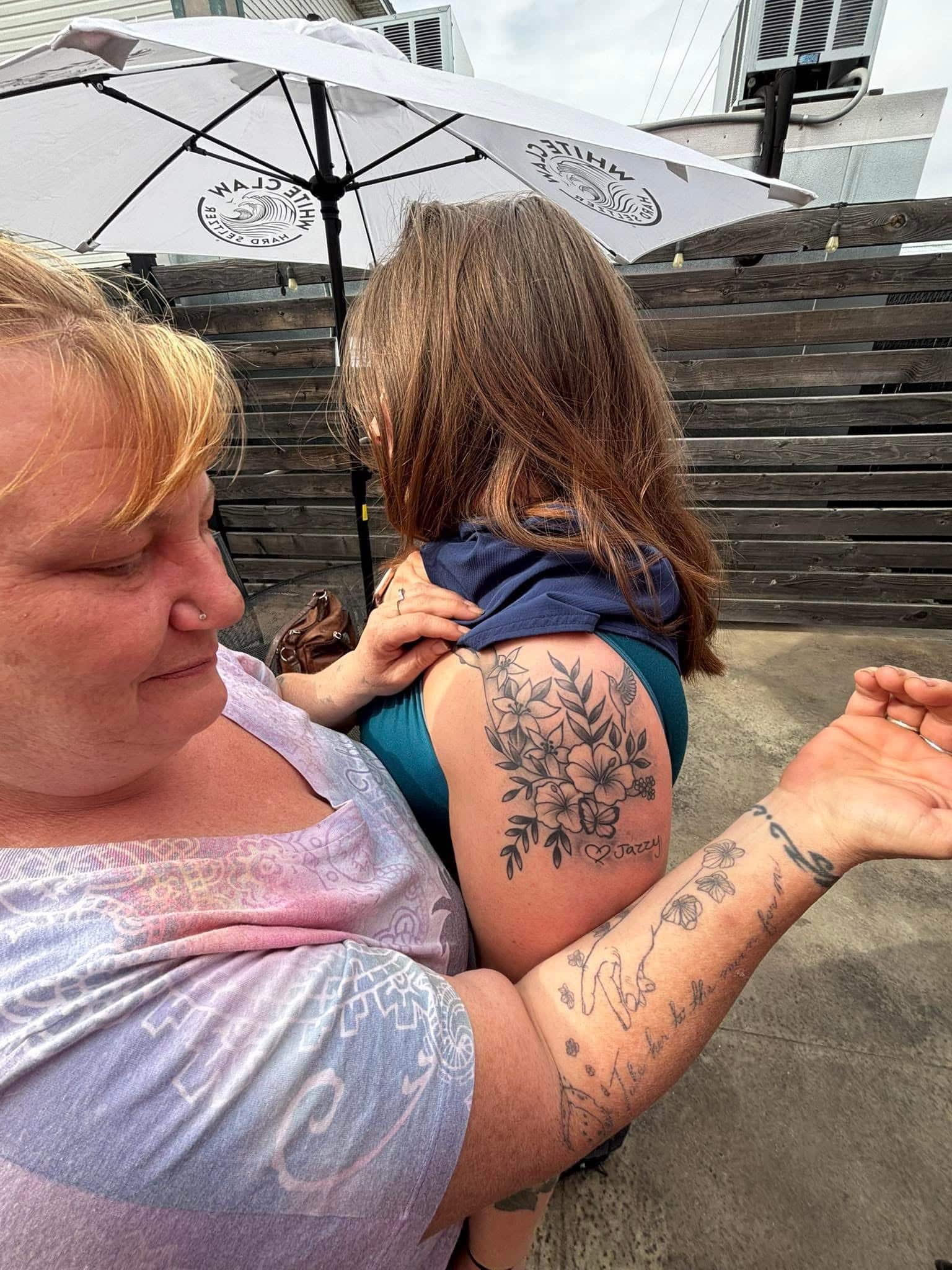
That same day, Antonia and Jordan were at their father Tony Martin’s house in Laclede, making Easter breakfast. Martin’s cell phone rang, and they saw it was Tish, which they all considered odd since the pair were long divorced and rarely called one another. Jordan answered the call. Atonia remembers her sister’s face turning pale and she hung up.
“Jazzy is dead,” Jordan whispered.
Antonia said she had an immediate gut reaction to the news.
“No, she’s not,” she replied, taking the phone from Jordan. Jordan told her Tish had been crying and screaming.
“I thought she had misheard, that there was some mistake, that there was a misunderstanding between what was actually happening and what Jordan heard,” Antonia said.
She called Tish back. Her mother was still screaming.
When Antonia, Jordan and Martin arrived at Tish’s house minutes later, Antonia saw there were law enforcement cars outside Jasmine’s trailer, but no ambulances.
“I knew right then that she was really gone,” Antonia said.
There was evidence in Jasmine’s trailer that she had been smoking fentanyl. She had been dead for at least six hours.
Antonia remembers Tish cursing at a police officer as he approached the family, who were standing off to the side of the trailer.
“Get the fuck away from me,” she said. “Don’t fucking come near me.”
Tish said she wasn’t angry at the officer specifically. But she had touched Jasmine, felt how frigid her body was, how she hadn’t responded to Tish’s frantic cries. She just remembers not wanting to hear what she already knew. Her daughter was dead.
It is currently unknown where Jasmine got the fentanyl. Her death is under investigation by the Idaho State Police.
Sophia Mattice-Aldous is a Murrow News fellow working directly with newsrooms at The Newport Miner and RANGE Media through a program administered by Washington State University. Her reporting is available for use via Creative Commons with credit.


