

What might have been a cut-and-dry meeting of the Spokane Transit Authority board — a presentation on ridership data, a discussion of the agency’s state lobbying efforts, some essential contract approvals — turned into a quiet war of maneuver between two factions with different visions of STAs near future.
On one side, the board’s existing power, led by STA Board Chair Al French and his allies from the county and Spokane Valley. On the other, a coalition of Spokane city lawmakers, anchored by Zack Zappone and Betsy Wilkerson — who have been advocates for STA reform — leading a more galvanized contingent of Spokane council members than the board has seen in the recent past.
The fight was over a seemingly dry piece of business: which board members would sit on, and who would chair, the board’s three committees. But at STA, committee assignments make up a key aspect of how power flows on the larger board. That’s especially true of the Board Operations Committee, which largely decides which initiatives the full board considers for a vote.
According to the bylaws, it was French’s job to present a draft of committee assignments, and the board’s job to discuss, tweak if necessary, and approve. But French had made some decisions with his draft committee list that proved controversial with the Spokane lawmakers on the board, including giving county lawmakers — including French himself — two of the voting seats on the powerful operations committee and cutting the city out completely.
Regardless of their plans for reform, the Spokane lawmakers ultimately argued, if the board stripped Spokane of voting seats on the operations committee, they would be taking power away from the single largest group of transit riders in the system. And initiatives backed by Spokane might never make it to the full board for a vote — even if the issues themselves had a majority of the overall board’s support.
And so, a discussion that French had allotted just 15 minutes to in the agenda stretched on for nearly an hour as board members argued and negotiated by proposing committee trades, airing personal tensions and citing RANGE articles.
At one point, non-voting member Hank Bynaker of Airway Heights put his head in his hands: they still had nearly 75 minutes to go.
A chess match months in the making
Since at least last spring, Zappone and Spokane City Council President Wilkerson have been pushing for the Spokane Transit Authority (STA) board to add free fares based on income to make it easier for people with limited means to ride the bus.
Until November’s election, those attempts were stymied by a conservative bloc made up of county and Spokane Valley officials.
At the end of December, communications received from a citizen’s public records request revealed that two of the longest serving members of the board, French and Spokane Valley Mayor Pam Haley, had texted and emailed with STA CEO Susan Meyer, had corresponded about their annoyance with Zappone, and strategized how to block ideas from Wilkerson and Zappone.
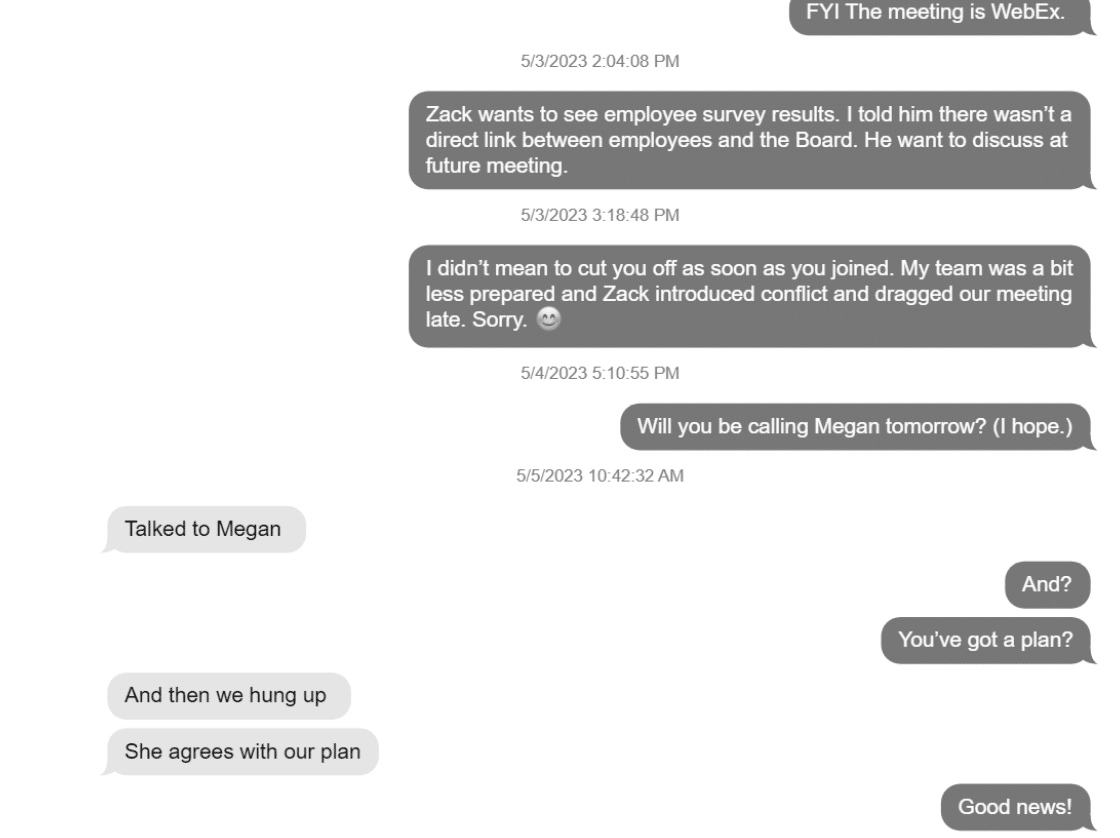
Text messages between Al French, in light gray on the left, and STA CEO Susan Meyer, in dark gray on the right.
Meyer, as CEO, doesn’t have a vote on the board, but French and Haley were usually joined by County Commissioner Josh Kerns in a coalition to fend off the priorities of their more progressive colleagues.
At the time, there was no similar alliance between Wilkerson and Zappone and Karen Stratton and Lori Kinnear, their Spokane City Council colleagues who also served on the board, so Zappone and Wilkerson often found themselves voting together to push progressive ideas and creative approaches to transit engagement with little support from others on the board.
Now, with the more moderate Kinnear and Stratton no longer in office, Wilkerson and and Zappone could find stronger allies in freshman legislators and progressive transit advocates Paul Dillon and Kitty Klitzke, both of whom will join the STA Board once the council’s appointment process concludes, and who joined Zappone and Wilkerson at Thursday’s meeting as alternates until their official appointments are finalized.
Those appointments have been subject to their own controversy, and will see some debate at tonight’s city council meeting, as District 1’s city council representatives Michael Cathcart and Jonathan Bingle have been pushing for Bingle’s appointment to the board to ensure representation of their district. That protest isn’t likely to succeed, however, and it’s probable the council will vote to make Dillon, Klitzke, Zappone and Wilkerson the permanent members representing Spokane at STA Board meetings for the year.
Those four councilmembers seem likely to form a coalition to tackle initiatives like transit accessibility and free fares for low income people head on, a strong position that would find them only needing one additional vote to reach a majority on the board with only nine voting members. French, Haley and Kerns are expected to continue mostly being in alignment on issues as well. That leaves just two members — Liberty Lake City Council member Dan Dunne and Tim Hattenburg, the sole Democrat on Spokane Valley’s City Council — as likely swing votes whenever the Spokane city group butts heads with the group led by French.
Thursday’s STA meeting was the first of 2024, and it set what could become an exhausting tone for the rest of the year, where disagreements could grind on, limiting time for other key issues.
It would be hard to outline all the twists and turns that brought us here, but the highlights include:
- French and Zappone sparring in the Inlander in early December about low-income fares.
- RANGE publishing Meyer’s texts with French and Haley detailing the group’s efforts to sideline Zappone.
- Wilkerson releasing her more progressive slate of proposed STA board members from Spokane City Council, excluding Bingle.
- French proposing his own committee assignments, which sidelined those Spokane council members and appointed himself, Kerns (another representative from the county), longtime French ally Pam Haley and Dunne, the city council member from Liberty Lake, as the only voting members on that same committee for 2024.
If passed, that operations committee roster would have marked the first time in at least eight years that one of the four major stakeholder groups — Spokane city, Spokane Valley, Spokane County, and a representative of five smaller cities — on the board was not represented by a voting member on the committee.
In addition to largely controlling the flow of ideas and legislation on the board, the operations committee also handles CEO evaluations, deals with HR complaints and drafts the rules of procedure for the full board. For several months, Zappone has been asking questions about HR complaints and general employee satisfaction with Meyer. Those questions have been rebuffed in the main board on procedural grounds that those discussions belong in the operations committee.
Read our reporting on how these committee appointments function here.
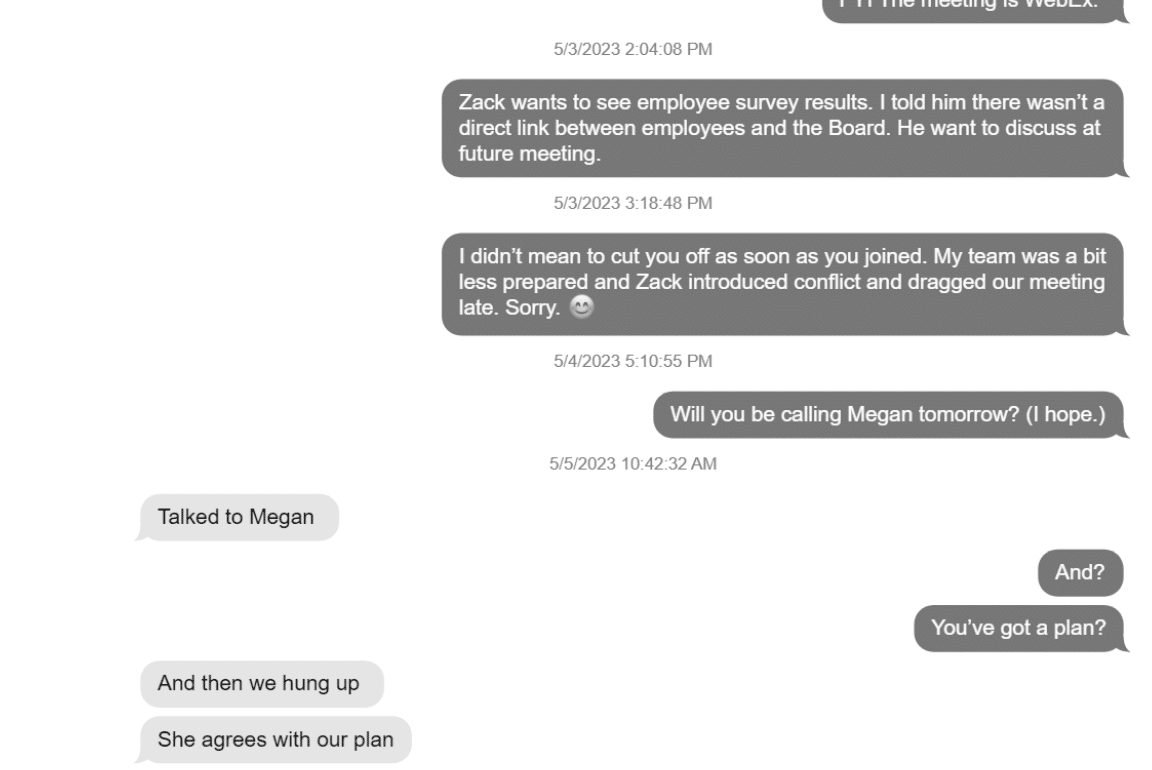
Light gray texts on the left are from Al French, dark gray texts on the right from STA CEO Susan Meyer.
And while these appointments have real consequences, one outgoing board member told RANGE part of how the fight got this entrenched comes down to the personalities of the combatants.
“[Zappone] is pretty political, and [French] is pretty political, and so you get those two going and it feels like this big political pissing match,” former Spokane Council Member Karen Stratton said before Thursday’s meeting. “Really, the board should be sitting down thinking what is the most efficient, the healthiest way we can work with our different entities or our various partners.”
“It's gotten so convoluted and nasty, but this isn't the way to handle this. It just feels like sniping back,” Stratton said. “I'm not saying this to be naughty, but it just feels like a bunch of kids in a sandbox fighting. It's like, ‘Okay, we don't like you right now and you've made us mad, so we're going to take this away.’ It’s not fair to the citizens in Spokane.”
Stratton served on the board through 2023 and ended her last meeting on December 21 by asking the board to consider an audit of STA’s governance, leadership and HR policies to build back public confidence: “Clear the air, start new. Get those questions out of the way.”
French’s proposed committee lists passed at the Board Operations Committee meeting on January 10 with the unanimous approval of the three members who were there – French, Haley and Dunne – but wasn’t seen by any Spokane city representatives. Due to a scheduling quirk, Spokane’s seat was vacant, because Kinnear, who was the city’s 2023 representative on the committee, no longer held office and the STA board wouldn’t appoint a replacement until Thursday.
Zappone, who burst into that meeting halfway through to ask why it was happening without Spokane city representation, was told by French that the meeting wasn’t open for public comment, and that because of the Spokane City Council election cycle, this scenario happened frequently — for the first meeting in January, there was no Spokane representative on that committee.
And with no city voices on the STA Board Operations Committee present that day, leading to a list of appointments that would then leave the city out of votes on the committee for the entirety of 2024, Spokane City Council Members began to fear that despite a solid voting bloc representing the largest ridership group in the STA, their ideas still would not be heard.
Blockade, blitz, blow-by-blow
After months of saber-rattling, in proposing to leave Spokane city without a vote on the Board Operations Committee, French had fired the first actual shot in what could shape up to be a yearlong war.
Armed with a joint letter from Mayor Lisa Brown and Wilkerson, the Spokane City Council members came to last Thursday’s meeting prepared to fight back.
“The City of Spokane is the largest jurisdiction by population in the public transportation benefit area and, pursuant to RCW 36.57A.050, is provided four of the nine STA governing board votes to assure proportional representation of its residents based on the city’s population,” the mayor’s statement read. “Decisions regarding these critical functions need to reflect the concerns of the City of Spokane, the largest municipal jurisdiction in the system. Without a voting presence on this Board Operations Committee, those concerns are likely to be overlooked or, worse, ignored when recommendations are made to the Board of Directors as a whole.”
The letter, sent to the entire board and Meyer, also cited STA’s Governing Committee Operating Guideline number 12, which reads:
“Governing Committee chairs and members should be rotated among Committees regularly to ensure that their governing experience is richer and more diverse. It is recommended that Committee chairs and members be rotated annually when feasible, and that no Committee chair or member serve a term of more than 2 consecutive years.”
Under that guideline, the Board Operations Committee would have been out of compliance with the guidelines since 2016: French had served eight terms in a row on the committee, and Haley seven. Chris Grover, the mayor of Cheney, had served four terms in a row from 2019 to 2022.
Zappone asked about the guidelines, asking that they be projected for the council to read. Megan Clark, legal counsel for STA, said the guidelines had been changed by resolution in 2019, and pulled up the website, which then only displayed items 1 through 11.
RANGE had also reviewed those guidelines on STA’s website on January 16, including the one cited in the letter, but by the time the STA Board circled around to discuss committee assignments around 2:30 pm on January 18, guidelines 12 through 18 had been removed from the website. The removed items can be reviewed in their entirety below.
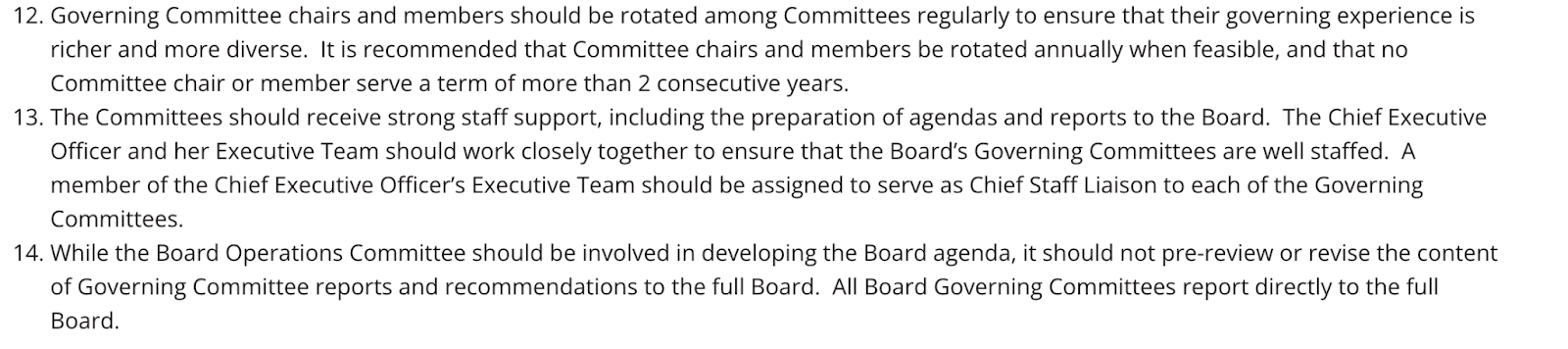
STA Governing Committee Operating Guidelines that were removed from the website sometime in between January 16 and 2:30 pm on January 18.
Over the course of an hour, the committee assignment discussion turned into a war of attrition.
Klitzke, who had been proposed as a non-voting appointee to the Board Operations Committee, said she didn’t want the appointment, and wanted time to get her feet under her and understand how the board works — another sticking point, as Zappone told RANGE he’s been asking for a full STA board training on bylaws and guidelines all last year.
French responded by stating her inexperience was part of why he’d suggested she be a non-voting member, but he was willing to appoint Wilkerson in her stead. Wilkerson “respectfully declined.”
Legal counsel repeatedly asked the board to follow the agenda, and vote on the appointments for the two other committees, Performance Monitoring & External Relations (PMER) and Planning & Development (P&D) first. But because the chairs of those committees would receive automatic appointments to the coveted Board Operations committee, Spokane city representatives reiterated that the problem of representation needed to be solved before they could approve any committee appointments.
Throughout, board members made so many motions — to approve the appointments, to amend the appointments, to amend their amendment to the appointments — that it became nearly impossible to track what they were voting on and in what order.
French said part of the committee composition came from accommodating a request from Haley.
“This last year has been a real challenge,” French said. “Mayor Haley has requested that she does not want to serve on PMER. And so, out of respect for [sic] that, I moved her over to P&D to give her a little break from some of the controversy that has been associated with PMER.”
It wasn’t immediately clear what controversy was associated with the PMER committee, but it was revealed when Zappone and Wilkerson, who had been assigned to the PMER and P&D committees, respectively, asked to swap places – Zappone wanted to be on P&D.
“I’m not going to support that,” French responded. “There’s a lot of work that comes before P&D this year and I know why you want to be on P&D, you want to control that committee.”
He then continued, saying having Zappone and Haley on P&D wouldn’t “solve the problem as far as Mayor Haley is concerned,” implying that Haley had asked to swap so she wouldn’t have to be on the same committee as Zappone.
Wilkerson chimed in, stating that French’s comments were out of line and that committee assignments should be about skillset, not personal issues.
“We all have conflict. We all have personality issues,” she said. “We have to be able to work through this.”
Haley did speak up later, stating that her request to swap committees was a timing issue and that PMER meetings often ran long.
After some more confusion about motions on the floor, the board voted 6-3 to approve Wilkerson and Zappone swapping committees. Despite saying Zappone wasn’t the issue, Haley joined French and Laura Padden, the Spokane Valley alternate filling in for Tim Hattenburg, in voting nay.
Only a little more chaos ensued as the board tried to re-shuffle the committee assignments, but finally, they were ready to vote on the first two committees. The lists that passed were almost exactly the same way they’d been written, with the exception of the Wilkerson/Zappone swap and a request from the non-voting union representative to switch onto the P&D committee.
Finally, they came back around to the committee that had started the chess match: Board Operations.
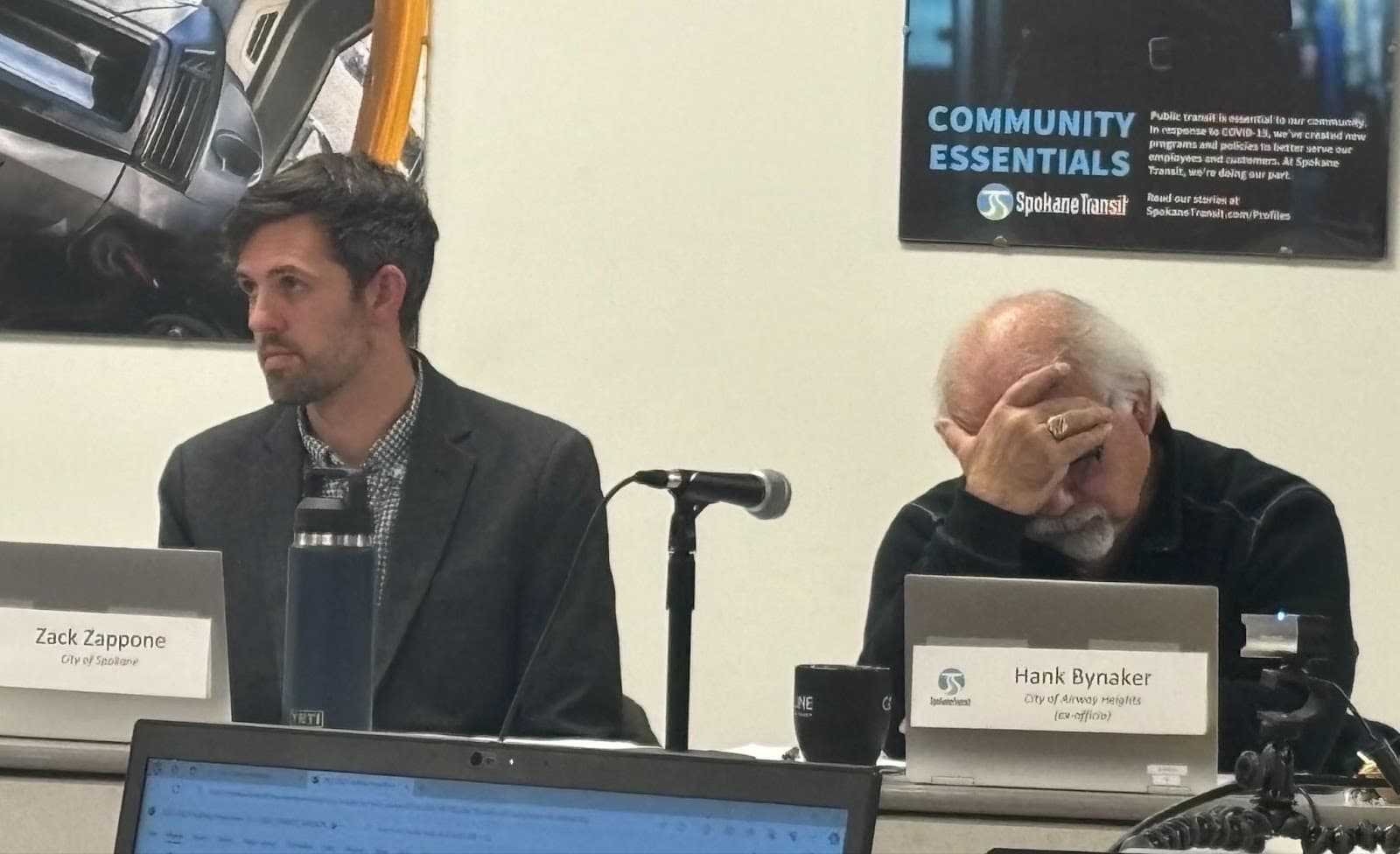
After nearly an hour of discussion, Zappone proposed that the Board Operations Committee be French, Haley, Kerns, Dunne and himself (replacing Klitzke), with Kerns being the non-voting member. There was no more discussion. The proposal passed 7-2, with Kerns and French voting no.
Though the vote ultimately garnered the majority approval, the damage had already been done: by the end of the afternoon, the meeting had run an hour over schedule, and multiple non-voting members had to leave to get to other engagements before the board could discuss important transit business.
“I’d love to stick around to hear that update but I have other obligations so with your permission, I’d like to be excused,” said Grover, the mayor of Cheney as he packed up his things.
“Yup,” French responded. “This is our future.”


