


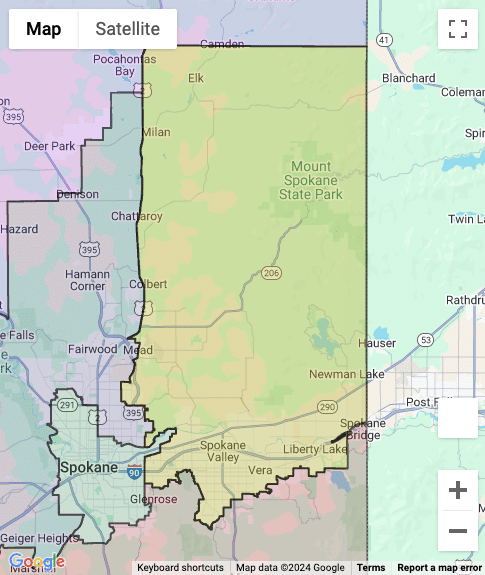
Either Democrat Miguel Valencia, a law student and a veteran, or Republican Leonard Christian, also a veteran and a state representative, will fill the state senate position for Washington District 4 next year. The district covers from Spokane Valley and Liberty Lake to Camden in Pend Oreille County.
The position is being vacated by Republican Senator Mike Padden next year, who is retiring after 28 legislative sessions in Olympia.
We partnered with Cascade PBS to write candidate profiles for the race earlier this year and have included them below. We’ve also asked Valencia and Leonard an additional set of three questions.
Christian has not responded to our questions via email or phone call, but we did our best to answer some of the questions using publicly available information and by providing links to articles he did participate in. If he responds, we’ll add his answers.
Miguel Valencia
Miguel Valencia, a Democrat, is a paralegal with the law firm Witherspoon Brajcich McPhee and a paralegal specialist with the Army National Guard. He is campaigning on a platform of free child care, support for unions and reducing the influence of corporate money in elections. His website says “there is no better way to show that we care about our children than to relieve parents of the high burden of paying for daycare and pre-k” and that “we should reduce the amount of money a candidate can raise from corporations, put a 10-year ban on receiving gifts after leaving office, and pressure the state political parties to ban corporate contributions.” He is endorsed by the Spokane County Democrats.
Miguel Valencia PDC link
Miguel Valencia campaign website
Miguel Valencia State Voter Guide
Jump to his responses to our questions here
Leonard Christian
Leonard Christian, a Republican, is vacating his District 4 seat in the Washington House of Representatives to run for the Senate position. He grew up in Spokane, the child of a single mother, and is an Air Force veteran and real estate broker. He campaigns on a record of “defending gun rights, opposing higher taxes, and supporting parental rights.” He also supported allowing police broader authority in pursuing people they believe have violated the law. He was a volunteer instructor at Spokane’s Moody Bible Institute. Former Spokane County Sheriff Ozzie Knezovich and County Commissioner Mary Kuney have endorsed Christian for the seat.
Leonard Christian PDC link
Leonard Christian campaign website
Leonard Christian State Voter Guide
Jump to his section here
Our questions, their responses
We asked both candidates for the open seat a set of three questions, touching on key issues we’ve heard from our readers. Only Valencia responded. His responses are posted verbatim — with light editing for grammar.
Miguel Valencia
What is the biggest issue facing Spokane Valley and what do you plan to do about it if elected?
The biggest issue facing the 4th Legislative District today is public safety. But public safety isn’t just about law enforcement; it’s about ensuring that our community is a safe, supportive, and thriving place for everyone. Addressing public safety comprehensively means going beyond policing to tackle the root causes that make our community vulnerable.
I will start by saying that we do need to support Law Enforcement with the resources they need. A strong and well-supported police department is essential for maintaining order and ensuring quick response times. I will advocate for proper funding, training and resources for our law enforcement agencies so they are well-equipped to serve and protect our community. This includes expanding mental health crisis intervention and building partnerships with local organizations to respond more effectively to complex situations. To me, this would not include the continued militarization of the police force.
I also think that health care is fundamental to public safety. When people can’t afford medical care, they are more likely to struggle with untreated illnesses and chronic conditions, which can affect public health overall. I support expanding access to affordable healthcare options so that every resident can get the care they need without fear of financial ruin. It is immoral to have a system that creates a situation in which people are scared to get the healthcare they need or to call an ambulance because of the cost.
Working families also need access to affordable childcare. Without it, parents are forced to make tough choices between their careers and caring for their children, which is a decision that I have seen play out within my own family. This oftentimes leads to financial instability and increased stress, which then ultimately impacts community well-being. I will work to make childcare more affordable and accessible, helping families get ahead and children thrive in safe, nurturing environments.
No child should ever go hungry. Food insecurity affects many families in Spokane Valley and in the 4th LD; it impacts children’s ability to learn and grow. I will support local food programs, a universal school meal program, and partnerships with organizations working to end hunger, ensuring that everyone has access to nutritious food.
I believe that our children deserve the chance to pursue higher education or job training without the burden of crippling student debt. Access to affordable education and training ensures that our youth can build successful futures. I will advocate for programs that reduce the financial barriers to attending college or trade school, empowering the next generation and strengthening our local economy.
Probably the top issue that comes to mind in public safety other than law enforcement is housing. Housing insecurity, in my opinion, is a significant public safety concern. When families don’t have stable housing, it affects every aspect of their lives, from health to education to employment. I will work to increase the availability of affordable housing, support renters’ rights and provide resources for those facing homelessness. Everyone deserves a safe place to call home.
Spokane Valley is a conservative place, and you’re running as a Democrat. How do you plan to bridge the gap between conservative values and more left-leaning ones? How do you plan to represent the voters of Spokane Valley?
The 4th Legislative District, which includes Spokane Valley, Liberty Lake, Millwood, Mead, Otis Orchards, and Elk, has long been a conservative stronghold. However, I believe that in today’s political climate, people—whether conservative or liberal—are tired of a corrupt political system bought by large corporations and the billionaire class.
I come from the same background as many people in the district. I grew up in Eastern Washington, where many of the folks I know worked blue-collar jobs. I’m married with three kids, served honorably in the Army, and currently serve in the Washington Army National Guard. I’ve seen firsthand how this corrupt system, driven by greed and a lack of human decency, is failing working people, and I find it immoral.
Take my opponent, for example—he accepts donations from Avista, Blue Cross Blue Shield, Chevron, DoorDash, and Koch Industries, just to name a few. How can someone claim to represent working-class people while being funded by corporations that actively work against their interests? How can he fight to lower utility costs when Avista funds him? Or fight against price gouging by private insurance companies when they fill his campaign coffers? How can he seriously address the climate crisis when his donors' profits depend on opposing it? And how can he stand up for workers’ rights when he accepts money from companies like DoorDash, which is known for its anti-union stance?
When it comes to bridging the gap between conservative and liberal values, I believe that most working-class people, regardless of political affiliation, share common ground on key issues. It’s not radical to believe that in the richest country in the world, and in a state with 13 billionaires, healthcare should be a human right. No one should go into medical debt from an emergency, and no one should be afraid to call an ambulance due to the cost.
It’s not radical to believe that a working-class family shouldn’t have to worry about affording daycare or preschool for their kids. It’s not radical to say that, in today’s economy, a college degree or trade school certification should be accessible to all, just as a high school diploma was 50 years ago. We shouldn’t be punishing 18-year-olds with hundreds of thousands of dollars in student debt simply for trying to get ahead.
And it’s not radical to believe that workers should have the right to come together and bargain for higher wages and better benefits, especially when we live in a time where CEOs make 200 times more than the average worker. It’s about time that these corporations pay their fair share because no one can work 200 times harder than another person.
I am always willing to sit down with anyone and have a conversation about the issues that matter to us all. I’ve had several lunches with Al Merkel, Mike Kelly and Rob Chase, and I’ve had long conversations with Leonard Christian and Suzanne Schmidt. While they may not agree with me on everything, they know I’m transparent and genuinely care about our community. For example, Mike Kelly and I both support the idea of workers owning stock and encouraging employee-owned businesses. Al Merkel and I found common ground on law enforcement funding and issues with the Growth Management Act. Rob Chase and I both oppose corporate monopolies and the crony capitalism that exploits consumers.
But my opponent, Leonard Christian, doesn’t even have the support of his own party. He isn’t endorsed by the Spokane County GOP, State Senator Mike Padden, Representative Suzanne Schmidt, or even Rob Chase, another Republican running in the 4th. Christian’s leadership is weak—he can’t unify his base or local leaders behind him. When asked in forums why he wants to be a state senator, his answers are vague, saying, "It’s the next step in my career," or “It will be better to run every four years rather than every two years” or that the Senate "ends its days earlier than the house." That tells me that in his eyes, this race is about him, not the people of the 4th District.
Worse yet, when asked what he plans to accomplish in the Senate, he undermines himself by saying that since he’s in the minority party, it’ll be hard to get things done. That’s a sorry excuse for doing nothing on behalf of the working people in our district.
Another important issue we can’t ignore is women’s rights. We’ve seen the dangerous impact of losing access to life-saving reproductive healthcare, especially in neighboring Idaho. My opponent supports an abortion ban with no exceptions, not even for rape or incest. This has led to a 25% reduction in OB-GYNs in Idaho, with Northern Idaho losing a maternal healthcare clinic entirely. As a result, women now have to travel farther for care, with potentially deadly consequences.
I plan to represent the voters of the 4th Legislative District by always keeping in mind what’s best for working-class people, and small businesses, and by being fiscally responsible while protecting individual rights.
Development and its balance with infrastructure has emerged as a prominent issue in Spokane Valley. If elected, what would you do to allow infrastructure to catch up to development?
Spokane Valley and Liberty Lake have experienced a lot of growth over the past four years. With this influx of new residents, we must act to ensure that our infrastructure can handle the increasing demands, allowing everyone to enjoy the quality of life that makes this area so special.
When it comes to housing infrastructure, I propose relaxing land use regulations to encourage mixed-use developments in areas where infrastructure already exists. By concentrating growth in these locations, we can mitigate some of the strain on our roads, utilities, and public services. Environmental impact assessments should be a standard part of our planning process, ensuring that we are making decisions that benefit both the community and the planet.
However, I also think it is important that the current working-class residents who may have lived here for generations aren’t being left to bear the bulk of the costs for these upgrades in our infrastructure. I advocate for implementing impact fees and other developer contributions to help fund improvements to roads, utilities, schools, and public safety services. I think that by requiring developers to contribute to these infrastructure needs, we can ensure that growth pays for growth, rather than placing the burden on existing taxpayers.
In terms of public transportation, our district has been too often left behind. For a city of Spokane Valley's size, we need better public transit options. I will prioritize investments to expand transit services, add bike lanes, and build more pedestrian-friendly infrastructure. Studies show that areas with enhanced public transportation see a reduction in traffic congestion and improvements in air quality, which are benefits we can all enjoy.
Of course, with so many infrastructure upgrades also comes thinking about the workforce that will be working to do these upgrades for our community. I believe in paying fair, prevailing wages and incentivizing the hiring of unionized companies to ensure workers are well-compensated and treated fairly. Infrastructure projects aren’t just about improving our physical landscape; they’re also opportunities to create good-paying, reliable jobs for our community. Union workers bring the skills and quality we need, and studies show that unionized construction projects are completed on time and with fewer safety incidents compared to non-union projects.
To sum it up, we need to focus on equitable funding, environmental responsibility, improving our public transit, and ensuring that the workers helping us accomplish this are being paid well with good benefits.
Leonard Christian
Christian did not respond to the questions RANGE sent, so we sought comments he has made publicly on the same topics. On public safety, the Spokesman-Review quoted Christian as saying he supported more stringent punishments for people who break the law.
“You can have all the law enforcement officers in the world, but without the ability to hold somebody, the criminal, accountable, it doesn’t do any good,” Christian told the Spokesman. “And I think that’s one of our problems with our current leadership for the state, is that the officers have not been respected.”
As a mirror to the question of a Democrat running in a conservative area, RANGE asked Christian about his biggest accomplishments as a state Representative and how he expects to make meaningful change in the state Legislature as a member of the minority party.
While he didn’t respond, his website says, “We can trust Representative Christian to continue to oppose the bad ideas coming out of Seattle that threaten our community with more crime, higher taxes, failing schools, and a loss of basic freedoms. Years of service to this community, years of defending America, and years of leadership in the House prove he is our best choice for the State Senate.”
Further reading
Read the Washington State Standard’s piece on Mike Padden, who is leaving the seat.
Read the Spokesman’s post-primary coverage of the race here.
Also read the Spokesman’s candidate profiles, Valencia’s here and Leonard’s here.
Listen to conversations hosted by The Spokesman with both Valencia and Christian.Read The Inlander’s primary coverage of the race here.


