If you’re registered to vote in Spokane, you should have your ballot by now. On it is a proposed amendment to the state constitution, city propositions, candidates for legislative offices. You’ve no doubt heard a lot about those — they’re campaigns often waged along the partisan lines of the culture wars that populate your social media feeds.
But as you fill in your ballot, the elections for the third branch of government might feel like they snuck up on you: municipal courts, to which we elect three judges in every city election. These races are more obscure than others, though you can find write ups in The Spokesman, and perhaps see some of the candidates at local party, activist and nonprofit events.
Municipal court is held across the river from Spokane City Hall — out of sight from the other functions of government. But the races are analyzed in the Progressive Voter Guide, the hyperconservative We Believe We Vote handbook and the generic voter guide generated by Spokane County.
Municipal judges make decisions on low-level criminal misdemeanor and civil infraction cases brought to them by the city prosecutor stemming from crimes committed within the city limits. The most prominent recent example of this is a slate of charges brought after dozens of people were arrested for failing to disperse on June 11 after they demonstrated against Immigration and Customs Enforcement (ICE). All but two of those cases were eventually dismissed.
But most cases are much less prominent, including drunk driving and domestic violence cases. Still, municipal judges often represent the initial contact someone makes with the criminal justice system, and if their interactions with that system are not resolved, it can result in a lifetime of incarceration. There are programs designed to prevent that from happening, but shortfalls in city budgets create what one judge called “cliffs” that make it more likely that someone who commits a crime will reoffend.
The municipal courts also oversee the city’s “therapeutic courts,” five lower-level courts that can assign community service and connect any offender to resources to identify the root cause of their offense and to solve that problem. The municipal judges can decide to refer cases they hear to the therapeutic courts, which can hear drunk driving and domestic violence cases, as well as cases caused by mental health problems. Therapeutic courts have fallen on the sword of state budget cuts recently and were at risk of being shuttered, but received grant funding from the state at the end of last year to keep them temporarily afloat.
While the municipal judge races typically fly under the radar of local elections and often carry only one candidate, this year is different: of the three positions, two are being challenged in somewhat heated terms.
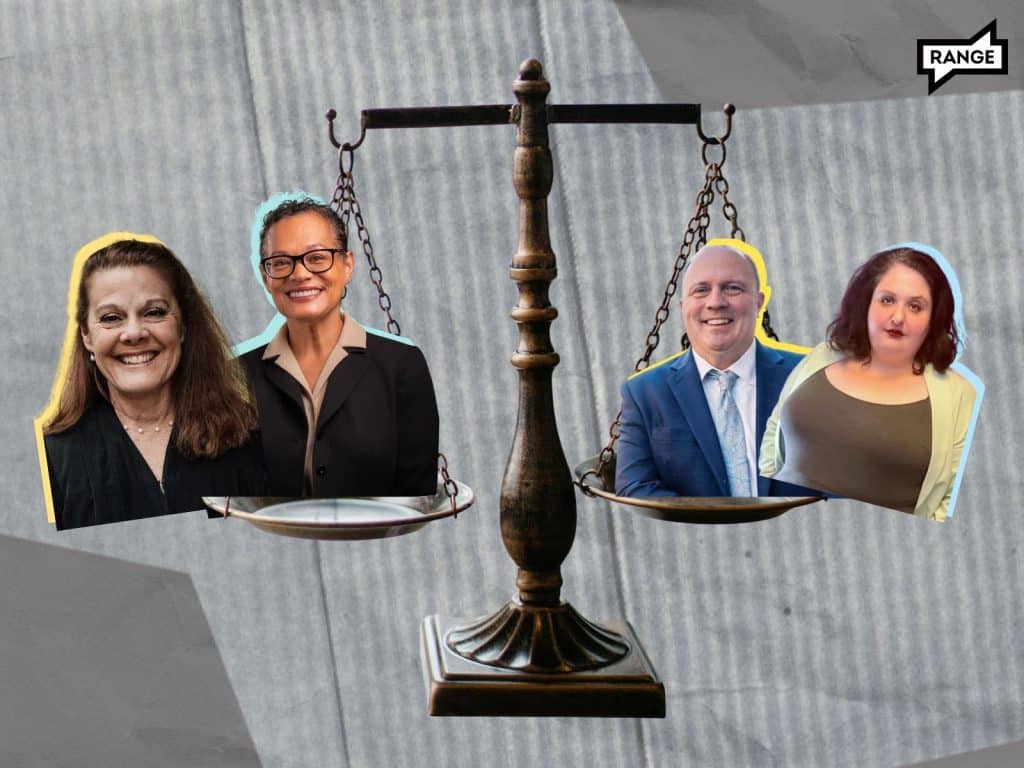
For Position 1, Kristin O’Sullivan, the presiding judge, is not being challenged, so RANGE is focusing on the remaining four candidates: former city attorney Lynden Smithson wants Judge Mary Logan’s Position 2 seat, while local defense attorney Sarah Freedman is challenging Judge Gloria Ochoa-Bruck for Position 3.
Here’s what we know about these folks and where they stand on some of the most pressing issues facing the municipal court.
Former city attorney challenges therapeutic court founder
Lynden Smithson
Smithson, who ran unsuccessfully for a district court position in 2018, is by far the most conservative candidate in the race (though municipal court races are nonpartisan). He made his bones as a criminal defense attorney in Moses Lake where he defended DUI and other low-level cases. In 2003, he was hired by the city of Spokane to prosecute “mostly domestic violence cases,” he told RANGE, and he’s worked for the city since.
Former Mayor Nadine Woodward hired him as city attorney in 2020, and during his time there, he increased prosecutions “probably out of necessity,” he said. He was replaced as city attorney by Mike Piccolo when Lisa Brown succeeded Woodward, but he still works in that office, working as a litigation attorney for the city.
He has the most favorable rating of the judge candidates from hyper conservative faith-based nonprofit (and Donald Trump-aligned) We Believe We Vote, which promotes right-wing political values to local Christian communities.
Smithson said he got into the race because downtown businesses were being disadvantaged by a city that’s too lenient on unhoused people.
“I’ve just kind of seen what’s going on downtown,” he told RANGE in an interview. “Business owners and property owners and people in town have talked to me about it, I think because I was a city attorney and kind of a higher-profile job. They said, ‘Can you please do something?’”
This is a common talking point of conservative critics of the city government who advocate for a stricter model of punishment for people who violate policies like the city’s camping ban.
Asked about whether therapeutic courts should be expanded, he said that because the city is in a budget crunch, it should not consider making community courts more robust.
“We don’t have the resources for now,” he said. “If I don’t have the gas to make it to Coeur d’Alene, I’m not going to drive to Missoula on the same tank, right?”
Smithson also said the therapeutic courts need more scrutiny before the city gives them more resources, even as state budget cuts have put the program in danger.
“We have to evaluate ourselves,” he said. “I want to increase public safety by compassionate accountability. Accountability, in my mind, goes both ways. I intend to hold people accountable that have committed crimes. … But at the same time, in the sense of community court and judges, [it] goes both ways.”
He said that though his approach is focused on more stringent punishments for breaking city code, sentencing should not be described as “punitive” but as “compassionate accountability.”
Smithson is endorsed by Woodward, conservative City Council Member Jonathan Bingle and the Spokane Police Guild, the union that represents Spokane police, among others.
Mary Logan
Logan has been serving on the court since 2009, when the municipal court was brought under the umbrella of the city of Spokane (it was previously contracted to the county) and has the most established legacy of the four competing candidates. In 2012, she helped create Spokane’s therapeutic courts and stood up their central function, the Community Court, in 2013. She now oversees that court, which connects people who’ve committed crimes with resources for mental health, substance use and housing.
Logan said Community Court was needed because district judges didn’t have a deep understanding of the circumstances of people who live in downtown Spokane.
“The sentencing would involve conditions that they couldn’t possibly afford,” said Logan, who was a public defender representing indigent and disenfranchised people charged with crimes before she was a judge. “And if they didn’t follow through with the conditions that involved treatment, and they couldn’t afford treatment, well that was a violation of the conditions. … It was just this repetitive cycle of incarceration without really getting to the reason.”
In addition to the philosophical mismatch between the district and municipal courts — which are referred to as “rehabilitative courts” — the therapeutic courts can access the funding to address some problems that rehabilitative courts can’t, Logan said.
For example, therapeutic courts have access to state funding to pay for things like electronic home monitoring devices or GPS devices for victims of domestic violence to know whether their attacker might be close, Logan said.
“In all of our therapeutic courts, we have received money from outside sources in order to do the work,” she said.
In response to Smithson’s accusation that there’s no accountability for the therapeutic courts, Logan told The Spokesman that people are regularly accounted for in that system when they show up for their initial hearings and because they are required to check in regularly at the Central Library and with service providers.
She also said she supports new funding measures to shore up resources for the courts, referencing a mental health tax that contributes insufficient amounts of money to city coffers to support the courts.
Logan is endorsed by Spokane Mayor Lisa Brown; state Senator Marcus Riccelli, a Democrat of Spokane; and County Commissioner Amber Waldref, one of two liberal members of the Spokane County Board of Commissioners; among others.
Defense attorney running for former tribal judge’s seat
Sarah Freedman
Freedman, who runs a private law practice from a small office on North Monroe Street, got her start serving county prosecutors in Klickitat and Spokane counties — positions she says gave her a special understanding of the mechanics of local prosecution.
She is running on a two-pronged platform of advocating for resources for the therapeutic courts and centering the desires of victims of violent crimes, who don’t always want to seek the most stringent punishments for their attackers.
She told RANGE prosecutors have the sole power over whether to prosecute a case — meaning the victim has no say in how they can reconcile with their attacker, who is often a loved one. Because of this, she said, prosecutors tend to pursue punitive measures rather than conciliatory ones, whether the victim wants their attacker to be punished or not.
“It’s not infrequent for the charging attorney to go in and say, ‘No, we need to keep the victim safe,’” Freedman said in an interview this summer. “But they’re not being listened to.”
Instead, she wants to expand the kinds of therapies that are used as tools to get offenders back on track. For example, she wants to adopt Eye Movement Desensitization and Reprocessing (EMDR) therapy in the therapeutic courts to rehabilitate people who’ve committed crimes related to mental health.
“I want to expand that into treatment programs that work on underlying traumas that are causing people to participate in problematic behavior,” she said.
She contends that there is currently a deficit of empathy in her opponent Gloria Ochoa-Bruck’s courtroom that disadvantages people with disabilities, including her own diagnosed ADHD, which was the subject of a recent piece by The Spokesman’s Emry Dinman. In the article, Freedman accuses Ochoa-Bruck of being unconcerned with people’s disabilities.
“I wouldn’t be running if it weren’t this courtroom,” she told RANGE.
Freedman is endorsed by the Spokane County Democrats, the aerospace union Machinists 751 and Morgan Maxey of Maxey Law Offices, PLLC, among others.
Gloria Ochoa-Bruck
Ochoa-Bruck, who came into the US as the infant child of non-English-speaking immigrants, is the current judge in Position 2, having served since 2021 when she beat incumbent Michael Antush in an election. Before that, she served as a judge on the Kalispel Tribal Court.
She declined to comment on Freedman’s allegations but said she empathizes with people who suffer from disabilities. She noted that she served on the state Supreme Court’s Disability Justice Task Force that gave the state recommendations on how to accommodate people with disabilities in the criminal justice system.
She said that justice has to be served for victims of crimes.
Ochoa-Bruck, who previously served as a judge for the Kalispel Tribal Court, described one case in which someone stole a baseball bat from the back of a car that had been given to the owner by a grandparent, causing the victim distress because the bat had sentimental value.
“ I think there’s a tendency sometimes to focus solely on the individual in need and not remember that we have a social contract with each other to not hurt one another and to make sure that we respect each other in our shared spaces,” Ochoa-Bruck said.
But she also emphasized that the goal of the courts is not to punish people who’ve committed crimes, but to put them on a productive life track. She said this is a difficult job because, to do so, the courts rely on networks of relationships between mental health providers, homeless services and people who help offenders navigate those systems. She advocated bringing some of those services under the purview of the municipal court to streamline this process.
Which is yet another area of difficulty. She said the courts should have access to better funding models than they currently do — deriving part of their budget from the pockets of the very people who come before her bench.
“We’re not supposed to generate revenue off the backs of people that are in poverty,” she said.
As for the therapeutic courts, she said she supports them but only has one vote of three (the other two being the other municipal judges) when it comes to establishing their scope.
Ochoa-Bruck is endorsed by Washington Supreme Court Justice Mary Yu, Judge Don Calistro of the Kalispel Tribal Court and Spokane business owner Taryn Coleman, who has also done promotional work for Smithson.
Correction: The judge races are described in the Progressive Voter’s Guide. The two remaining cases from the June 11 protests are being litigated in municipal court. And Lynden Smithson is a litigation attorney for the city.