

For weeks, my family and I hunted for our white whale: a three-bedroom apartment in Spokane, Washington. After weeks and weeks of refreshing Zillow, Craigslist and Realtor.com every morning, I finally found it — a listing for a three-bedroom apartment posted just minutes earlier. When I called to inquire about it, the receptionist was shocked that someone had already found the listing. Our quest had at last come to an end.
Our search for an apartment was nearly six years ago now, but not much has changed. Spokane’s housing crisis has only gotten worse, and three-bedroom rentals are still uncommon. A quick search of Zillow shows that currently, just 23% of the available homes and apartments have three or more bedrooms.
There are plenty of studios, one-bedrooms and two-bedrooms available, but for families wanting three bedrooms, finding a place to live is incredibly stressful. It’s also the result of a seemingly insignificant piece of state code that changed how buildings could be developed in Washington and de-incentivized the construction of apartments that could fit a family.
How building up instead of out can help
In 2020, 69% of our city’s housing stock consisted of single-family detached houses, but there are times in life when we want to have the choice to live in an apartment or townhome or duplex: recent grads, single folks, new-to-town-house-hunting families, older couples, people who just aren’t interested in home and yard maintenance, people interested in the night life and others might want something other than a single-family house, or might want to live in the heart of the city. And for those interested in public safety, downtowns are safer and more vibrant when more people live, work and frequent them.
Building the denser housing is fiscally responsible: every mile of water pipe, sewage pipe, and street built costs the city tax dollars to maintain. The city saves money when that mile serves 1,000 residents rather than 100 you’d get in Spokane’s outlying areas. (There’s no moral superiority here; I live in one of those outlying areas.)
Denser housing is also more climate friendly: it allows for fewer car trips (why drive to the park when you can walk?) and requires less energy to heat. It also prevents our area’s green space and farmland from being overrun with sprawling housing developments.
If all these benefits exist, why is Spokane still missing so much middle and high density housing? One problem is building code. If we want developers to build these types of housing, the building code must allow them to be built profitably.
While the city has removed parking minimum mandates and allowed multi-family homes to be built on lots previously reserved for single-family homes — hugely important steps towards incentivizing building of denser housing — there’s more to do.
Other parts of building code, like seemingly-boring stairway codes, also make building housing difficult. But soon, a bill in the state legislature could help.
Double the stairs, half the benefits (or, artificial limitations to building up)
To build a residential building with four or more floors (or a mixed-use building with retail on the ground floor and three or more floors of housing above), Spokane’s code currently dictates that each dwelling unit must have access to two stairways to evacuate. These requirements came about with building codes created when large urban fires, like the one that destroyed much of downtown Spokane in 1889, were recent memories.
We’ll get into fire safety in a second, but first I’ll explain how two stairways impact housing.
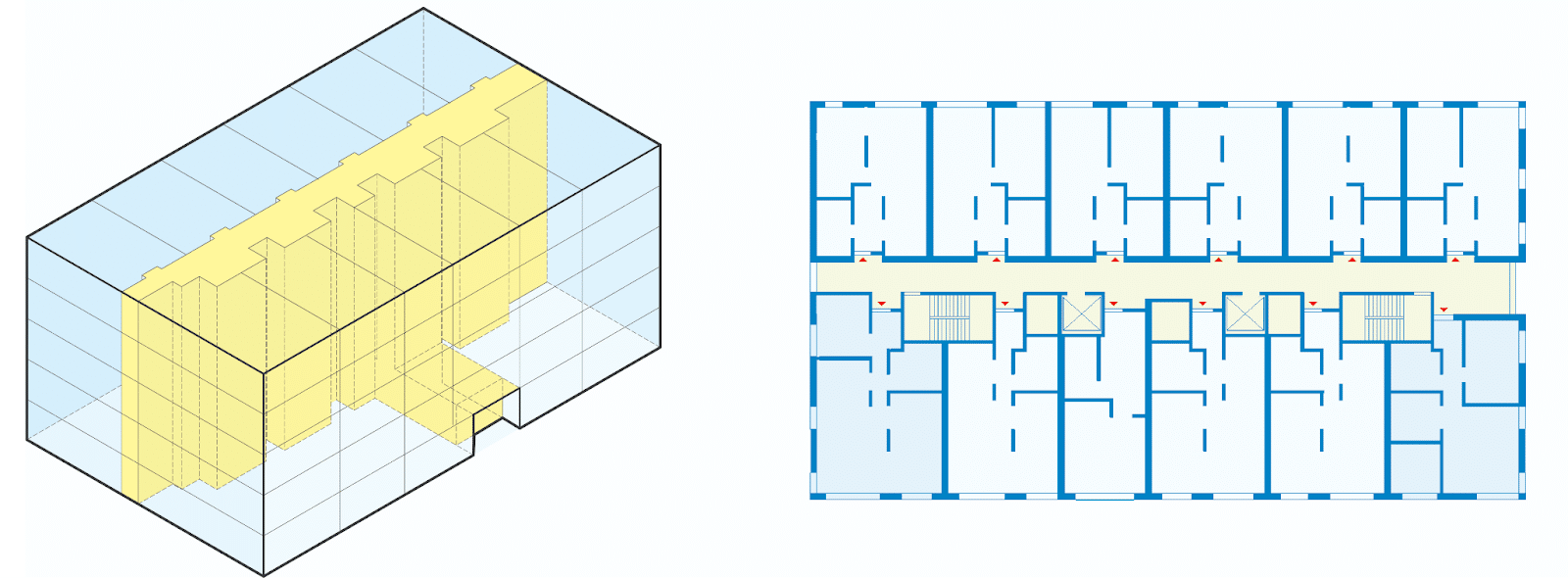
Diagram by Michael Eliason/Larch Lab
This two-stairway arrangement typically results in:
- A large building sporting one long corridor with apartments on either side, like one might see in a hotel. These are called “double-loaded corridors”.
- Mostly studios and one bedroom units, which don’t tend to serve families well.
- Units with windows on one side only, eliminating the possibility of cooling cross ventilation that can save as much as 80% on cooling costs. And north-side units miss out on warming sunlight during the winter.
- Larger apartment projects because the long corridor isn’t rentable space, and developers need to make up for the cost of building that space. When projects need to be larger, they tend to require the developer to buy up multiple parcels (“land assemblage”), which is yet another hurdle for housing development – small infill projects are one way out of our housing crisis.
- Less communal space because the long corridor takes up space in the building’s lot that could be dedicated to things like courtyards or green space – perks that are good for families.
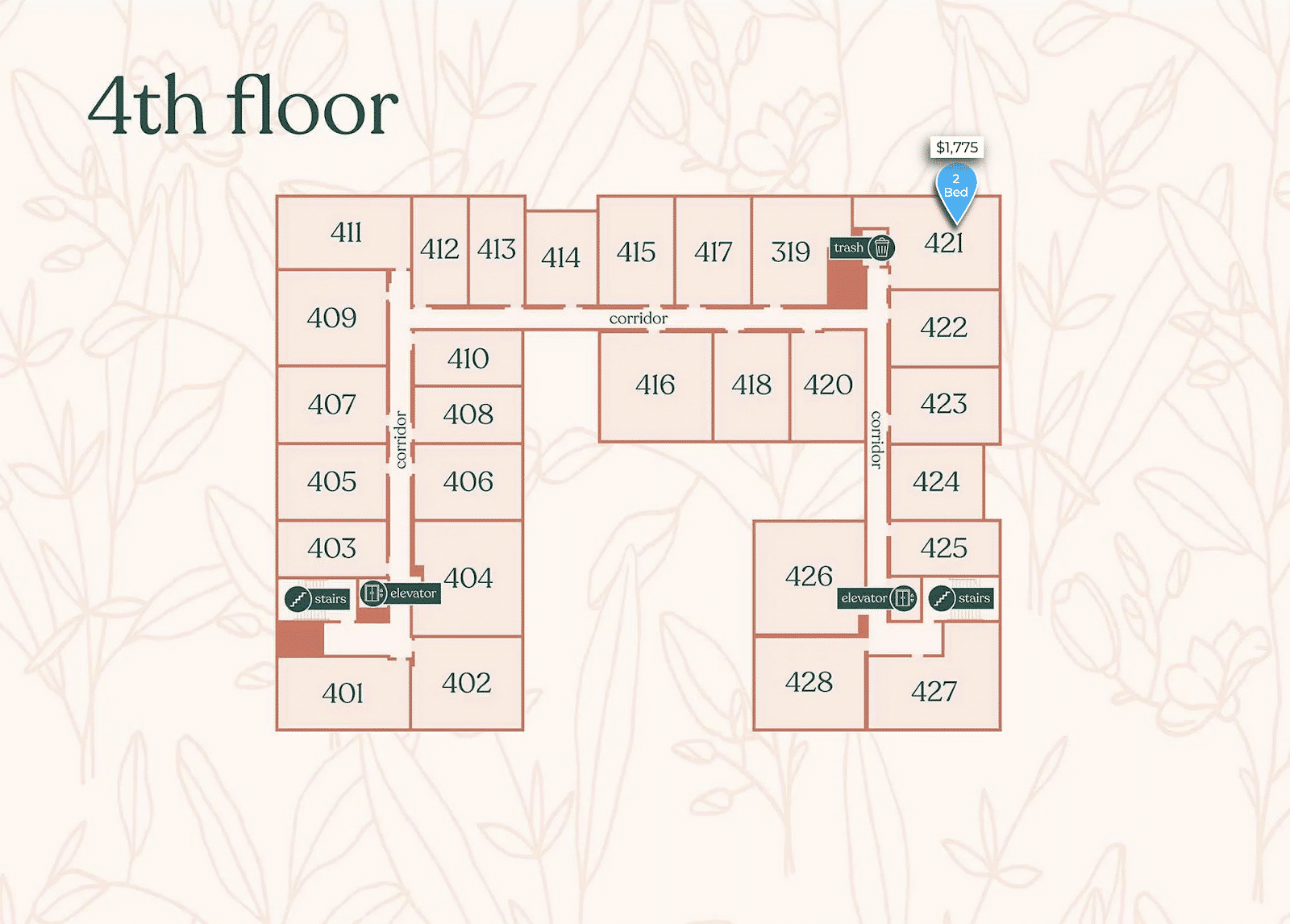
The Warren, a newer 139-unit apartment building in downtown Spokane, consists entirely of studio, one-bedroom and two-bedroom units. The architects were of course bound by the city’s current stairway code, so they designed a double-loaded corridor. On the fourth floor, 20 of the 28 units have windows on only one side.
Beyond just new buildings, our current code also impacts redevelopment of historic Spokane buildings: Josh Hissong, founder of local architecture firm HDG Architecture, told KXLY in November that it’s a “huge expenditure to bring a building up to code for life and safety.” To add a second stairway to older, brick buildings is difficult, Hisson said, which can also de-incentivize redevelopment.
So if the double-stairway codes have such significant downsides, what’s the alternative?
The point access block
All across Europe and Asia, you see five- and six-story buildings with only one stairway (or if they have two stairways, they aren’t connected by a corridor). They have a fancy name (“point access blocks”) because each dwelling unit is accessed from a single access point (think stair and elevator lobby) rather than a corridor.
This isn’t just in other countries: Seattle's building code has allowed certain six-story point access blocks since the 70s.
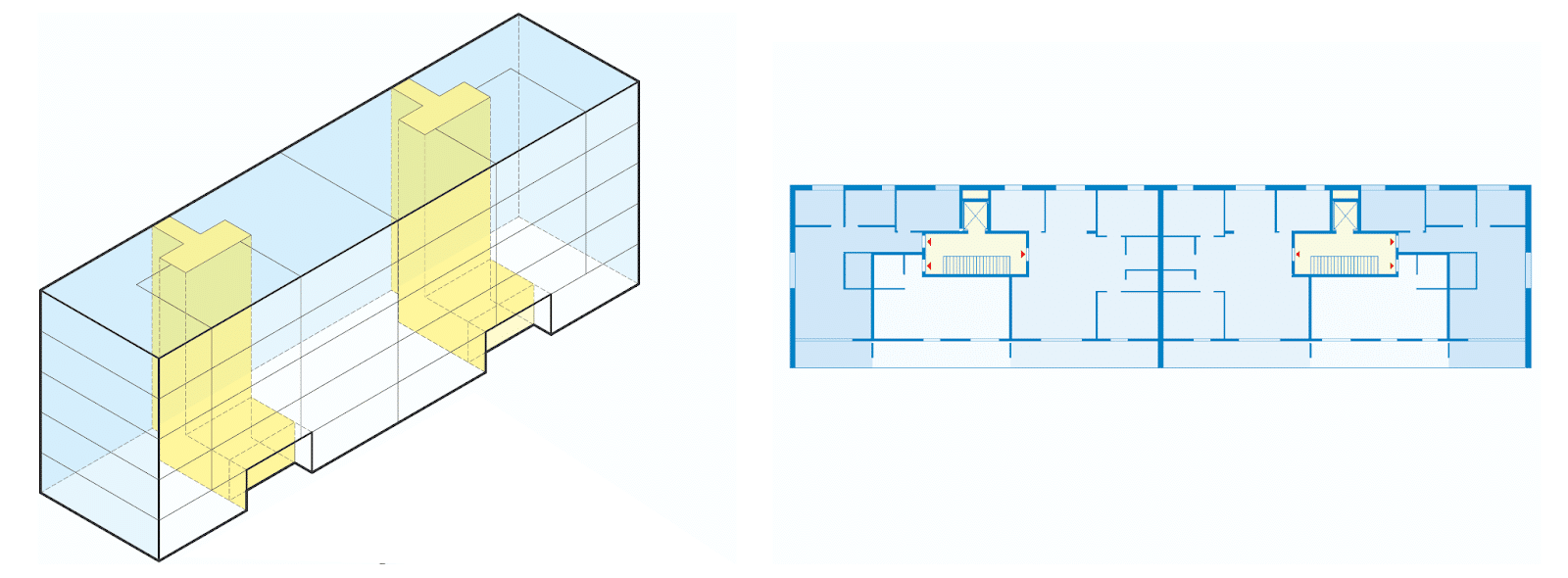
Diagram by Michael Eliason/Larch Lab
Benefits of point access blocks:
- Units can have windows on multiple sides, which allow the cross ventilation discussed above.
- Bedrooms in these units can be placed away from the arterials the buildings sit on.
- No long corridor saves room on the lot for larger units or amenities, like courtyards.
- Units can be family-sized (two- and three-bedroom units).
- Buildings can be built on smaller lots.
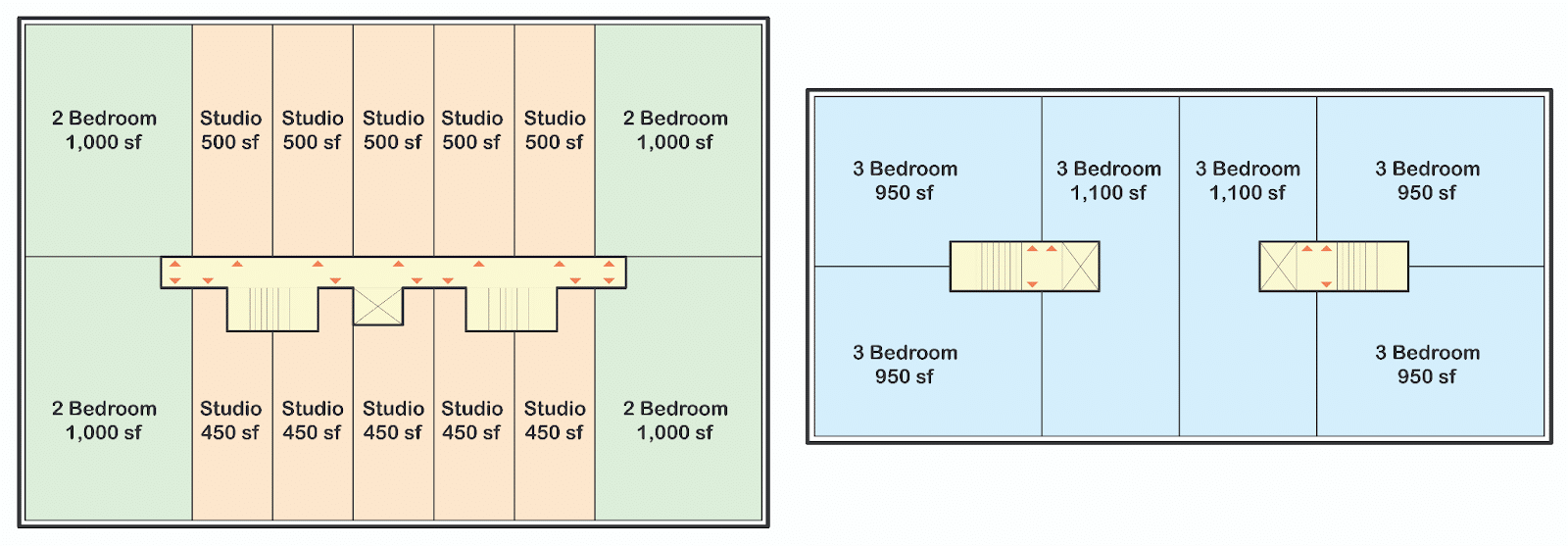
A comparison of the unit types that tend to get built in double-loaded corridor buildings and point access block buildings. Diagram by Michael Eliason/Larch Lab
One might be (understandably) concerned about the fire safety of having fewer stairways. The thing is, the US has a lower death-by-fire rate than some countries that allow fewer stairways, and a higher rate than others — indicating that the number of stairways may not be as correlated to fire safety as we might think.
We made risk tradeoffs every day — we don’t live in little plastic bubbles. For instance, it would be safer to build our single family homes with fire suppression sprinkler systems. But we don’t, because we’re not willing to put up with the added cost or poorer aesthetics or whatever. And most of us drive on our roads, where 40,000 Americans die every year. We make calculated safety risks all the time.
In the case of housing, America’s risk aversion regarding stairways has cost us, making housing harder to build and more expensive and family-sized units more scarce.
Local examples – yes, this affects Spokane
In reality, Spokane’s building code does allow point access blocks to be built, but they are limited to just three floors.
These Kendall Yards buildings, which house Mom’s Tattoo, The Scoop and two floors of apartments, are point access block buildings – you can see the entrances to each stairway between the retail spaces. Assuming it was zoned correctly, this building could have had five floors of dwelling units instead of two. (Goes to show that our housing crisis is at least partially the result of our own policy choices.)
The Warren, that downtown apartment building mentioned earlier, could have been designed as a series of point access blocks had single stair reform happened before it was built.
Here’s a Swiss building with a similar shape to The Warren to give you an idea of what the rest of the world is doing. This building consists of five point access blocks.
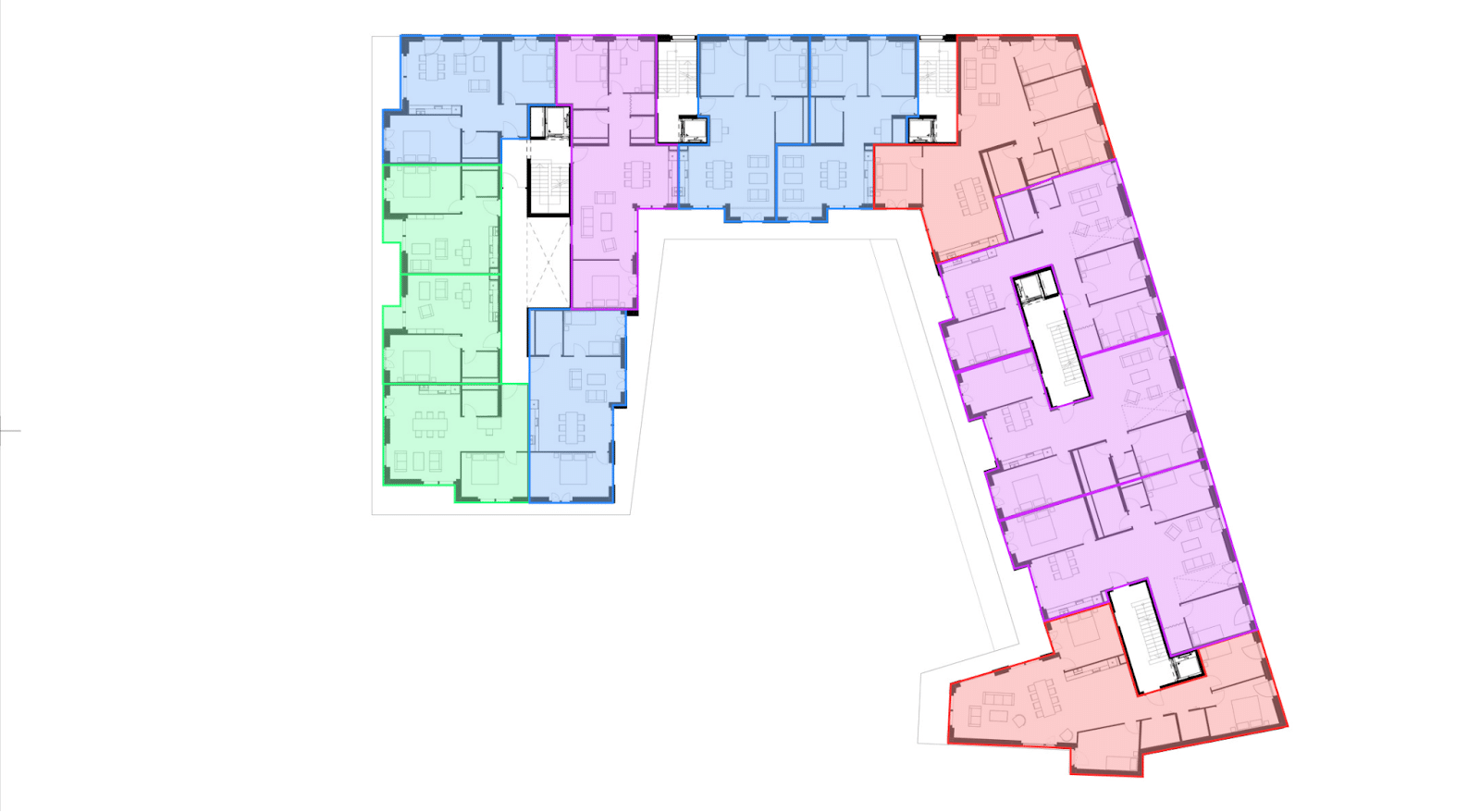
This floor in particular features three one-bedroom units (green), four two-bedroom units (blue), four three-bedroom units (purple), and two four-bedroom units (red). All but two units on this floor have windows on more than one side. I’ll go more into detail on why, but designs like these can actually end up being safer in the event of a fire versus a double-loaded corridor.
Another example: the new Ironside Apartments east of downtown Spokane. You guessed it, this building also features a double-loaded corridor. It’s on the Spokane River, but the even-numbered units here get views of the parking lot instead. If the building was not divided by the corridor, far more units could have had windows with views of the river and cross-ventilation from river breezes. And of course most of these units are not family-sized units – aside from the corner units, the rest appear to be one-bedrooms.
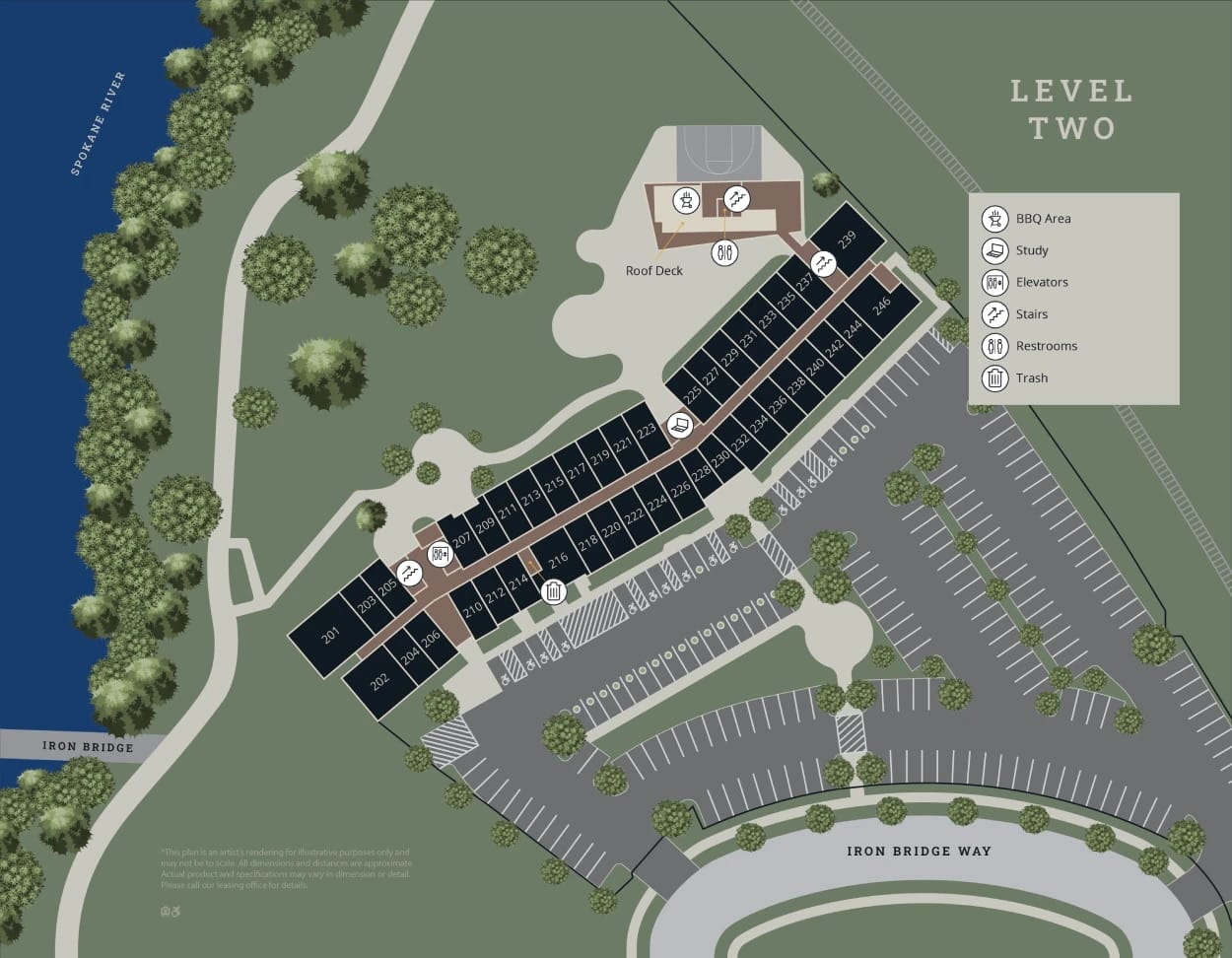
Unfortunately, Washington cities cannot (in most cases) adopt a building code that is more lax than the state’s code, so Spokane is bound by the code that requires residential buildings to have two stairways with a corridor connecting them … for now.
Enter Senate Bill 5491
Good news! In 2023, the Washington state legislature instructed the Washington State Building Code Council (which ultimately writes and approves code amendments) to investigate single stair reforms and make any code changes in their current crop of amendments going into effect in 2026.
A Building Code Council committee has written a proposal of the code changes, which seem to be fairly similar to ones that allow Seattle to build point access block buildings. And if you’re concerned about fire safety, maybe this will help: the proposal was written in collaboration with the Washington State Association of Fire Marshalls.
Like Seattle’s code, the proposed code for Washington has fire-safety-related limitations to make up for the lack of a second stair. This gets a bit technical so bear with me:
- There can only be four or fewer dwelling units per floor per block. This reduces the “occupant load” – that is, the number of people needing to use the stairway to evacuate in an emergency. Large apartment buildings with two stairways like The Warren and the Ironside Apartments have more than eight units per floor, so therefore have a higher occupant load per stairway than point access block buildings would have under this code.
- The building cannot have more than six stories. This also reduces occupant load on the stairway and ensures ladder trucks can reach the dwelling units as another means of egress for its residents.
- Dwelling unit front doors must be twenty feet or less from the stairway, allowing for quicker evacuation. Again, large apartments with two stairways (including The Warren and the Ironside Apartments) regularly have dwelling unit front doors more than 20 feet from a stairway.
- The stairway must be pressurized. Without getting too scientific, this is intended to keep smoke and fire out of the stairway so it remains usable during evacuation.
This proposal would not legalize the Swiss building I showed above due to some further fire-related limitations, but it certainly gets us closer.
Wheels of bureaucracy turn slowly: the proposed code changes must go through some layers of review before they can be adopted and are expected to become effective in state building code on November 1, 2026.
As of now, the proposal adds the code as an Appendix, which means the city of Spokane can choose whether or not to adopt them, and whether or not to add any additional regulation – a process also requiring some levels of bureaucracy including Plan Commission and City Council – so it remains to be seen when exactly Spokane’s developers could start building point access block buildings.
If this seems important to you, contact your city council member and let them know you’d like to see single stair reforms adopted in Spokane as soon as the state allows.
Here’s to hoping the city moves quickly 🍻
Further Reading
If you're a real wonk like me, and want even *more* reading about point access blocks and single stair reform, I've curated a reading list for you:
- This video explainer of single-stair reform
- This policy brief for single-stair reform by Seattle architect Mike Eliason
- In-depth explainer, including why double loaded corridors result in fewer family-sized units
- This video assuaging fire concerns
- Here are all the governments moving on single stair reform
- How “international” the International Building Code actually is
- A library of currently-illegal floor plans that seem pretty lit


