

Someday, Division Street could be safer, quieter and more friendly to pedestrians and drivers alike. A rapid transit bus line could stretch from downtown Spokane all the way out to a new transit center in Mead running along dedicated transit lanes, hitting each stop as regularly as every 7.5 minutes. With more foot traffic utilizing the bus line and improved pedestrian and cyclist infrastructure, businesses along the Division corridor could thrive.
In this same near-future utopia, all of the region’s buses put out zero emissions and live in a “clean energy” campus. Most bus stops are sheltered and all of them feature signage about routes in languages other than English. For those who live outside the normal transit area, an Uber-like van ride via public transit is just a phone call away. Para-transit booking is easier, too, and “safety ambassadors” regularly ride the bus lines to help riders feel comfortable and assist in navigation.
This is the future the Spokane Transit Authority (STA) is preparing to create in their newest strategic plan, and they anticipate it could all happen by 2035.
STA’s Connect 2035 plan, which will serve as the roadmap for the agency’s next decade of services and expansion, is scheduled for its final public hearing at this week’s STA board meeting and will go before the board for a vote at the end of 2024 or the beginning of 2025.
The plan is ambitious, and focused on three main goals: elevate the customer experience, lead and collaborate with community partners to enhance the quality of life in the region and strengthen capacity to anticipate and respond to the demands of our region. (You can view a shiny 64-page booklet of the plan here.)
“It's more than just buses. It's more than strategic actions,” said Karl Otterstrom, STA’s chief planning and development officer. “It's really a whole symphony of people working together to make good transit.”
Keep reading to learn exactly what the plan does (and doesn’t) include, how projects were chosen, who was involved in the process, how much it all costs and how you can share feedback before the plan goes to the board to be voted on.
What projects can you expect in the next ten years?
The Division Bus Rapid Transit (BRT) is one of the biggest projects on the list. Anyone familiar with the City Line — the long purplish buses pulling up every few minutes, trundling from Browne’s Addition through downtown Spokane all the way out to Spokane Community College — has seen what a BRT line can do. The Division BRT plans to replicate the success of the City Line but running north-south from downtown all the way to Mead.
This project is intended to be completed alongside the completion of the forever-under-construction North-South Freeway. Right now, about 50,000 vehicles traverse Division Street every single day. As the freeway takes on much of that load, the idea is to make Spokane’s chonkiest car conveyance less congested and friendlier to people who don’t want to drive. The Division BRT would devote one lane north and south solely to buses and cars turning right.
The funding for this project comes from the Washington State Department of Transportation’s Move Ahead WA fund, which is supported by dollars from the Climate Commitment Act (which recently survived a citizen-led initiative that sought to kill it).
Spokane City Council Member and STA board member Kitty Klitzke said this was the project she was most excited for, calling it a vital part of “building out a mass transit network for the future.” Klitzke serves Council District 3; Division Street forms the district border from Boone to Francis.
“Providing that north-south connectivity is just going to help us create a pretty good transit grid so that people can get places much more quickly,” Klitzke said.
Another of the large projects is continued investment in zero emission buses as STA shoots for the entirety of their fleet to be zero emission by 2045 to comply with state law. It’s also good for the agency’s finances. After the initial capital investment — which has been partially offset by grants — zero emission buses cost less money to keep running.
Currently, STA has 36 zero emission buses, making up nearly a quarter of their fleet — which are estimated to have saved the agency 30.9% per mile in maintenance costs this year.
As STA adds full electric capacity, those buses will need a home. Connect 2035 proposes a brand new clean energy campus to house and charge the fleet, “all designed and tooled around vehicles that are going to be zero emission,” according to Otterstrom.
Beyond these two big projects, Connect 2035 divided other potential projects into three buckets: reduced fares, mobility-on-demand (imagine public transit with Uber-like characteristics) and high performance transit (which bus rapid transit falls under).
The agency had budgeted enough funding to move forward with two out of the three buckets, or a grab bag of smaller projects cobbled together from a variety of buckets. After reviewing staff, rider and board rankings of the smaller initiatives, Otterstrom recommended the board move forward with a combination of initiatives from each bucket, including:
- A reduced fare pilot program for low-income riders
- Planning and design for future High Performance Transit corridors along Route 61 to Fairchild AirBase, Route 90 to the Valley park-and-ride on Appleway, and extending the Division BRT all the way up to Mead.
- Transit-Oriented Development planning efforts near STA stations, in partnership with local city governments
- Mobility-on-Demand pilots (think Uber, but an STA van) to northeast Spokane, North Spokane Valley, Latah Valley, Liberty Lake and unincorporated West Plains.
- A Mobility-on-Demand pilot tailored for older adults and people with disabilities
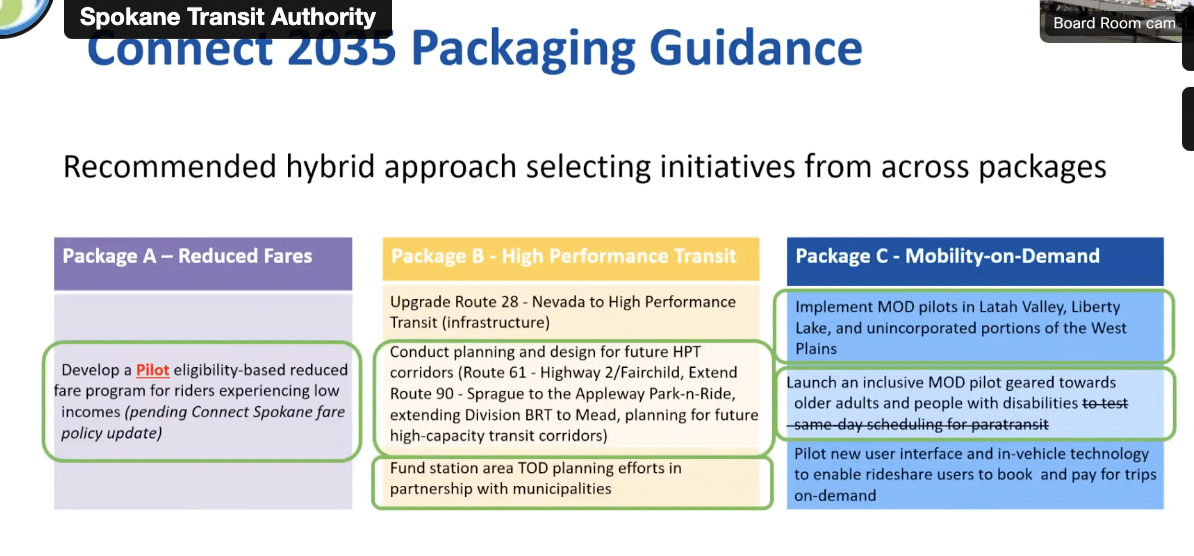
Screenshot from Otterstrom’s presentation to the STA board.
The plan also includes a list of smaller investments, like adding more electric vehicle charging stations at STA park-and-rides, increasing language access in signage at STA stations, upgrading break rooms and amenities for drivers along routes and improving their back-end technology systems to give riders more accurate real-time information on their bus routes.
While the plan includes a long list of projects to improve transit in the region, the very first project slated for completion is the implementation of “safety ambassadors” on bus lines.
The ambassadors would serve as a combination of customer service and security officer, according to Otterstrom, “being on the routes, providing presence, helping people be oriented on how the rules of conduct and fares work.”
While safety on buses has been a huge discussion point among board members, these ambassadors will be reassuring riders who already feel safer than the average American transit rider. According to data collected by STA’s 2023 Fixed Route Rider survey, 70% of riders reported feeling safe while riding the bus, compared to a national average of 42%. The data was collected by ETC Institute and benchmarked against a database of surveys from other transit agencies across the country.
Getting ambassadors on the buses has already been built into the 2025 budget — making the timeline crystal clear.
For the other projects on the list, the dates are a lot fuzzier.
“We've identified the projects, the initiatives, we've identified the relative cost, the relative timeline, how long it takes to, or timeframes for implementation,” Otterstrom said. “What we have to do now is, how do we sequence that over time?”
How is the plan paid for?
Connect 2035 is funded by a sales tax collected by STA, grants and fares. But, “New initiatives identified in the plan are funded through available and project funding, largely derived from sales tax and future grant opportunities,” according to STA spokesperson Carly Cortright.
Because that sales tax revenue also helps to maintain the agency’s regular service, and grants are considered one-time money, the Connect 2035 plan had to walk a tight rope.
That funding limitation guided how projects were chosen. “One time money can't produce more service,” Otterstrom said. “You don't want to buy more buses and hire more operators simply to lay them off in two years, so that is a delicate balance.”
A home-ec style example: you can buy a TV with one-time money like a tax return, but it wouldn’t be smart to sign up for a Netflix subscription (or a RANGE membership) with a $20 bill, unless you know you’re going to have at least $20 coming in every month.
So even though one of the most frequent requests STA heard from riders was more bus service on late nights and weekends, or new bus lines out to unserved areas, Otterstrom said that just wasn’t feasible with the budget for the plan.
Any projects in Connect 2035 that seem like ongoing expenses are labeled as pilot projects, which means they’ll be run for a period of time, assessed for their effectiveness, and then the STA board can decide if it wants to identify revenue streams to fund them as permanent projects further in the future.
For example, STA wants to test how mobility-on-demand can help connect people in less-populated, further-flung areas where full service doesn’t pencil.
How was the plan planned?
The planning for Connect 2035 included a lengthy public engagement process: STA hosted events, conversations with riders, businesses and community organizations and meetings with municipal boards. They received 2,485 responses to three surveys they put out, and had 13,500+ “touchpoints” with riders and community members over more than two years, all of which informed the selection and prioritization of the projects in Connect 2035.
For Otterstrom, one of the biggest successes of the plan was in beginning (or, in some cases, continuing) relationships with community organizations that he hopes will last long past the final draft of Connect 2035.
STA says it wants to be more engaged with underrepresented communities and to kickstart that with Connect 2035, the agency did in-depth interviews with 26 community organizations, including Latinos En Spokane, Spectrum Center, Kalispel Tribe, The Arc of Spokane, The NATIVE Project, NAACP Spokane, YWCA and Asians for Collective Liberation (listed in the survey under their former name from 2022.)
“A good public hearing is one in which the public has been engaged long before that,” Otterstrom said. He feels STA has succeeded in that aspect, hearing the public all the way through, and they won’t stop now.
Otterstrom says this is part of a deeper commitment STA is making to have “Not just a, ‘Hey, we'll reach out when we need to talk to you about something’ relationship, but more of a ‘Hey, we have this relationship so you can talk to us anytime you have questions.’” He sees opportunities for future collaboration and partnership in increasing equitable access to transit across the region.
Spokane City Council Member and STA Board Member Zack Zappone said the equity process and outreach was a good start.
“They definitely made a lot of intentional efforts to reach out to historically underrepresented or disadvantaged communities,” Zappone said.
While he was impressed by the interviews with community organization leaders early in the process, by the end, he worried that STA didn’t quite reach everyone they could have. They sent out surveys, but to Zappone, it wasn’t clear if members from marginalized communities actually responded and had their voices recorded, because filling out demographic information on the surveys was optional.
Staff also did surveys and workshops with the STA board and staff, to see how these stakeholder groups ranked the importance of the potential projects.
What are some of the potential flaws?
The best laid plans of mice and transit agencies oft go awry — and in the case of transit agencies, they also face community criticism.
The plan received pushback from members of the transit and urbanist advocacy group Spokane Reimagined, who were frustrated by the inclusion of mobility-on-demand pilot projects to low density neighborhoods rather than prioritizing high performance transit to denser neighborhoods with larger ridership.
Erik Lowe, one of the founders of the group, feels like STA isn’t dreaming big enough.
“STA is asking the wrong questions. They never ask about rail in their surveys because they've established that rail is a great investment, for another time,” Lowe wrote in a text to RANGE. “We should be going to voters and showing them what awesome stuff we could do with more money rather than holding the agency's hands behind its back because the board is thinking small.”
They also felt the board, who will make the ultimate decision on the plan and the timeline of projects, was out-of-touch with the desires of both the public and the staff, pointing to this slide shared during one of Otterstrom’s presentations on the plan where public and staff priorities overlapped significantly, but differed from the board’s rankings.
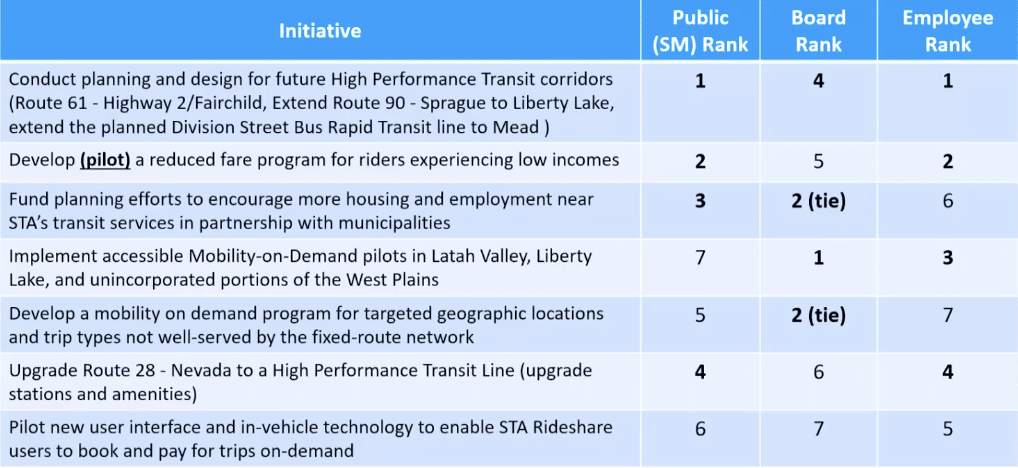
While priorities differed across staff, public and the board — and sometimes differed drastically — Otterstrom said he believes Connect 2035 balances those different desires well. When it came to funding the specific, smaller initiatives, the hybrid he proposed ensured each group got their top three priorities funded.
“I believe we've done a good job over the years of listening to folks and assimilating their input as best we can, while not making it all about one group or another,” Otterstrom said.
Klitzke’s personal priorities differed from the board ranking, which collated rankings from all the members of the large board, but she was pretty happy with how the final draft shook out.
“This was a decent compromise,” Klitzke said. “This isn’t what I would have wanted if it was just the Kitty Klitzke Transit Plan, but it’s not — it’s something for the whole region.”
Lowe isn’t sure where exactly the disconnect comes from between the public and board members because “the ones not in alignment with the public won’t talk to [him],” but he does note one clear difference: many STA board members don’t regularly ride the bus.
“I don't expect the board to be as fanatical about STA's success as I am (though they should be, because STA is the future of our region), but I do expect them to ride the bus,” Lowe wrote.
Klitzke told RANGE she always appreciates the insights of transit advocates, even when they want more from STA than STA wants for itself. “They’re very ahead of their time on some things, but what they’re saying is informed — they’re looking at trends in communities that have invested well and have great transit systems,” Klitzke said.
When it came to the mobility-on-demand complaint, she thought the projects that made the list actually represented a good compromise.
“There are areas in the Northeast that would appreciate more transit, but there isn’t a good street grid system up there or the density to justify transit, but this would be an interesting bridge,” she said. “And, the mobility-on-demand is all pilot projects, so the saving grace of it is that it will be a proof of concept and help us prioritize where we would make future investments.”
Another potential flaw: the planning process was started over two years ago, and didn’t account for the loss of STA’s longtime CEO Susan Meyer, who may have different priorities than whoever comes on to replace her.
Still, Connect 2035 “is the board’s plan,” Otterstrom said, not the CEO’s plan. If the new CEO has new ideas or wants to see changes, they could make their pitch to the board.
There is another clear disconnect between the board and riders. According to data presented to the board on February 23, 2023, 14.4% of people who fall within STA’s service area are nonwhite, but they make up 24.8% of STA’s actual ridership. BIPOC people only represent 11% of the voting members of the board, though — less than the half the number you’d expect from a body that actually represented its riders.
Nationally, most transit agencies under-represent the communities of color they serve. In Spokane’s case, that means Spokane City Council President Betsy Wilkerson is the lone vote representing all communities of color.
How can I get involved?
Although the Connect 2035 plan has been in development for a while and is close to finalized, you still have time to get involved and share your input.
At this week’s board meeting, STA has scheduled a public hearing to take feedback from you, the public, on the proposed Connect 2035 plan before they vote to make any of this a reality.
You can offer input on any aspect of the plan. One of the places with the most wiggle room for public input is in the sequencing of the projects — it’s a 10-year plan, and not everything can happen at once, so in the final version, the board will seek to lay out a timeline for which projects happen when.
And even after the plan is finalized, projects will inevitably evolve as well. Ten years is a long time, and, whether it’s an unexpected change in CEO or responding to community feedback on a rolling basis as conditions evolve, Otterstrom said, “All good plans are also editable plans.”
RANGE also reached out to Spokane Valley Mayor Pam Haley and Liberty Lake Council Member Dan Dunne, who both sit on the STA board, for comment, but neither responded.
Editor's note: an earlier version of this story said zero emission buses saved STA 30.9% per mile in operating costs. The actual savings were in maintenance costs, which is a small but important distinction.


