


This story was written in partnership between RANGE and Stonewall News Northwest, a newsroom serving the rural LGBTQ+ community of the Pacific Northwest. Learn more about Stonewall News Northwest’s work here.
On February 20, one of Spokane City Council Member Paul Dillon’s constituents sent him an email asking for a policy that would support queer people in Spokane.
“I have been losing a lot of sleep over the onslaught of attacks from the [presidential] admin on our community, and over the loss of many of our trans siblings in the wake of them,” the constituent wrote. “I saw recently that Worcester, Boston, declared themselves a sanctuary city for trans and gender-diverse people … I was wondering if that would be a possibility to bring up in City Council here?”
It was. Dillon had been working on a draft since January.
A month later, at the Gender Freedom March in downtown Spokane, Dillon made the official announcement: the city council would take up a Shield Law ordinance, which mirrors the standing Washington state law, to ensure no city resources are used to investigate or detain people who sought gender-affirming or reproductive healthcare.
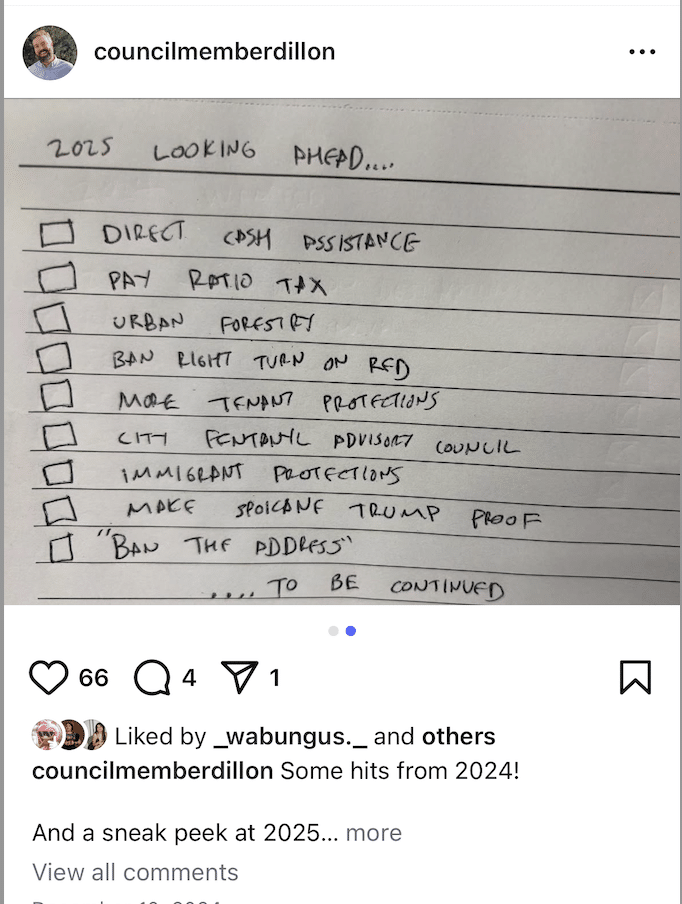
While the city council was on winter break, Dillon had been prepping for 2025, and published a list of his intentions for the year ahead on his council member Instagram page. One of those goals was to “make Spokane Trump-proof.”
In the opening salvo of 2025, President Donald Trump’s administration moved quickly to target transgender people with executive orders, and Dillon said he knew he needed to do something to protect transgender, nonbinary and gender-diverse people in Spokane.
Originally, the plan had been to pass a nonbinding resolution to demonstrate the council’s support for the queer community in town. But working closely on the project with the council’s intern, Dillon realized there were real things they could codify into law via an ordinance that would add material protections for the community here.
He circulated early drafts of the ordinance to stakeholder groups, like Odyssey Youth Movement, Trans Spokane, Spectrum Center, Spokane Pride and the Inland Northwest Business Alliance. He also sought feedback on the language from staff members at the Spokane Regional Health District and internal workgroups at the city — the Human Rights Commission and the Equity Subcommittee.
“I was surprised to learn that a lot of the language in our Title 18 Human Rights Code hadn't been updated since 2017,” Dillon said. “ There was still outdated language mixing gender and sex and kind of swapping definitions interchangeably while not broadening to include, for example, Two-Spirit individuals.”
Here’s a quick breakdown of exactly what the ordinance does:
- Creates a Shield Law for Spokane, which means that no city resources will be used to assist in investigating or detaining an individual for exercising their rights, which include seeking gender-affirming care. This clarifies city-specific protection, in addition to the state’s standing Shield Law, which queer community leaders have asked for amid concerns about Governor Bob Ferguson’s commitment to the LGBTQ+ community.
- Cleans up outdated language in the city’s Human Rights code, defining gender affirming care in the city’s glossary and adding “Two Spirit” — an indigenous queer identity — to the LGBTQIA2S+ community definition.
- Prohibits the city from collecting or disseminating information about anyone’s sex assigned at birth, unless it’s related to a criminal investigation.
- Guarantees health insurance for city employees and their families will cover reproductive and gender-affirming healthcare, as well as care for HIV+ people.
- Directs the Spokane Police Department to maintain an LGTBQIA2S+ liaison officer to act as a point of contact and build trust with the community.
- Requires the city to conduct regular review of policies and practices to ensure they’re equitable and affirming for LGBTQIA2S+ people.
- Directs the city to collaborate with LGBTQIA2S+ leaders and event organizers to ensure public safety and well-being for community members and event attendees.
The final draft of the ordinance is scheduled for a first reading on April 21 and a vote on April 28.
Council Member Zack Zappone, the first openly queer candidate to be elected to the Spokane City Council and co-sponsor of the ordinance, said that as national policies have a real impact locally, it’s important for Spokane to “guarantee that you do have protections, that you do belong.”
By enshrining these protections, especially the guaranteed healthcare coverage, it ensures that “if anything were to ever change in the future, if there was a new mayor, they’d be held to the code, and if they tried to peel back these protections, it would be a more difficult public process,” Zappone said.
“We need a lot more understanding and kindness in Spokane and our society. At large, I really believe that the trans, non-binary and gender non-conforming community is beautiful and strong and they deserve support,” Dillon said. “I hope that this ordinance at least helps make a difference to those goals.
‘A nice start’
Since the first official discussion of the ordinance, when it was introduced at the March 24 Finance and Administration Committee meeting, queer community leaders have been advocating for its passage.
“Hearing the proposed update to the municipal code was a relief because I feel honored that my city notices my community, upholds our rights and safeguards the care we need, which is currently being attacked federally,” Louis Stay, the director of Trans Spokane, said during the meeting.
Erin C. who did not provide her last name during the meeting, spoke about how crucial the ordinance was for queer youth.
“My son is transgender,” she said. “Since the November election, we’ve been living in fear, and since January 20, every single day there is an uncertainty or a fear that we are constantly thinking about. Is this community safe? What about our friends that live just across the border? Will we have access to healthcare?”
Knowing that there are local efforts to protect her son and his future was reassuring, she said.
As the ordinance has moved through the city’s legislative process, queer community leaders have been supportive as well.
“ This ordinance does a lot that needs to be done, and it creates a pathway for us to advocate for future policy that does even more,” said KJ January, director of advocacy at Spectrum Center. “It's an opening. It's a start.”
There’s a lot to like about the ordinance: January pointed to the language updates to codify LGBTQIA2S+ people’s rights within the city as a necessary change “which should have been done decades ago,” and the enhanced privacy protections for queer people who may be seeking refuge in Spokane from anti-queer laws in other states.
She’d like to see the city’s protections for her community go even further. “I feel like it could be a little bit more aggressive with it, especially when it comes to the intersectionality of it all, where it comes to BIPOC humans as well as disabled individuals.”
Jenny McCormick, a spokesperson for Trans Spokane, described the ordinance as “a nice start and a huge step in the right direction.”
“It does give some reassurance from Spokane that we're being seen, we're heard and this is a safe place for trans people,” she said. “One of the things that is nice is that it changes some older city codes to be in line with what's already required by state law, such as changing the city ordinance that no city resources or employees may be used to criminally investigate someone for gender-affirming care.”
While doubling up city code with state code might seem on its face like a pointless gesture, January sees it as a necessity in a tenuous political climate.
“We are not certain about how Governor Ferguson will react to potential threats from the federal government, based on how he’s moving,” January said. “And he’s been largely silent since the executive orders started pouring in.”
There have been some affirmations of the Washington state government’s support from others technically in the Governor’s office, like the LGBTQ+ Commission’s consistent advocacy, Attorney General Nick Brown’s challenge to Trump’s threat to cut funding for any medical institution providing gender-affirming care for minors and Office of Superintendent of Public Instruction Chris Reykdal’s recommitment to DEI efforts in schools and protections for trans students.
One of the only direct communications on LGBTQ+ issues from Ferguson’s office has been to expedite gender marker changes on birth certificates. Since then, Ferguson has fought against the legislature’s attempts to pass a wealth tax, proposed cuts to state Medicaid and advocated for furloughs as a cost-saving measure, all moves that have progressives feeling wary.
“Our eyes are on Ferguson,” said January.
If the ordinance passes in two weeks (as it likely will with a progressive supermajority on the council), McCormick will feel like “ there's more work that could be done, but it's enough of a foot in the door to start heading in a better direction as a whole,” she said. “ And it reaffirms that for a lot of people who are concerned in the current climate of the US right now, that Spokane is safe and people can come here.”
Dillon doesn’t see that as the end of the work that needs to be done. “This is part of a longer journey to work to uplift the voices of trans individuals in Spokane,” he said.
For Zappone, while the specifics of the law are important, it’s the bigger picture statement that matters most.
“This ordinance is about providing safety and freedom for all community members, in particular LGBTQ community members,” Zappone said. “Everybody in Spokane deserves to feel included in their community and safe in their community, and they have the right to make choices about their own body. It shouldn't be government bureaucrats that are deciding what you can and cannot do.”
Make your voice heard
There are two more opportunities to testify on this ordinance. You can sign up to speak for two minutes on April 21 at the 6 pm regular Spokane City Council meeting during the “First Readings,” section. On April 28, during the 6 pm regular Spokane City Council meeting, you can sign up to testify specifically on this ordinance, listed in the sign-up sheet as “Ordinance C36667,” for up to three minutes.
Council meetings can be intimidating to attend, and even more so to speak at, so Spectrum Center is hosting public testimony workshops on April 16 and 23, where interested people can write, edit and practice delivering their testimonies. More information on those workshops and how to attend can be found here.
While much of the response to the ordinance has been positive, there have been some pretty vocal naysayers, including Spokane City Council Member Jonathan Bingle. He proposed a slate of amendments to the ordinance that would have banned trans women from competing in city-funded sports events like Bloomsday and mandated that city bathrooms are segregated based on sex assigned at birth.Those amendments were voted down 5-2 by the council during an agenda review session earlier this week, but for some queer people, harm has already been done.
“To hear different harmful rhetorics, even from different council members, it makes it feel unsafe for people to be able to talk to council members and talk to the city leadership,” McCormick said.
To alleviate some of the safety concerns while still supporting people in sharing their voices, Spectrum Center is hosting watch parties during the council meetings where the ordinance is up for discussion and a vote. People will be able to watch the meetings in community and testify from a space they feel comfortable in.
Dillon hopes that this ordinance is the first step in making City Hall feel more accessible and safe for queer Spokanites.
“I think that we have a long way to go in terms of making council a more welcoming environment,” Dillon said. “ I think that given where we are at as a society, and safety being paramount, [hosting watch parties] is a wise decision, and I'm fully supportive and I look forward to joining them in celebration after this ordinance passes.”


