

This story was published in partnership with the University of Washington’s Center for Human Rights, who provided data analysis.
Searches for “alien,” “overstay” and “unlawful entry.” Dozens of searches for “immigration,” and “immigration+.” More than 700 searches with just “ICE” as the reason. Hundreds of searches made by Border Patrol and Homeland Security.
For the first six months of 2025, federal and out-of-state law enforcement agencies across the country searched Spokane County Flock cameras, in many cases explicitly using the technology to hunt down undocumented immigrants.
In Washington, state law prevents local and state resources from being used to assist in federal immigration enforcement. But as electeds like the Spokane City Council celebrate the Keep Washington Working Act for protecting immigrants and Congressman Michael Baumgartner criticizes it for “prioritizing criminal aliens over law-abiding citizens,” the law has proven ineffectual when it comes to protecting immigrants’ data from federal overreach.
As news has continued to break statewide that Washington immigrants’ data has been accessed by federal agencies like Immigration and Customs Enforcement (ICE) and Border Patrol through weak protection mechanisms at the Department of Licensing and access to local Flock networks given by agencies across the state, documents obtained by RANGE show that Spokane County is no exception.
Earlier this year, we requested a network audit of all searches of the Spokane County Sheriff’s Office’s (SCSO) Flock network made between January 1, 2025 to June 23, 2025, which shows the requesting agency, the search reason they gave, any case number attached, when they searched and how many networks and cameras they searched from.
According to the audit, US Border Patrol (USBP) had direct access to search Spokane County Flock cameras through at least June 23. They used that access to search Spokane County cameras 186 times, with nine of those searches specifically looking for people in Washington.
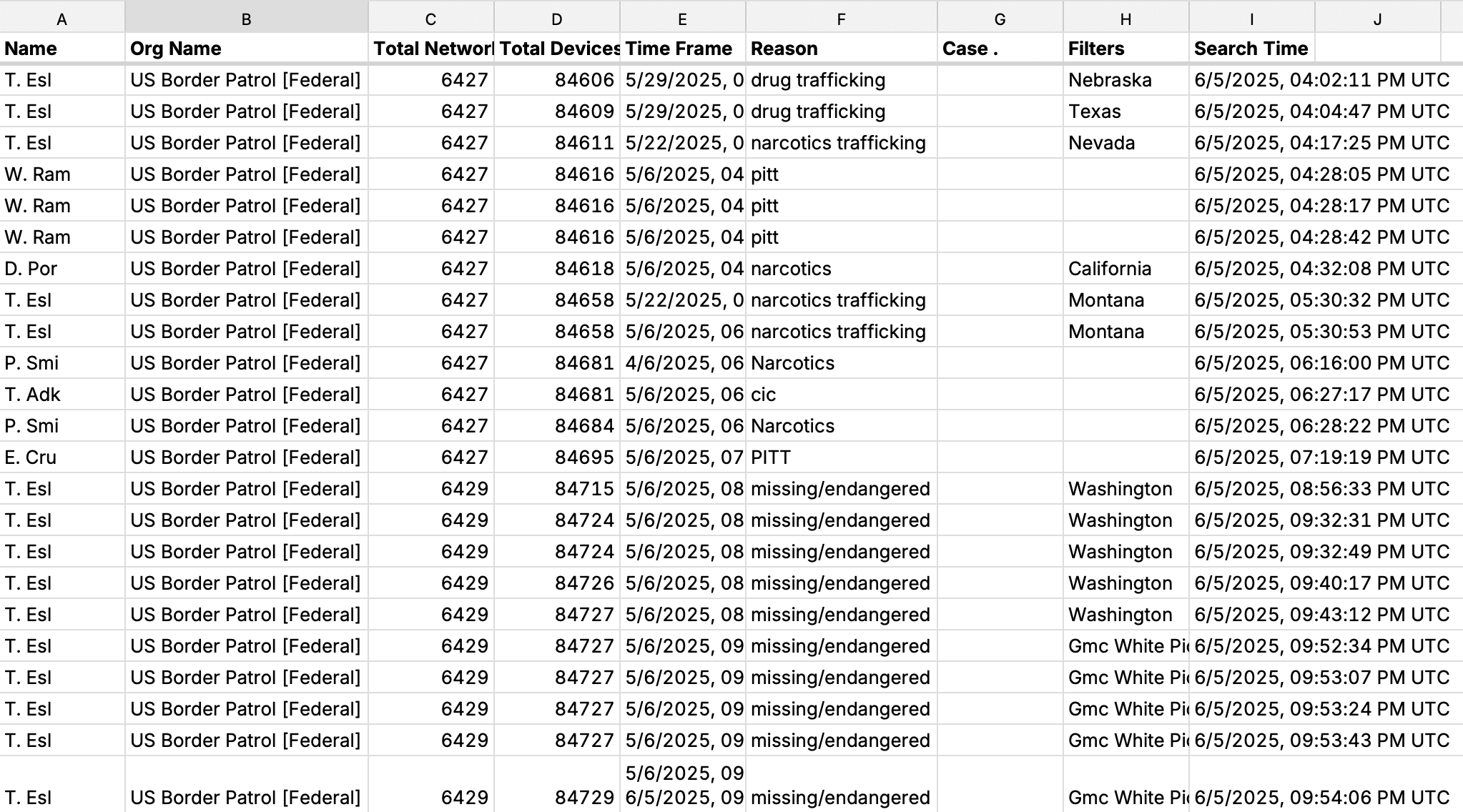
The searches made directly by USBP are just the tip of the iceberg; reporting by 404 Media revealed that ICE had access to Flock cameras across the country through a login registered to Homeland Security Investigations (HSI), which performed hundreds of searches nationally during 2025.
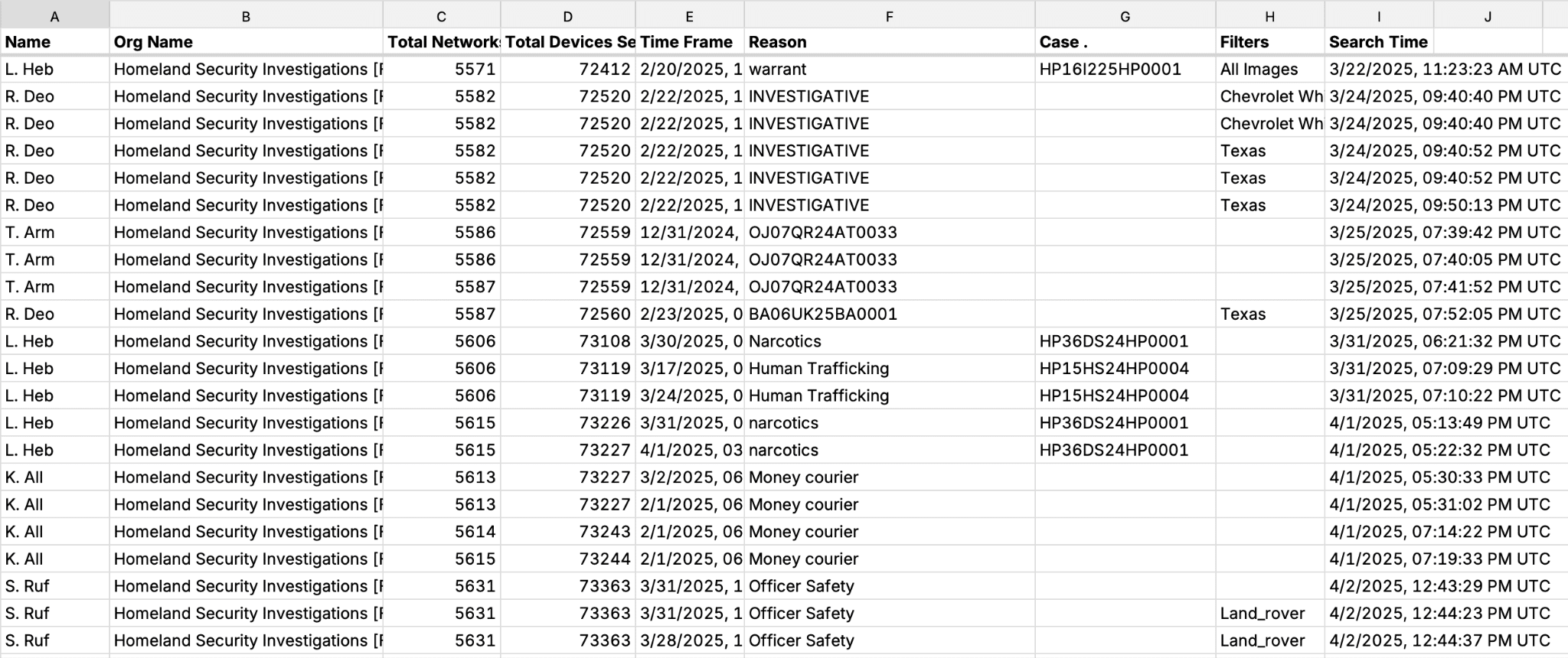
That HSI account made 182 searches on Spokane County cameras in the first six months of 2025.
While some of the HSI searches make a clear case for why they’re using Flock cameras, citing “Human trafficking,” or a specific case number, many of their requests had no case number attached and used vague terms like “investigative,” “officer safety,” or “Linked to an ongoing investigations [sic],” in the search field, which makes it nearly impossible to tell who or what they were actually looking for with those searches.
Spokane County Sheriff John Nowels told The Spokesman Review in October that agencies like Border Patrol and ICE do not have immediate access to the county Flock database. However, the network audit shows these searches were being made all the way up until the last active day of our request — June 23. The sheriff’s office has been unable to say exactly when they turned off the national look-up feature, which allowed federal and out-of-state agencies blanket permission to search local cameras.
What is Flock and who else has access to these cameras?
Flock is a surveillance technology brand that sells a specific brand of Automated License Plate Reader (ALPR) that are used on a subscription model by law enforcement agencies across the state.
The cameras constantly log photos of any car that drives past them, whether that driver has potentially committed a crime or not, which is then stored for up to 30 days in a database owned by the law enforcement agencies. That database can then be searched by whoever has a direct log-in to it, or any agencies that it has been shared with. Read more about Flock cameras in our region and where they’re located here.
The county currently has more than 60 Flock cameras operational in the region, including mobile Flock cameras mounted on cars that travel the county.
The side door
Flock software is somewhat complex to describe, but essentially there are settings SCSO can toggle on and off. They can add organizations to a list that are allowed to search their data, which researchers at the University of Washington (UW) call “front door” access. SCSO can also turn on or off a “National Look-up” feature, which allows organizations across the country to search their cameras without express agency-level permission. This is what UW researchers call “back door access.”
It’s unclear what SCSO’s network settings are and whether they share camera access with Border Patrol directly or if these searches were made through “back door” access because RANGE’s public records requests for that information sent in August have not yet been filled.
Direct searches from Border Patrol and ICE weren’t the only way Spokane cameras were used to assist in federal operations. At least 45 out-of-state agencies, mostly local police departments from red states, made more than 1,000 immigration-related searches on Spokane County cameras.
Search reasons included “immigration violations,” “immigration overstay,” “alien” and “ice pick-up,” among others. There were also other searches that we can’t say with 100% certainty are for immigration reasons, but raised some red flags, like: “suspicious traveler” “overstay,” and “suspicious vehicle at border entry.” Even searches for “missing/endangered” people could be suspicious, given that Texas sheriffs searched for a woman who got an abortion — who they were investigating for the death of her fetus — and publicly stated it was for a welfare check.
More than 700 searches were made — mostly from police departments in Florida, Georgia and Texas — that just gave “ICE” as their search reason.
The researchers at UW call these searches made by one agency on behalf of another agency “side door access.”
This has gone as far as Illinois police officer Todd Hutchison giving his log in to a DEA agent who made immigration-related searches on Hutchison’s account. None of those searches checked Spokane’s cameras, however, six other searches from Hutchison labelled “narcotics,” do appear on the log.
In October, Sheriff John Nowels told The Spokesman that if federal agencies asked for information related to a criminal investigation, his office would provide it, but that hadn’t happened yet. “If in fact we have provided anything to federal law enforcement offices it would be because of a criminal investigation,” he said.
While SCSO deputies don’t seem to have made any obvious “side door” searches on behalf of ICE or Border Patrol, contrary to what Nowels told The Spokesman, his employees made plenty of searches for other federal law enforcement offices.
We found at least 167 searches made on behalf of the Bureau of Alcohol, Tobacco, Firearms and Explosives, the Drug Enforcement Administration and the US Marshals Service — all federal agencies. Some or all of these searches may have been for active criminal investigations, but it’s impossible to know for sure; only a single one of these searches had a case number attached.
Most search fields simply had things like “usms fugitive,” “ATF Request,” “HSI DEA Assist,” or “usms.”
While SCSO has declined to return multiple requests for comment, they did take an initial phone call from RANGE on Monday, November 24. During that call, Nowels and spokesperson Mark Gregory didn’t deny making searches on behalf of federal agencies.
“We don’t do it for HSI, not even HSI, but we don’t do it for civil detainers, anything like that,” Nowels said. “But if HSI is working a human trafficking case, the US Marshals are out looking for bad guys, we will look stuff up for them and I think it’s appropriate and it does not violate the Keep Washington Working Act.” (A civil immigration detainer is a request to law enforcement to keep a person in local custody for deportation.)
The KWWA states that: “State and local law enforcement agencies may not provide nonpublicly available personal information about an individual, including individuals subject to community custody pursuant to RCW 28 9.94A.701 and 9.94A.702, to federal immigration authorities in a noncriminal matter, except as required by state or federal law.”
After news broke that these kinds of “side door” searches were showing up on cameras across Washington, including Mukilteo, Lynwood and Everett, State Sen. Marko Liias (D-Edmonds) told the Everett Herald that this kind of access “violates the spirit of our Keep Washington Working Act.”
“The goal of the Legislature was that the federal government would manage its immigration enforcement and that our state and local resources would be focused on protecting our communities from more immediate crimes and public safety risks,” Liias told the Herald.
The American Civil Liberties Union of Washington has maintained that sharing state-collected data like license plate information with federal immigration agencies is against Washington state law, calling the KWWA “the floor, not the ceiling,” of state protections.
Last Wednesday, we asked the SCSO spokesperson Mark Gregory if SCSO was aware that the county Flock cameras were searched for immigration violations, if the county considers these searches to be violations of the KWWA, and if the county was even aware that federal agencies had access to search Spokane County cameras all the way up until at least June 23.
They have declined to answer. We will update the story if they ever do.
The blank door
The front, side and back doors at least leave some kind of trace. The fourth option — which we’re calling “the blank door,” — is more nefarious.
While searches blatantly looking for “immigration” can now be blocked by the network owners, as reporting from The Urbanist pointed out, there is no easy way to curb queries with vague, blank or dishonest search reasons.
In the first six months of 2025, there were almost 70,000 searches on the SCSO cameras where the sole reason given for the search was “investigation” and the case number field was left blank.
When you factor in variations on the term investigation, like “inv,” “INV,” or “investigative,” there are hundreds of thousands of searches made with a vague search reason and no case number listed.
SCSO and Spokane Police Department (SPD) officers combined made at least 81 of those searches, and an additional 20 searches with the reason as “1” and no case number attached.
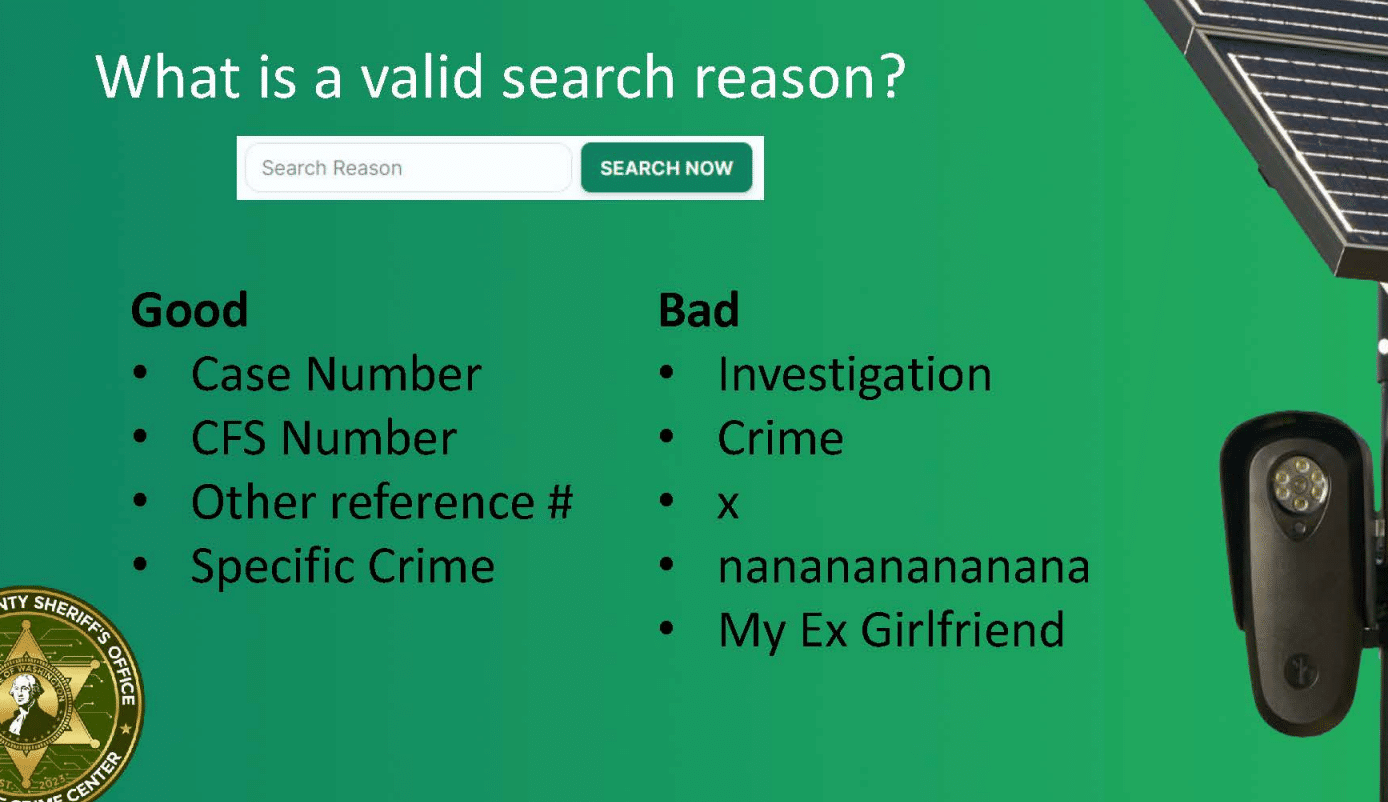
These kinds of searches with nondescript search fields make it impossible to tell what the user is actually searching for. It could be an immigration-related search on the sly for a federal officer who asked. It could be tracking an ex-girlfriend’s movements. It could also be for an ongoing missing person or murder investigation, but there is no way of knowing when officers include no information on why they’re searching sometimes tens of thousands of cameras for the sole purpose of “investigation.”
Despite the thousands of searches with invalid reasons, Nowels told RANGE last week that they do quarterly audits of Flock searches and that no officer had ever been disciplined for misuse of the system, to his knowledge.
He also said, “Everybody who searches the system, they have to identify what case number they’re using or what reason they’re actually querying the data. You can’t just go in on a free-for-all. There has to be some reason you’re accessing the data.”
SCSO declined to provide current internal policies, but training documents from 2024 that we reviewed state that “investigation” and non-descriptive search reasons are “bad” reasons to search Flock.
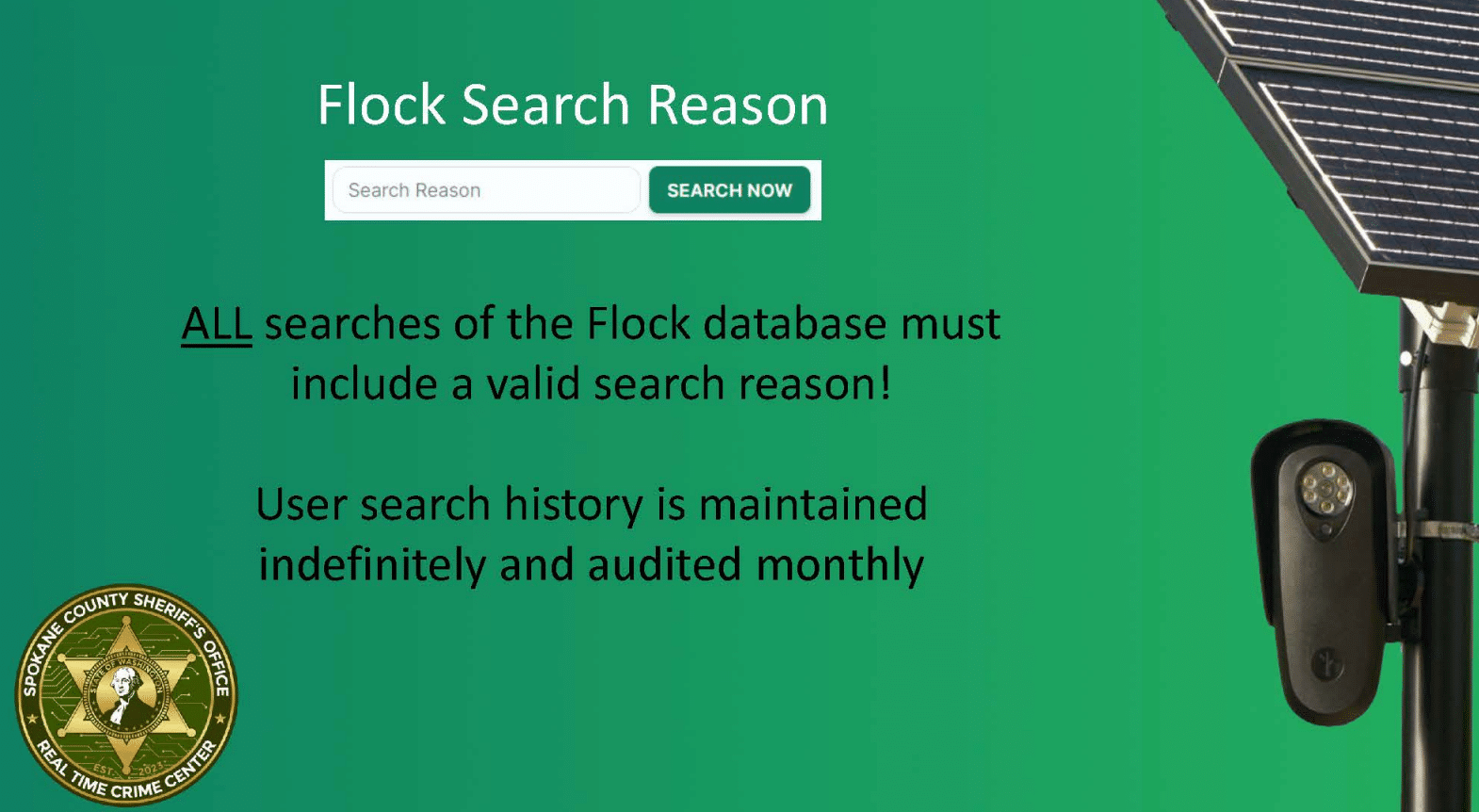
We asked the county last week specifically about these searches that are left blank and whether there were any plans to curb this kind of usage of the Flock cameras. We asked what potential consequences an employee might face for misuse of the system.
We also asked how many cases the SCSO has solved specifically because of Flock technology.
They declined to provide answers. If they do, we will update this story.
Additional reporting contributed by Aaron Hedge.
For information on this investigative series, why we’re reporting it and what’s coming next, click here.
Editor's note: this story has been updated to fix a typo.


