


Often, decisions made by the Spokane County Board of County Commissioners (BOCC) fly under the radar, which is not shocking considering their weekly meetings are at 2 pm on Tuesdays — a difficult time for working community members to attend. And yet, the BOCC is one of the most influential decision-making bodies in our region, if not the most influential.
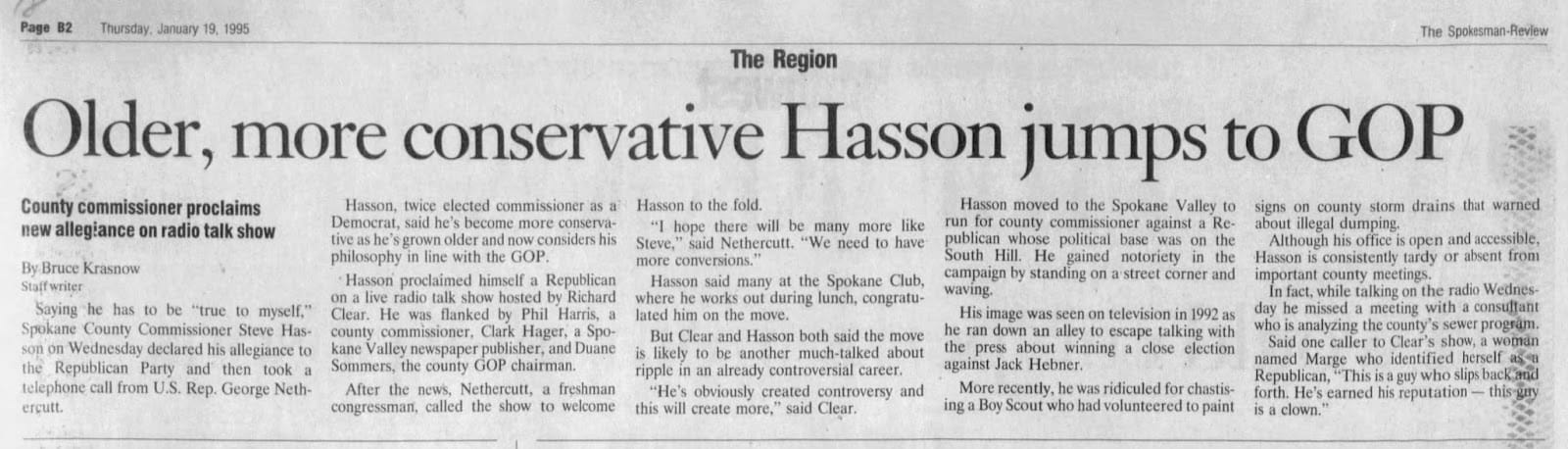
And its longest-standing commissioner, Al French (R), is facing a challenge to his seat by Molly Marshall (D). The board is made up of five seats — three of which are held by Republicans — so if Marshall wins the District 5 seat, it would flip a historically conservative board to Democrats for the first time since 1995.
A common way the board exercises power is through appointing representatives to the many lower-level public boards and commissions in the county.
We do our best to preview all the most important decisions the BOCC makes at its Tuesday meetings in our weekly CIVICS sections, but we wanted to go even further in making complex government systems more transparent and easy for you to understand.
In this article, we’ve broken down the board appointments on a few of the most important boards, as well as when the appointments expire and would need to be refilled by whoever is on the BOCC at the time. Click here to jump to the board breakdowns.
All the boards, all the time
The BOCC appoints members to a total of 36 boards and commissions with a variety of subjects ranging from the airport to clean air for our region to wastewater policy, according to its website.
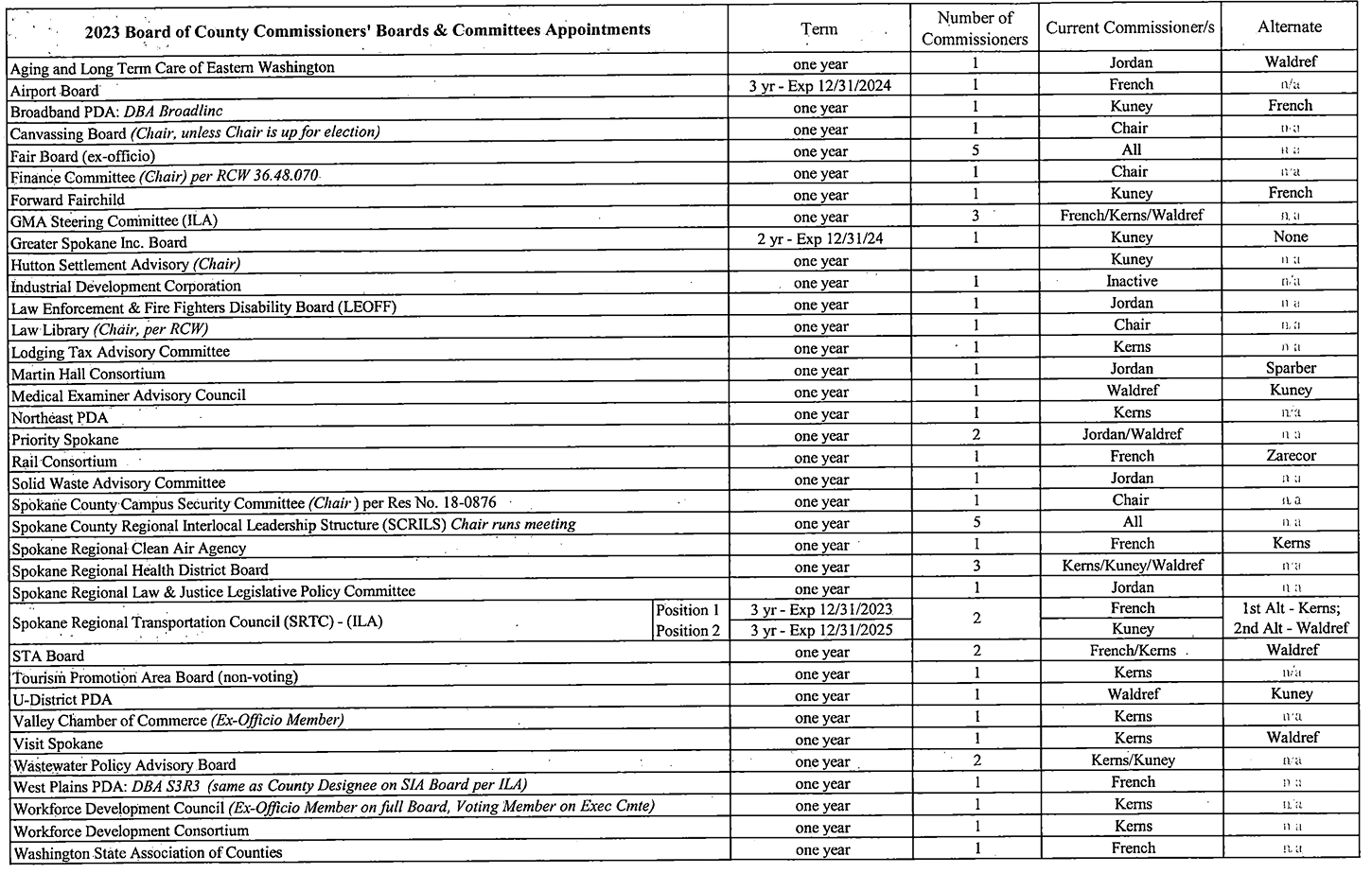
Complete list of board appointments, photo courtesy of BOCC website.)
Spokane City Council also appoints members to many of those boards, you can find its list of boards and commissions on their website too.
Some of the most important agencies in the region are the Spokane Regional Health District (SRHD), the Spokane Transit Authority (STA), the Spokane Regional Transportation Council (SRTC), the Spokane Airport and S3R3 Solutions. They have at least two things in common: we cover them (at least occasionally) in our CIVICS section, and each of their Boards of Directors have members appointed by the BOCC — and sometimes, the majority of members.
In SRHD’s case, every member of the seven-person board has been appointed by the BOCC. It is also the only board on the list that County Commissioner Al French does not currently sit on, though he has in the past.
Across the region, these boards make decisions that deeply impact the people they serve, like SRHD’s potentially illegal termination of Spokane Regional Health Officer Dr. Bob Lutz in the middle of the COVID-19 pandemic and the Spokane Airport Board’s decision to keep secret crucial information about its PFAS contamination.
More big decisions loom on the horizon. SRHD’s board will decide whether to privatize its Opioid Treatment Services late this year or early next year. The board decision at STA as to who will be its next CEO has a similar timeline.
Bell told us that according to the BOCC’s clerk, a draft list of board appointments for 2025 will be presented to the board in December for discussion. They can act on it then or wait until early January, when the full body will be sworn in (three commissioners are up for election currently).
A Visual Guide to Power
The Spokane Regional Health District Board
According to its website, “Spokane Regional Health District’s Board of Health is the governing body of the health district, uniting the cities and county in a cooperative effort to oversee all matters pertaining to public health, according to state law.”
It “creates and promotes prudent health policy, ensures compliance with all applicable chapters of state law and invites participation by all persons and organizations interested in public health. Its members adopt local ordinances and resolutions and approves budgets.”
SRHD’s BOH regularly meets on the last Thursday of the month, at 12:30 pm, and we cover it in CIVICS.
This is what the current BOH looks like. This entire board is appointed by the BOCC:
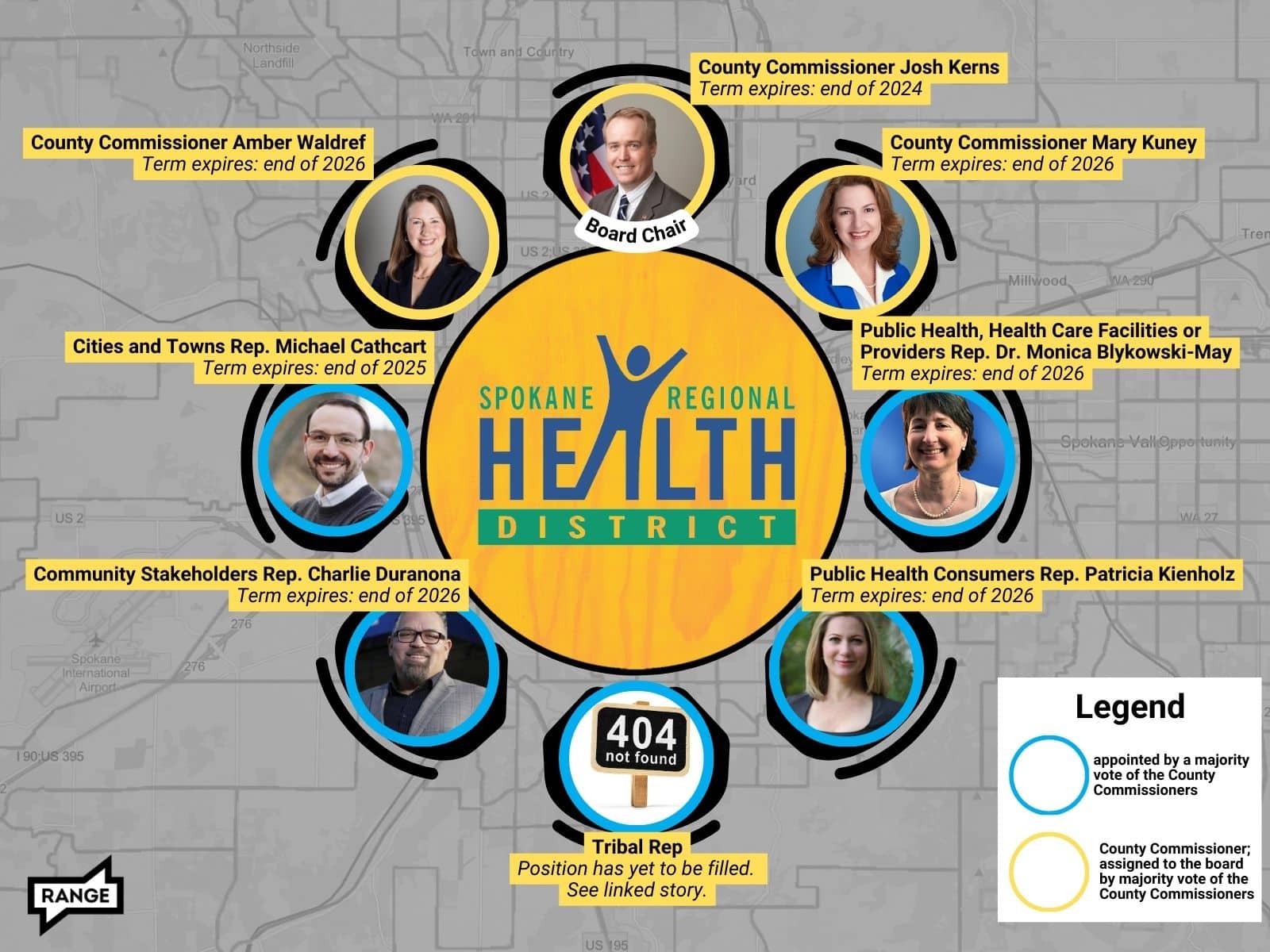
Note: the Tribal Representative position is vacant and has been since it was created by new state regulations. Why it’s vacant is a bit of a tangle: the BOCC hasn’t voted to approve an appointee to fill the spot. They say it’s because they haven’t received a clear choice from the American Indian Health Commission of Washington (AIHCW), which is responsible for sending a candidate recommendation to the BOCC. The AIHCW says they’ve sent multiple options. For the full story, click here.
Important Decisions
Over the last few years, the BOH has consistently made decisions with huge impacts for Spokane.
Some of those decisions we’ve been following include:
- The allegedly illegal termination of top health official Dr. Bob Lutz, and the fallout from that decision
- The termination of the Breast, Cervical and Colon Health Program (BCCHP)
- Where new clinics would be located
- Choosing the leaders at SRHD
Some of the decisions that SRHD’s Public Information Officer Kelli Hawkins pointed to as highlights for SRHD include:
- The “thorough and efficient” hiring process that led to choosing Dr. Alicia Thompson as SRHD’s Administrative Officer
- The BOH’s support for better working conditions for SRHD employees, decreasing the workweek from 40 to 37.5 hours and keeping the workplace hybrid, even after COVID-19 restrictions ceased.
- The board’s approval of SRHD’s Strategic Planning Process this year
- The board’s support of more efficient record keeping systems, especially in the Treatment Services Division
A huge decision that’s currently being discussed: whether SRHD will continue in its Feasibility Study on the potential privatization of its opioid Treatment Services Division, which we’ve covered in-depth here, here and here.
Spokane Transit Authority
Per its website, “STA is overseen by a regional board that provides the policy and legislative direction for Spokane Transit’s CEO, and approves its actions, budgets, and long-term plans. It also has the authority to levy taxes as authorized by state law (with voter approval).
“The Board of Directors is composed of nine voting and four non-voting elected officials from Spokane County and cities in the Public Transportation Benefit Area, which include Airway Heights, Cheney, Medical Lake, Millwood, Liberty Lake, Spokane, and Spokane Valley, and a non-voting representative of labor.”
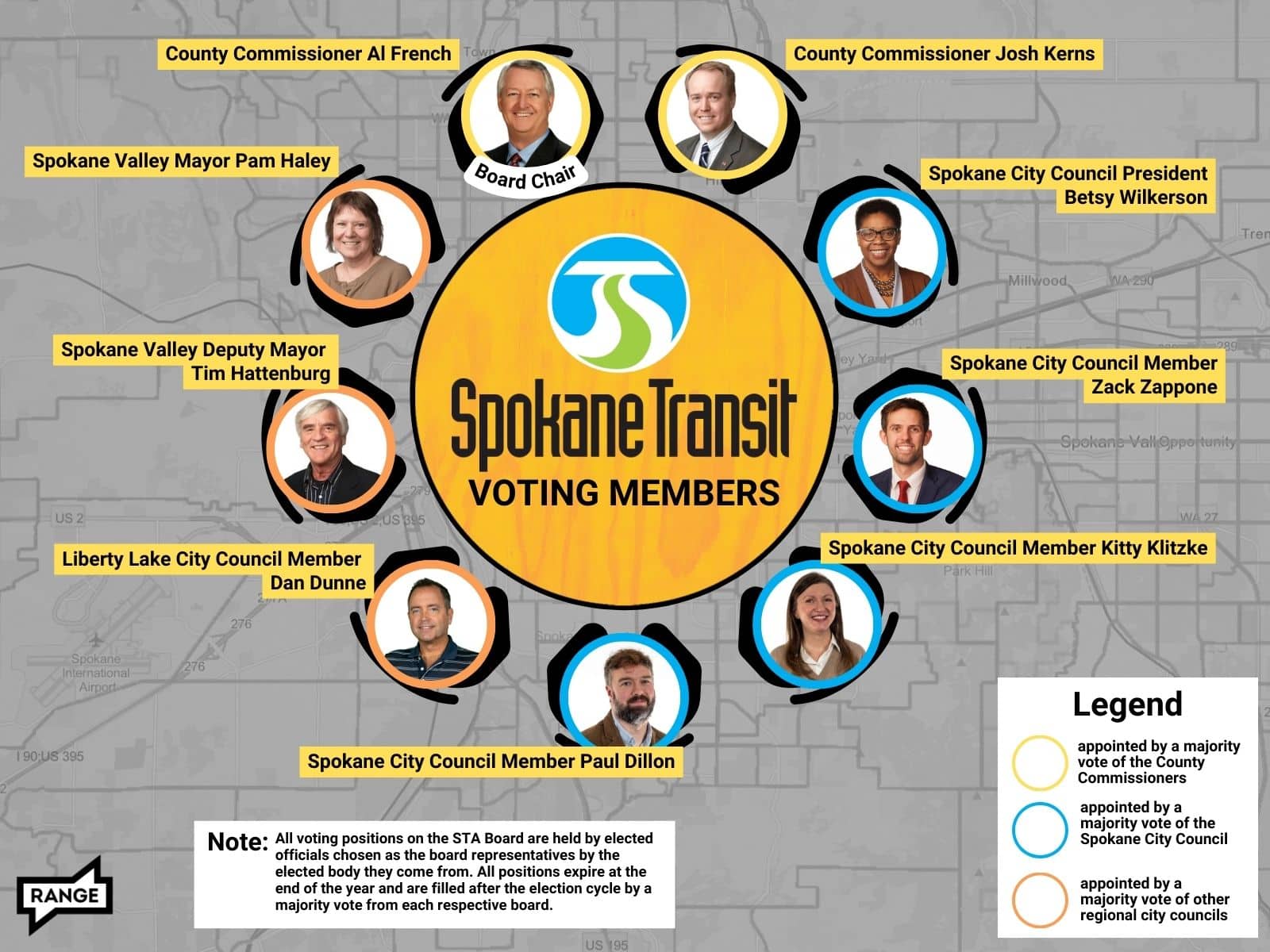
The BOCC appoints two commissioners to the board each year. This is what the current STA Board looks like, excluding non-voting members:
Important Decisions
As Spokane has grown, so has the need for public transit. We asked STA spokesperson Carly Cortright to highlight some of the most impactful decisions the STA board has made for the agency in the last few years.
Cortright told us to direct questions about the board to Al French, chairman of the STA board, stating, “I don't want to put words in their mouth of what they think are the most important decisions that they've made and then have them feel that it was something different.”
In what may come as a surprise to no one, French did not respond to our call for comment, so we chose our own important items! We will update this list if French gets back to us, but don’t hold your breath.
- Implementing the City Line, the “first bus rapid transit system in Washington east of the Cascades,” which connects downtown to the university district and runs from Browne’s Addition to Spokane Community College.
- Supporting the Zero Fare for Youth program implemented in 2023 and paid for with funds generated by the Climate Commitment Act (which could be killed if statewide Initiative 2117 passes.)
- Approving and informing the 10-year strategic plan (for which they are seeking public feedback on during the STA board meeting on November 21)
- Preparing to run a sales tax on the ballot to replace a .2% sales tax approved by voters in 2016 that will sunset in December of 2028, the assumed revenue from which is a key component of STA’s 2025-2030 Transit Development Plan.
- Voting Al French as chairman again, even after texts received in a public records request revealed he had coordinated with CEO Meyer to stall progressive priorities, made off-color and transphobic jokes and disparaged Spokane City Council President Betsy Wilkerson’s efforts to codify diversity, equity and inclusion considerations in transportation plans.
An ongoing decision-making process that could be greatly impacted by any changes in representatives on the board: the search for a new CEO to replace Susan Meyer. There have already been significant disagreements on what the search process should look like, and we anticipate debates about who should fill Meyer’s shoes could be even more contentious.
Spokane Airport Board
The city and county of Spokane jointly own the Spokane International Airport, Felts Field and the Airport Business Park.
According to the website for the Spokane Airport Board, “The city and county operate the airports under provisions of RCW 14.08, which establishes the operation of airports by more than one municipality under joint agreement. The operating authority of Spokane Airports is the Spokane Airport Board, consisting of seven appointees from the two governmental bodies. The Board annually oversees a capital and operating budget of approximately $118 million from various funding sources…
The Spokane Airport Board was formed in 1962 and has operated Spokane's airports since that time. The Board’s three properties are operated and maintained by revenues derived from rents and fees generated on the facilities. None receive appropriated tax dollars.”
The BOCC and the Spokane City Council both appoint three members to the board, and then those six members jointly appoint a seventh member. Here’s what the seven-member board looks like:
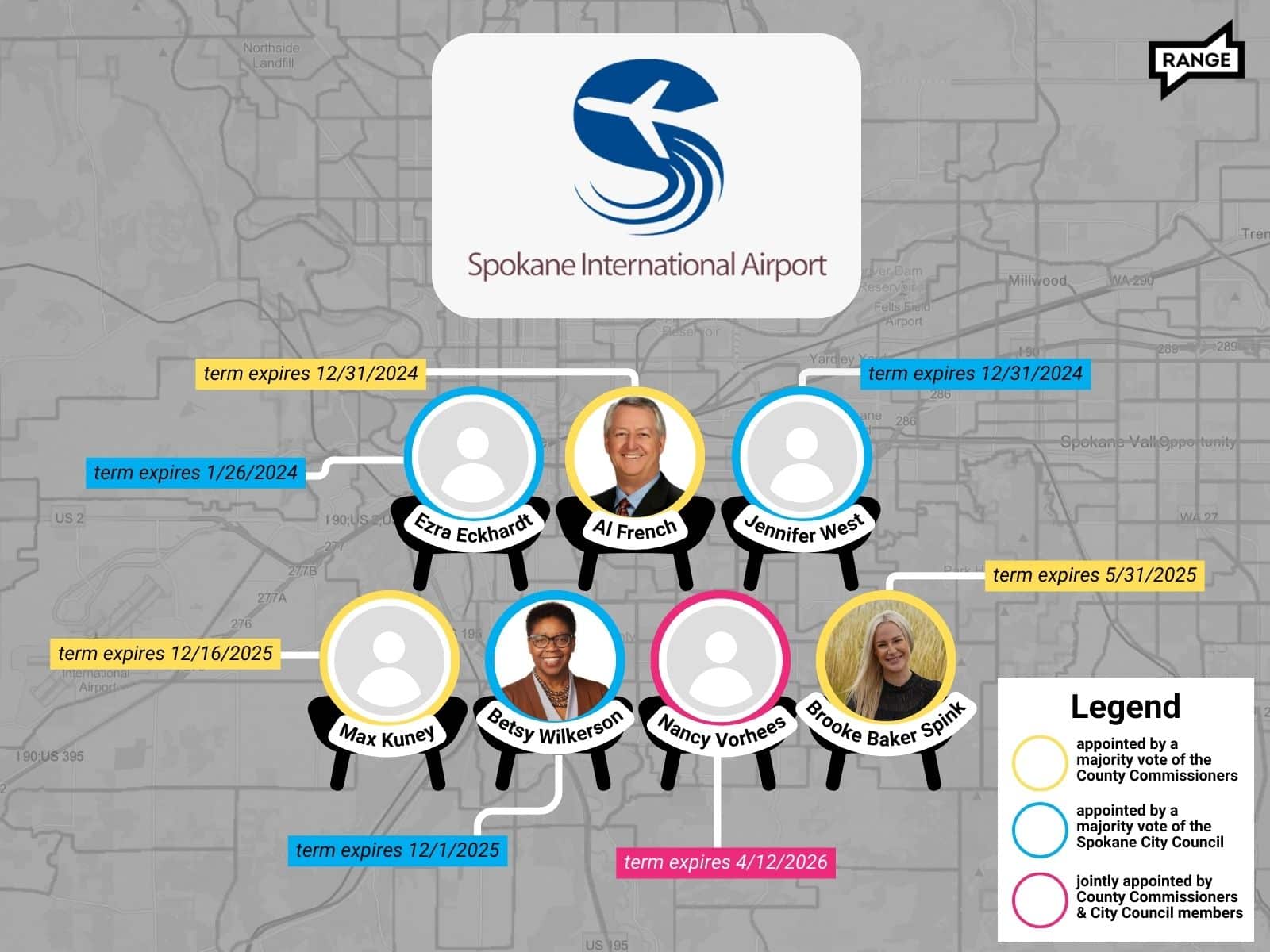
Note: Max Kuney is also the husband of County Commissioner Mary Kuney.
Important Decisions
The Spokane Airport Board may seem like one of the more boring boards in the region, but every once in a while, they still have to make big decisions, like:
- Not disclosing crucial information about its PFAS-contamination on the West Plains.
- Building a hangar at Felts Field for the Historic Flight Foundation, which has been forced to sell off assets after its founder lost a judgment over $20 million in court.
- Making key financial decisions about airport expansion.
Spokane Regional Transportation Council
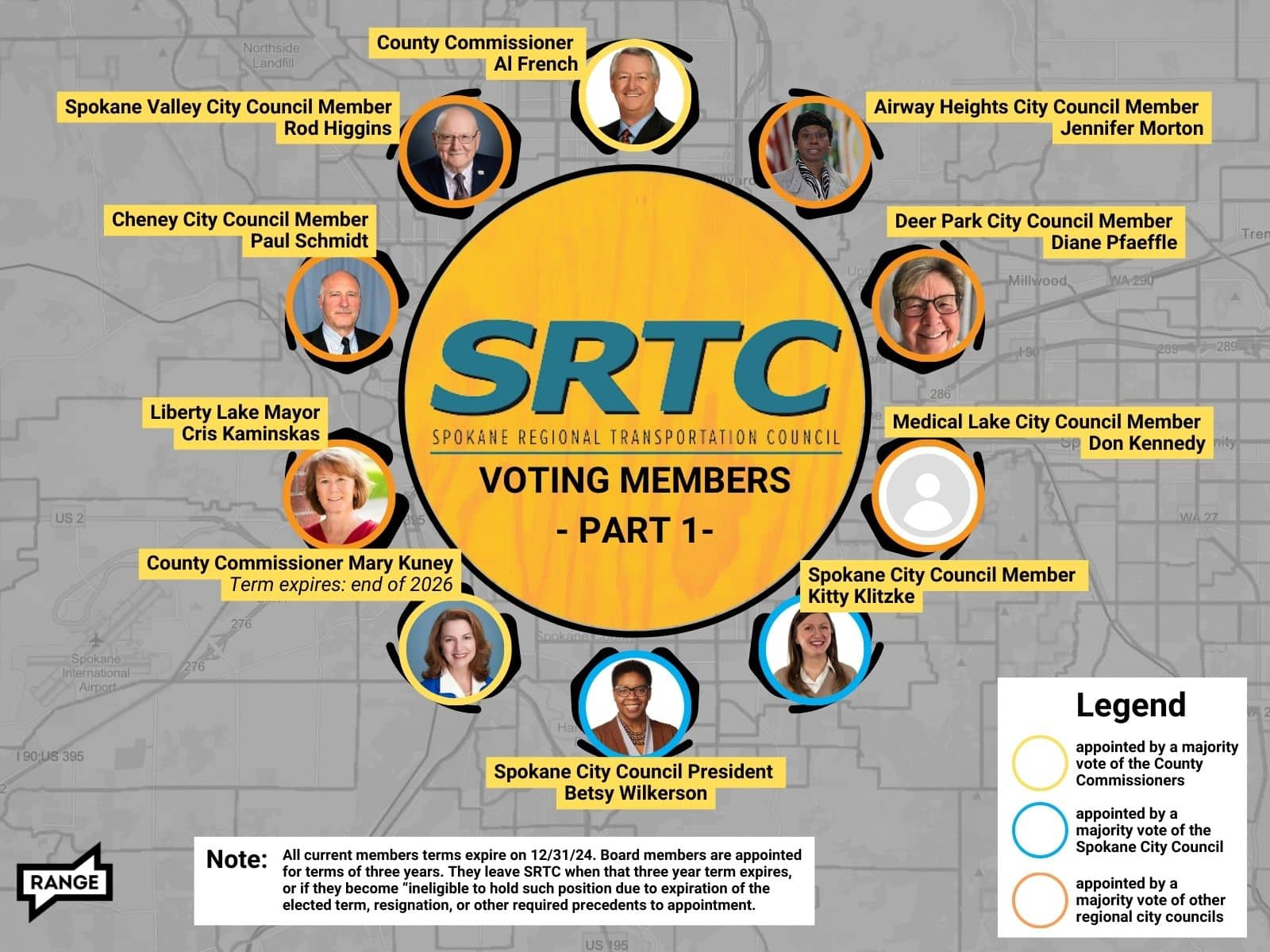
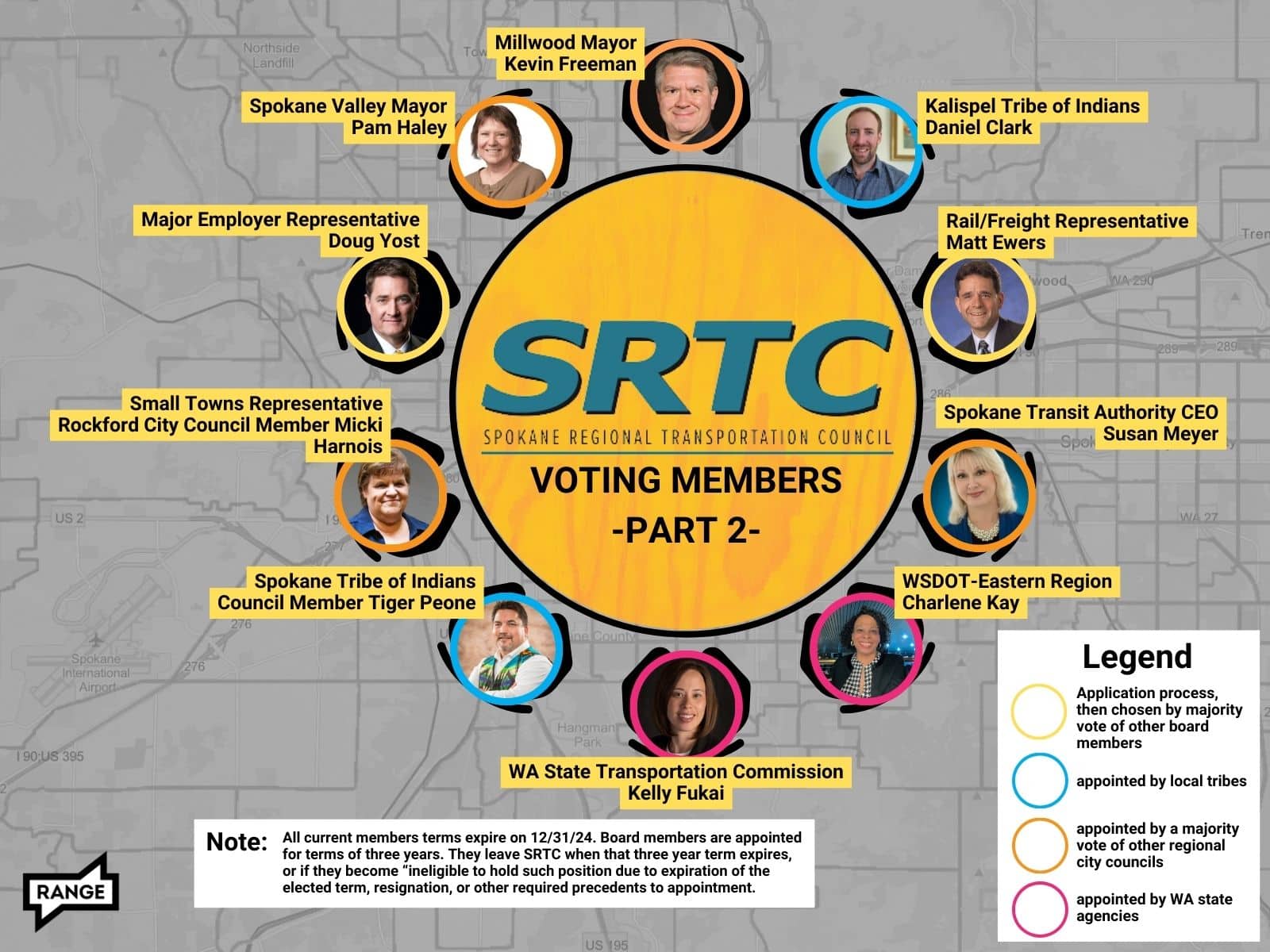
“The Spokane Regional Transportation Council (SRTC) is the lead agency for transportation planning services for the area covered by Spokane County,” their website reads. “The Board of Directors is the decision-making body of SRTC. The board consists of 20 voting members who are either elected officials or member agency executives, and two ex-officio (non-voting) members. The Board meets the second Thursday of each month at 1 pm.”
The SRTC is one of the physically largest boards on the list, with 20 voting members, appointed in a variety of ways. Just like at STA and S3R3, French serves as the board chair. Here’s what the SRTC board looks like right now:
Important Decisions
- Overseeing a four-year, 65-project, $896 million regional transportation plan.
- Adopted Horizon 2045, the region’s long-range transportation plan
- Approved a Safe and Complete Streets policy and reviews ongoing project applications to make Spokane a more pedestrian-friendly city
S3R3
Though it’s a public body, the development authority S3R3 Solutions bills itself as something more corporate-sounding: “your trusted business partner at the intersection of access, place and growth.
According to its website, it is “a client-centered firm that marshals the resources of public and private service providers to recruit new and existing businesses into the West Plains Airport Area and drives economic prosperity through the creation of jobs.”
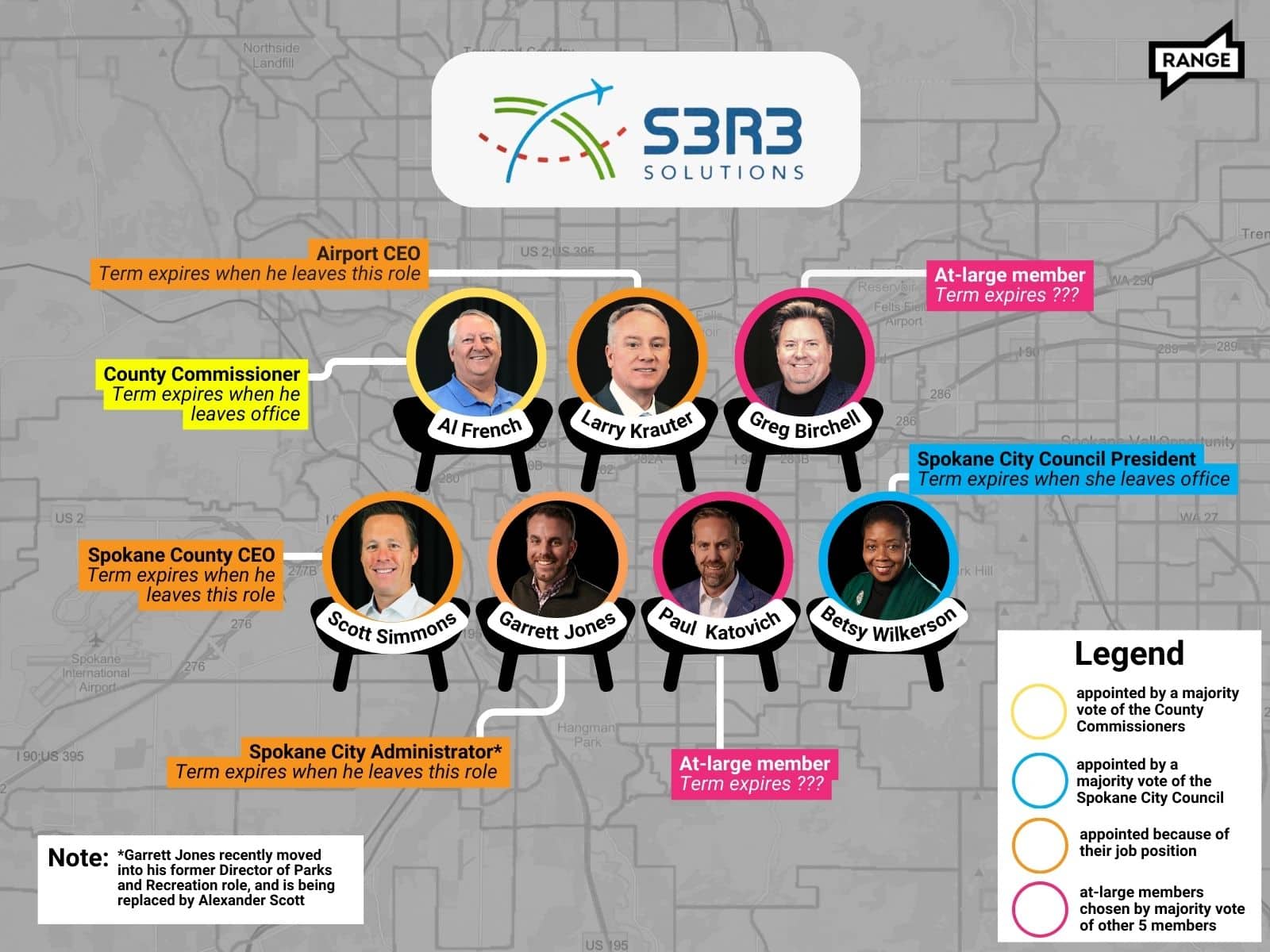
It is governed by a board made up of city and county staff, elected officials and local business leaders.
We reached out to S3R3 Solutions seeking clarification on why the board is structured the way it is, when at-large members’ terms expire and how exactly those at-large members make the shortlist to be voted on by the other board members. As of publication, we have not received answers to those questions but will update if we receive them. Here’s what the board looks like:
Important Decisions:
- Planning wetland mitigation areas to offset new development in the West Plains.
- Pursuing new businesses to come to the West Plains.
- Facilitate development of land in the airport business park.
Conflict with the city of Spokane
In the past year, conflict on these boards has become more frequent, more tense and more polarized, with battle lines often drawn along partisan lines. Appointees from the metropolitan and progressive-majority Spokane City Council face off against the appointees from the conservative-majority BOCC, who often ally themselves with representatives of smaller cities and rural towns on these boards.
While these conflicts can fall on partisan lines, there are also questions about differing regional needs and what fair representation for each participating governmental body looks like. That's because the amount of taxes coming from each body’s constituents can vary wildly. Discussions about spending and representation also get complicated. For example, the city of Spokane contributes the greatest portion of both tax revenue and ridership to STA, but the city is also within the county, so how should board appointments be fairly divided between the Spokane City Council and the BOCC?
Conflict has also paused some potential future collaboration opportunities, like the Spokane Regional Homeless Authority (SRHA), a proposed body that has gone into indefinite hibernation after months of negotiating. The chief reason cited by the city for the stall was Spokane’s concerns with the board’s proposed makeup, which didn’t include enough service providers and would have left the city with only two spots on the 13-person body — despite likely contributing a majority of the funds to be spent by the SRHA.
Still, Spokane Mayor Lisa Brown says there has been a little movement and cooperation at the staff level of the governments, if not between the BOCC and her administration.
In his recent debate, French said the SRHA fell through because, “Mayor Brown wants to control the regional system, and based upon what they’ve achieved so far, I’d be opposed to that.”
Regional relations, specifically between the BOCC and the city of Spokane, have gotten even more tense since progressive Lisa Brown took office as Spokane’s mayor. Though neither Spokane City Council nor the BOCC appoint members to the Spokane Regional Emergency Communications governing board, it has been the site of the most recent conflict: discord over whether the city is getting its money’s worth of services and are better off as part of the regional collaboration, or would be able to have more cost-effective emergency communications if they pulled out of SREC — the issue Brown says has been the most contentious.
“For the city, the main thing is you want good outcomes to come from these boards that take into account the interests of the people who live in the city, but also it’s financial. These are our tax dollars,” Brown said.
In her first year in office, she says she has been fighting for fair representation on boards, fair financial treatment (specifically at SREC, where she said city residents pay two different taxes to support it) and collaboration with the county on addressing the fentanyl crisis. She also pointed to SRHD, where no members are chosen by the city, despite the fact that “the city is where a lot of the impacts are being felt.”
Spokane City Council Member Michael Cathcart was chosen by the BOCC to represent all the surrounding cities and towns in the county, but he wasn’t chosen by the city to represent itself, which is an issue for Brown.
No Spokane City Council seats are up for election this year, but three of the five BOCC seats are. County Commissioners Josh Kerns and Chris Jordan are both running unopposed and are basically certain to retain their spots, but the race between County Commissioner Al French and Democrat Molly Marshall is shaping up to be a much closer race.
If Marshall wins, the BOCC would be under progressive majority for the first time since January of 1995, according to research by local historian Logan Camporeale.
If Marshall loses, the conservative majority will hold strong, but the attempts at collaboration can’t stop, Brown said.
“Despite not having an ideal relationship with the BOCC now, we have nevertheless moved forward on some things,” Brown said. “I don’t want to paint a picture that is like nothing can happen if you don’t have the people you prefer in office.”
The successes of collaboration she pointed to? City and county staff have worked together, and there has been an agreement reached on expansion of funding for co-responders in the Fire Department, utilizing both city and county dollars.
“The public chooses their elected representatives and then it’s on those elected representatives to work together no matter who they are,” Brown said.


