

Mayor Lisa Brown’s administration has a plan to make our city more vibrant, especially downtown: tax out the parking lots. This, coupled with existing incentives for land owners to build housing rather than let much downtown real estate essentially sit fallow, will create a more walkable, denser and friendlier city.
The tax would be implemented through an ordinance allowed by state law imposing 12% fees on surface lots and 6% fees in parking garages. This would add about $0.50 to a $3.85 parking tab, the price motorists pay to park for two hours in Riverfront Park, or $0.30 to two-hour, $5 session in Riverpark Square. Per state law, the money must be used to fund transportation projects like street and sidewalk maintenance.
But the real long-term benefit would be a revitalized – and safer, more populated, more prosperous, culturally richer – downtown core after surface lots are redeveloped into housing, commercial spaces, arts venues, hotels and the like.
Critics might imagine that there would be a lack of parking downtown if surface lots are redeveloped over the years. They might even see the efforts as counterintuitive if they adhere to prevailing logic that says less parking will draw less traffic and therefore less money to the downtown core.
The long term benefits may seem pie-in-the-sky, but once we consider the cartoonish inefficiencies of commercial parking, the effort begins to make perfect sense.
The blight of parking lots
A whopping 30% of land downtown is dedicated to car storage, and the effect is not neutral: parking lots are not housing – a salt in the wound of Spokane’s housing crisis. Parking lots do not provide jobs. They do not create community or contribute to culture.
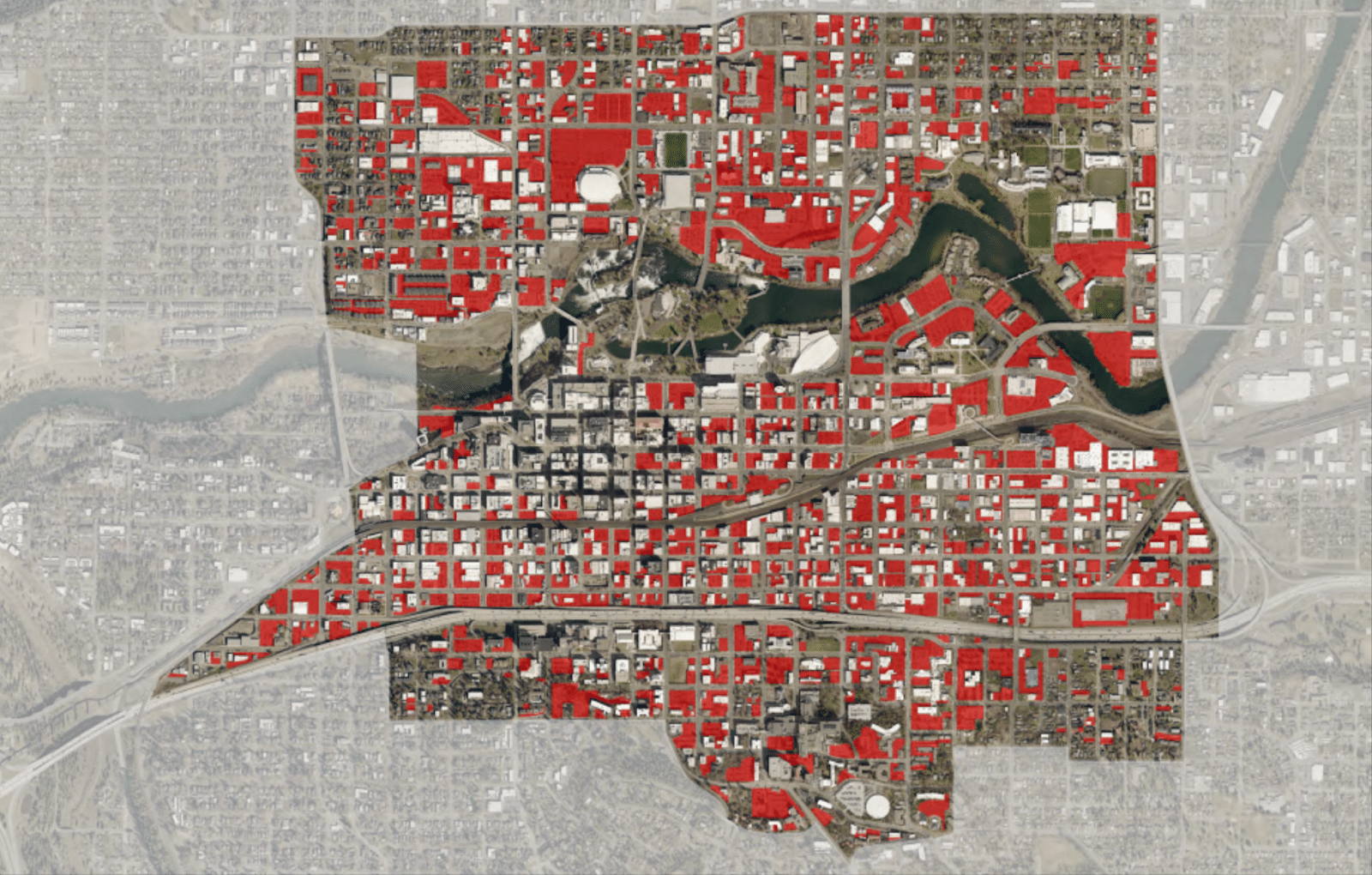
Surface parking lots shaded in red. Source: City of Spokane.
Most of the time, these off-street parking lots sit pretty empty. Even in 2019 — that blissful pre-pandemic year when in-office work was more common — a study found that off-street parking usage topped out at 56% during the busiest times.
Parking lots also generate precious little property tax revenue. For instance, Diamond Parking paid $3,615.44 in property taxes in 2025 for this lot at 28 W Main Avenue, while the owners of 24 W Main Avenue next door – a building with housing and two small businesses that create jobs and community – paid $19,108.23. The lots are nearly identical in size.
As largely uncontrolled and unmonitored spaces, parking facilities attract crime. Author and activist Jane Jacobs wrote about the safety of cities coming from “eyes on the street”. That is, the more positive foot traffic an area has (like from neighbors, shop employees, etc), the less crime will occur. Without staff and with each customer walking away shortly after arrival, parking lots lack frequent positive foot traffic.
They also degrade a block’s walkability by spreading buildings out. One reason well-loved places like Rome, Paris, and even Disneyland feel alive, safe and welcoming is because they don’t have surface parking lots breaking up their cores.
Parking revenues don’t stay in our local Spokane economy. Many commercial parking lots downtown funnel money to their out-of-town corporate owners, like Seattle-based Diamond Parking, JRD Parking, Republic Parking Northwest and GT Mulkiteo. Many of them use the reservation and payment system ParkMobile, which is Atlanta-based. The owners, wherever they are based, can sit on the properties for decades, performing minimal upkeep while the land beneath them appreciates thanks to public or private investments by others in the area.
Study after study after study of our city has found that surface parking lots in particular are a severe underutilization of land, especially in the urban core, which we so badly want to be lively, prosperous and safe and to have cultural value.
While the tax is undoubtedly a stick, the city is also increasing the number of carrots offered to those owners of surface lots to encourage redevelopment. The parking tax ordinance waives permit fees for those applying to build housing on surface parking lots. And land owners who have an approved building permit for housing on their parking lot would not have to pay the tax.
(A third carrot, the pre-existing Parking to People program, which is unrelated to the parking tax ordinance, gives tax breaks to those who build affordable housing where parking lots once stood. Bafflingly, Spokane is the only city in the state to take advantage of this state program.)
City leaders hope this combination of carrots and sticks are enough to encourage redevelopment.
Wouldn’t this reduce parking space for people who need it?
No. Hiking the cost of parking actually increases parking availability by incentivizing carpooling, using alternate modes of transportation and less lingering.
Parking lots are hilariously inefficient — they don’t provide much value in relation to the land area they actually occupy. To park a single vehicle, roughly 325 square feet of earth is required for the stall itself and the maneuvering space around the stall. These images compare that space to living space, which illustrates just how antithetical commercial lots are to the health of urban environments.
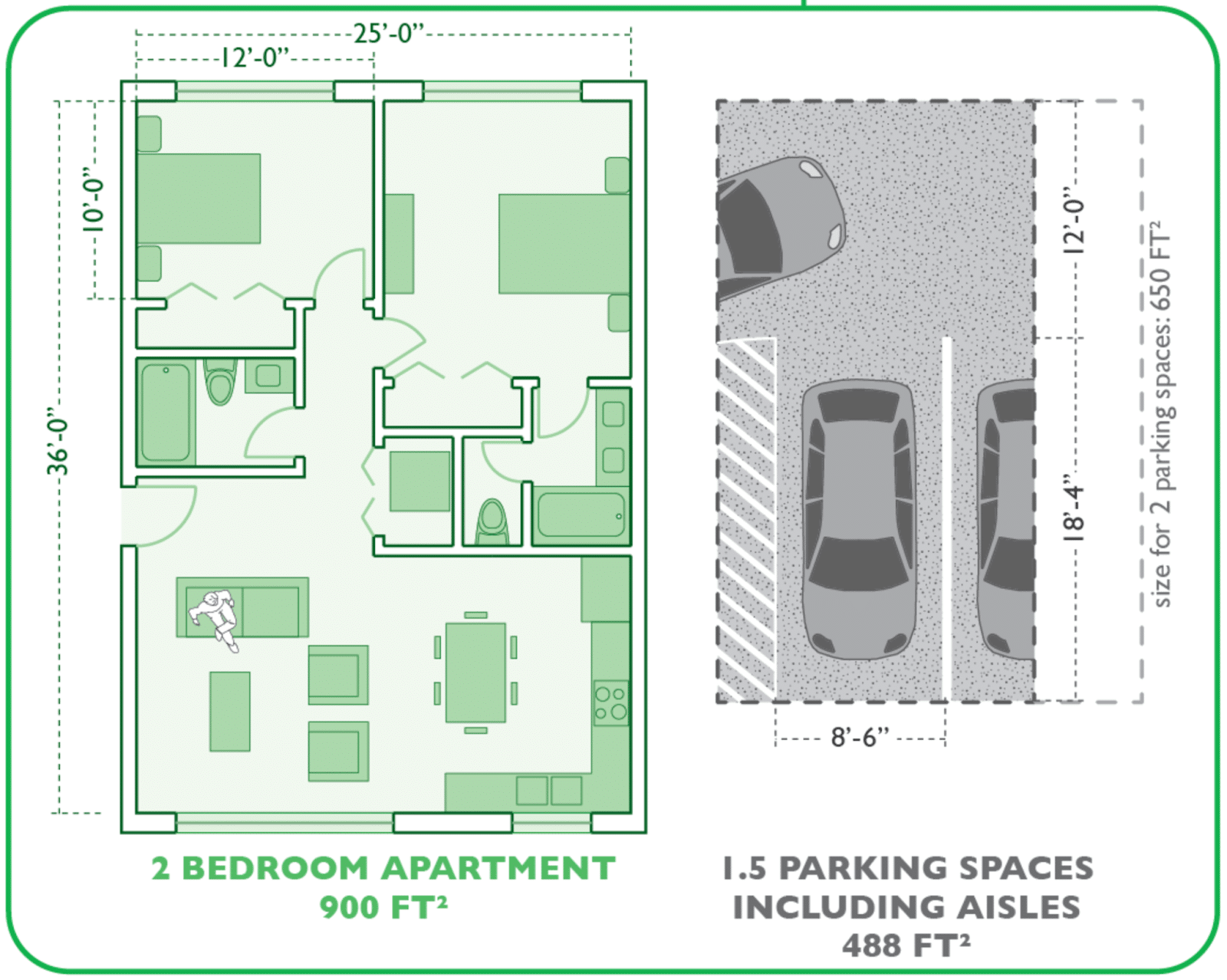
Comparing residential space with parking space. Source: Seth Goodman, graphingparking.com
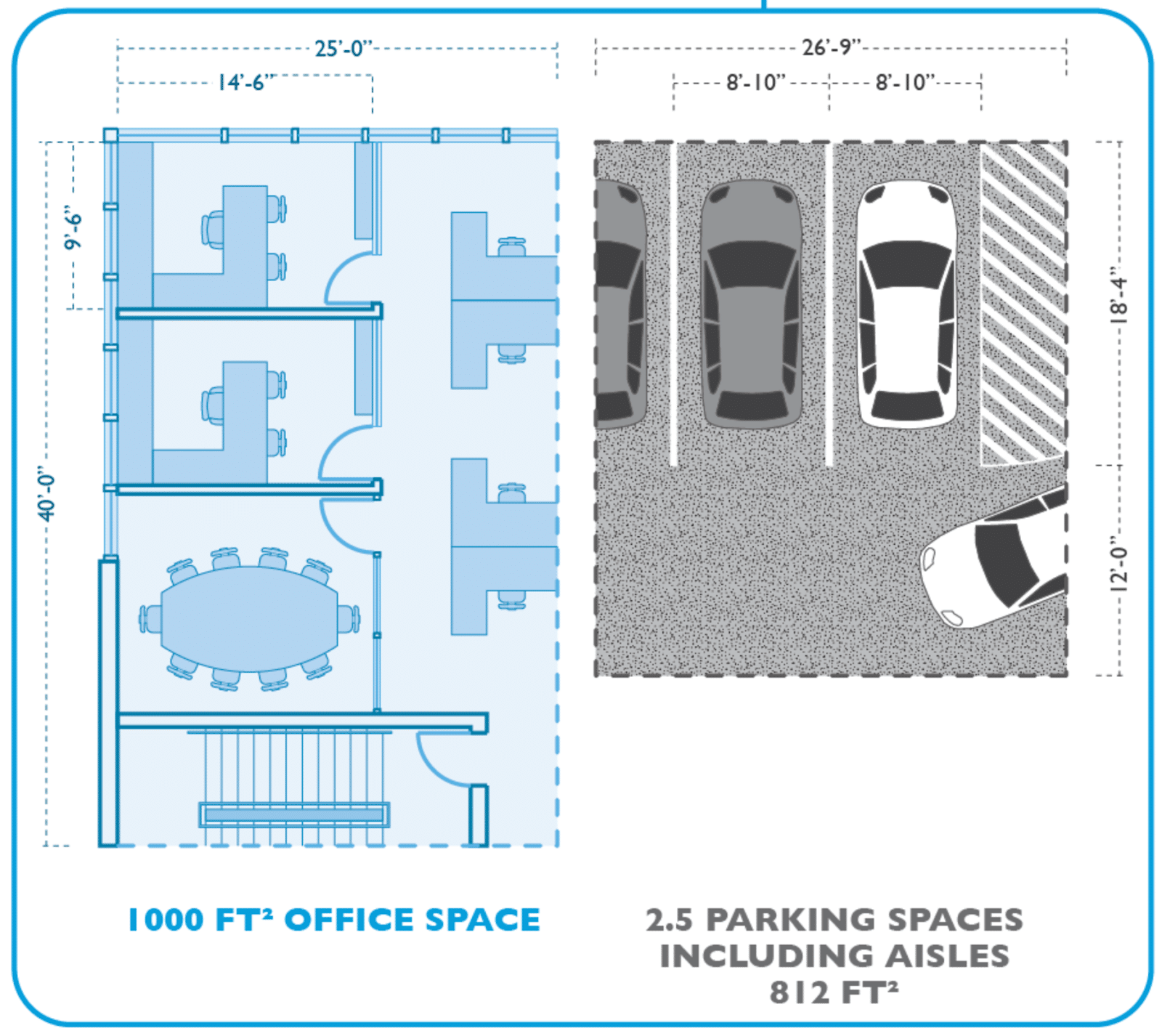
Comparing office space with parking. Source: Seth Goodman, graphingparking.com
Even better, building housing in and around the urban core results in fewer cars needing to be parked as those residents are more likely to choose to walk or cycle to their destinations.
You might imagine that there would be less revenue for important transportation projects if the surface lots are redeveloped. But the city is betting that a redevelopment that would provide jobs, commerce and housing would bring in more property and sales tax dollars to the city than a parking lot would ever bring in under the Commercial Parking Tax.
The revenue angle
In the meantime, the tax will help the city solve more immediate problems in our city, like the pot-hole-ridden, cracked-up roads lined by sidewalks deformed by tree roots and consumed by weeds.
One reason for this disrepair is that Spokane is — famously to anyone with one eye on city council meetings — in a crippling budget crunch. This problem is worsened by the Trump administration, which is threatening any federal funding that goes to local transportation development in sanctuary states like Washington. The city receives millions every year in transportation dollars from the federal government.
It also receives millions from the state, which is facing budget issues of its own, especially when it comes to transportation funding.
At the same time, road revitalization in neighborhoods is funded by a local portion of car registration fees, a revenue source that has plateaued as per-mile paving costs have soared and local streets have experienced increasing wear and tear from heavier cars.
Cars weigh on average 30% more than they did 40 years ago, meaning they cause significantly more damage when they roll across the asphalt. According to the fourth power law used in road construction, a 30% increase in weight equates to 186% more damage. The average car from 40 years ago would have to drive the same stretch of road nearly three times to cause the same amount of damage as today's average car would in one pass.
This means people who drive light cars are footing the bill for damage inflicted mostly by people who drive heavy ones. Perversely, the owners of vehicles weighing 6,000 pounds or more, like most Ford F250 models and Tesla Cybertrucks, don’t pay the local tab fee at all, despite the F250 causing five times the pavement damage a Tesla Model 3 does.
The fourth power law also suggests that infrastructure designed for the smallest and lightest vehicles — cargo ebikes, for instance, which cause a miniscule 1/50,000 of the pavement damage of a Subaru Crosstrek — to go the shortest distance is least expensive to maintain. In contrast, our current system is wide streets that carry few passengers in heavy vehicles long distances – the most expensive combination.
The road ahead
It’s a win-win strategy: revitalize downtown with redevelopment of under-utilized lots. In the meantime, bring in some revenue to fix the crumbling roads and sidewalks.
The Local Option Transportation Tax for Commercial Parking ordinance is scheduled for a final reading at the city council meeting on November 17. It needs five votes to pass and would go into effect January 1, 2026.


