

A brand new survey for homeless people just dropped, and it’s not designed or administered by the city, county or other municipality.
This weekend, the Spokane Business Association (SBA) will expand their efforts to “end visible homelessness downtown,” by hiring a consultant formerly in charge of homelessness during the first Trump administration. Robert G. Marbut, who was the Executive Director of the U.S. Interagency Council on Homelessness from 2019 to early 2021, will help SBA administer surveys to unhoused people near shelters.
The questions on the survey ask for demographics like gender and date of birth, information about when a person started experiencing homelessness and questions designed to tell SBA how long each person has resided in Spokane, partially by asking indirect questions like where a person attended their senior year of high school, where they were living before they started experiencing homelessness and where they slept before the COVID pandemic.
The survey also has a question asking for the reason someone came to Spokane with a set of options a person can choose from:
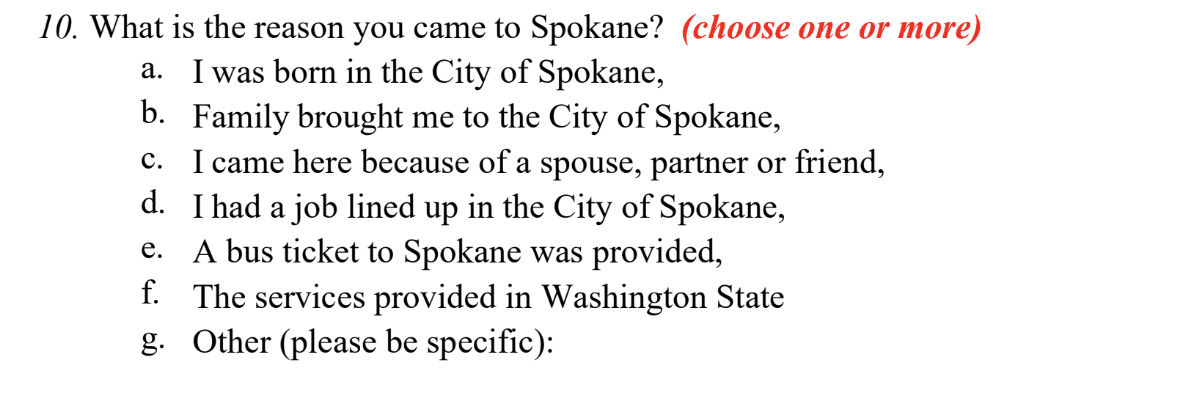
The survey’s final two questions ask if someone had a job before they were homeless and if they currently have a job.
Gavin Cooley, director of strategic initiatives for SBA, wrote in a newsletter he sent today that the survey collection is aligned with Spokane’s Homeward Bound program, where individuals “who may have stability in another community,” are given tickets to return to that other community.
He told RANGE that understanding where people experiencing homelessness in Spokane are coming from “is really important.”
“If we’re creating the conditions where people can come to Spokane and go to a marketplace for fentanyl and methamphetamine, like downtown, they can engage in open drug use without any intervention whatsoever,” Cooley said that SBA wants to know.
“This is more than just important data collection—it’s an opportunity to engage with the realities of homelessness in Spokane,” he wrote in his email. “These surveys will complement the data gathered in our recent annual HUD Point-in-Time Count, by offering deeper insight into Spokane’s homeless population—particularly where individuals originally come from.”
But most of the data that would be collected from the SBA survey is already collected by the city’s Point-In-Time Count they conducted in January. Results of the most recent count haven’t been released publicly yet, but in 2024, 73% of unhoused people surveyed said they were from Spokane County. About 10% of the remaining people not from Spokane said they were from elsewhere in Washington. Data for the 2025 PIT count will be available this summer.
Because the SBA survey focuses intensely on the idea of identifying those who, in Cooley’s words, “are coming to Spokane,” and because they’ll be conducted by volunteers with just 20 minutes of training, service providers worry the survey will do more harm than good.
Lerria Schuh, who works with Experience Matters, pointed to the question about high school attendance as problematic. “ It feels very much like they're trying to identify people who are ‘from here,’ and that feels gross,” she said.
“ I moved here from Montana and if I had had struggles within the first couple years of moving here, would I have been less worthy of assistance because I decided to move to Spokane?” Schuh asked. “The answer should be no. It shouldn't matter where we come from, we should be helping humans.”
Hallie Burchinal, executive director of Compassionate Addiction Treatment (CAT) Spokane, told RANGE those kinds of questions “perpetuate the stigmatized thinking that the people experiencing homelessness in Spokane aren't from here.” Not only is it stigmatizing, Burchinal said, “ It's been proven time and time again to not be true.”
Burchinal said the methodology and questions chosen seemed designed to engineer a specific outcome for a political narrative.
She echoed Schuh’s sentiment that where you were born and raised isn’t relevant to the help you need. It’s like if a student moves into a new school district and needs free lunches to eat; you don’t ask them where they’re from and tell them to go back to their old district if they want food.
Cooley doesn’t see the harm in the surveys. If they replicate the city data, then it will be just another point of confirmation for the city. If their data is different, it will give SBA the information they need to inform their approach “to addressing chronic homelessness, public health, and safety in our city.”
But Burchinal, who spent several years homeless, said she doesn’t think whatever data Cooley collects will be accurate.
“ When you're in that situation, you just don't give truthful answers because it doesn't feel safe,” Burchinal said. “ So you're not even collecting real data. You're collecting information from people that don't trust you and aren't gonna give you what you're asking for.”
The city runs its PIT count differently: volunteer teams receive an hour of training and are guided through the streets by local service providers who have built trust with the unhoused people there. In Burchinal’s opinion, that trust leads to more accurate data.
SBA is partnering with Union Gospel Mission, where the training will take place, but Cooley wouldn’t tell RANGE what training SBA’s volunteers were being given, calling the question “spin city.”
Representatives of Union Gospel Mission didn’t answer a request for comment. We will update this story if they do.
Who is Robert Marbut?
SBA’s approach was designed by Dr. Robert Marbut — Trump’s former homelessness czar who has argued that feeding unhoused people is enabling them.
Marbut is famous for his “Housing Fourth,” philosophy, which purports that people shouldn’t have housing until they have demonstrated they have gotten clean and two other things, though we can’t find a quote of what exactly they are.
It’s a stark contrast to the demonstrably more effective “Housing First,” philosophy, which argues people need a stable place to live in order to receive mental healthcare, find employment, rebuild community, recover from substance use disorders or take other actions to exit chronic homelessness.
Marbut has called his approach a “Velvet Hammer,” and it’s understandable why his approach would appeal to leaders at SBA.
During work with cities like Daytona Beach and St. Petersburg, Marbut’s recommendations have included criminalizing all behaviors associated with homelessness (like panhandling and camping on public property) and warehousing people at large congregate shelters, similar to the former Trent Shelter, which is owned by Larry Stone, the founder of SBA and Cooley’s boss.
While the Trent Shelter had no indoor showers or bathrooms, the Marbut-designed shelter in St. Petersburg went even further: though it was zero barrier, anyone who broke the shelter’s restrictive rules were forced to sleep outside in a courtyard that frequently flooded. The results in St. Petersburg weren’t particularly effective: only 7% of people who left the shelter exited into permanent housing, while 67% left for an “unknown destination” — which means a destination outside the rehousing system, and likely back on the streets.
One of Marbut’s past contracts was for $7,201.25 a month, but that was with a city, not a business association. Cooley declined multiple times to say how much Marbut was being paid, saying it “has no bearing whatsoever on what we’re talking about.”
‘Housing Fourth’
Diane Yentel, CEO of the National Low Income Housing Coalition, has called Marbut’s approach “paternalistic, patronizing, filled with poverty blaming/shaming.”
The local service providers we spoke to were just as critical.
“The housing first model is evidence based. It works,” said Lydia, a service provider who asked to be referred to by her first name only. “I can’t even count how many times people have said ‘I just need to get somewhere stable and then I can detox.’ If people have a place that can keep their stuff safely while they go to detox, [it’s more likely] that they’re not going to get out and go straight back to the streets.”
Burchinal questioned the intention behind the survey. “Is it that you want to cut services off, that you want to try to ship people out?,” she asked. Or, she asked, would the survey be used to create pressure for another large congregate shelter where people are punished in degrading ways?
Schuh was critical of SBA’s approach in general, which doesn’t center people who have lived through homelessness. “It's the people with lived experience who hold the key to getting the solution when they've already walked through one variant of it or another with some success,” she said.
“The other challenge I have with the survey is that we have tons of data,” Schuh said. “So if SBA really wants some quality data, they just need to go out to the people who have already collected it.”
Cooley is constantly pointing to the high and rising overdose rates as a reason the city needs to do things the SBA way. But the service providers connecting with unhoused people more deeply than walking past them at 5 am or asking them where they went to high school think that SBA’s approach will actually make things worse.
“We’re losing people at an alarming rate,” Lydia said. “People are dying, and his way — this ‘Housing Fourth,’ situation — if it went fullscale, I think we would lose twice as many people.”
Lydia participated in the city’s PIT Count for one day and she recalled a particular group of unhoused people she surveyed. Of the seven people she talked to, five described similar situations: “they’d gotten evicted or their rent went up during COVID and they couldn’t pay it, or [a service provider] lost money that was helping them pay for housing and they got evicted. There’s so many different stories and he’s putting everybody in a box and that is not okay.”
(Notably, in the same email he sent calling for volunteers, Cooley also asked people to sign in against state legislation that would set a 7% cap on rental raises and require landlords to give tenants ample notification of upcoming rent raises.)
Like both Lydia and Cooley, the city doesn’t want to see unhoused people dying on the streets. Last week, they announced a new plan in collaboration with Spokane County to expand medication assisted treatment in the region. Soon, the Spokane City Council will vote on a slate of ordinances that could change regulations around homelessness, like when emergency beds are required to be opened and when and where sit-and-lie laws will apply.
City Council Member Paul Dillon, whose phone had been ringing off the hook all day from service providers concerned about SBA and Marbut’s surveys, said that he won’t support anything that further criminalizes homelessness in alignment with Marbut’s methods. Dillon prefers “compassionate and stabilizing solutions” with data showing their efficacy.
“What gets lost is a focus solely on homelessness and not enough on what we are doing to keep folks one major issue — medical, car breakdowns, job loss — away, from becoming homeless,” Dillon said. “That’s what SBA could be focusing on.”
Editor’s note: Lerria Schuh also works for the Smith-Barbieri Progressive Fund, which has provided funding for RANGE. RANGE maintains rigorous control over our editorial content and, while we may call funders for comment on stories where their perspective is relevant, they have zero oversight or input into anything we write.


