

Editor’s note: “I love and appreciate RANGE’s work so much, but do you have to write about depressing things ALL the time?” This is a sentiment we get from readers and our periodic surveys. And we definitely get it — we’re in it every day. So when the Spokane Renaissance Faire came up, we saw an opportunity to explore a different type of RANGE story: one where we can find a little queer joy, paint you a nice picture and still somehow tie it all back to some fascinating labor history. We hope you enjoy this as a leisurely Sunday read.
Hordes of townsfolk crowd the jousting pitch, eagerly awaiting the first clash of swords. Criers in armor and bold colors marking their country-of-origin begin to rouse the crowd, shouting the names and countries of the knights that will be fighting. Sir MacDoan’l from Scotland, his cheeks streaked with dark blue paint, hoists his sword high and a bloodthirsty chant rises from his section. And then, with a shout of medieval-speak that climbs above the noise of the fray, a man with a booming baritone moves the peasants off the bench in the front, making way for a pack of ladies in velvet carrying parasols.
The queen has arrived.
This is the opening scene of the Empire Arena at the recent Spokane Renaissance Faire, which is set specifically in Tudor England under the rule of Henry VIII, who you may remember for his six wives and his eventual creation of the Anglican Church after the Pope refused to let him keep divorcing or beheading them. Though Henry himself wasn’t wandering the faire grounds, two of his wives were — Queen Catherine of Aragon (divorced), and Anne Boleyn (beheaded), who was serving as her lady-in-waiting during the historical moment this faire is set in.
The line to enter the painted plywood castle walls of the faire had snaked from field to field in Green Bluff, tracing a path from the painted plywood castle walls nearly all the way to the parking lot when I arrived at 11:30 am. An hour later, the arena seemed packed and — with the queen’s blessing — the jousting began. But as the sun got higher in the sky, the line outside the castle walls only grew.
The parking lot swelled until overflow cars spilled into the ditches of the road leading into the faire. Traffic backed up to the main highway — with some committed revelers trekking nearly a mile into the castle gates. Some were turned away to keep capacity below fire code limits, even a couple who made the journey down from Canada. Once inside the faire, the lines still persisted, with wait times of over an hour just to snag one of the comically large turkey legs that Tiktok videos would tell you are a crucial piece of experiencing a renaissance faire.
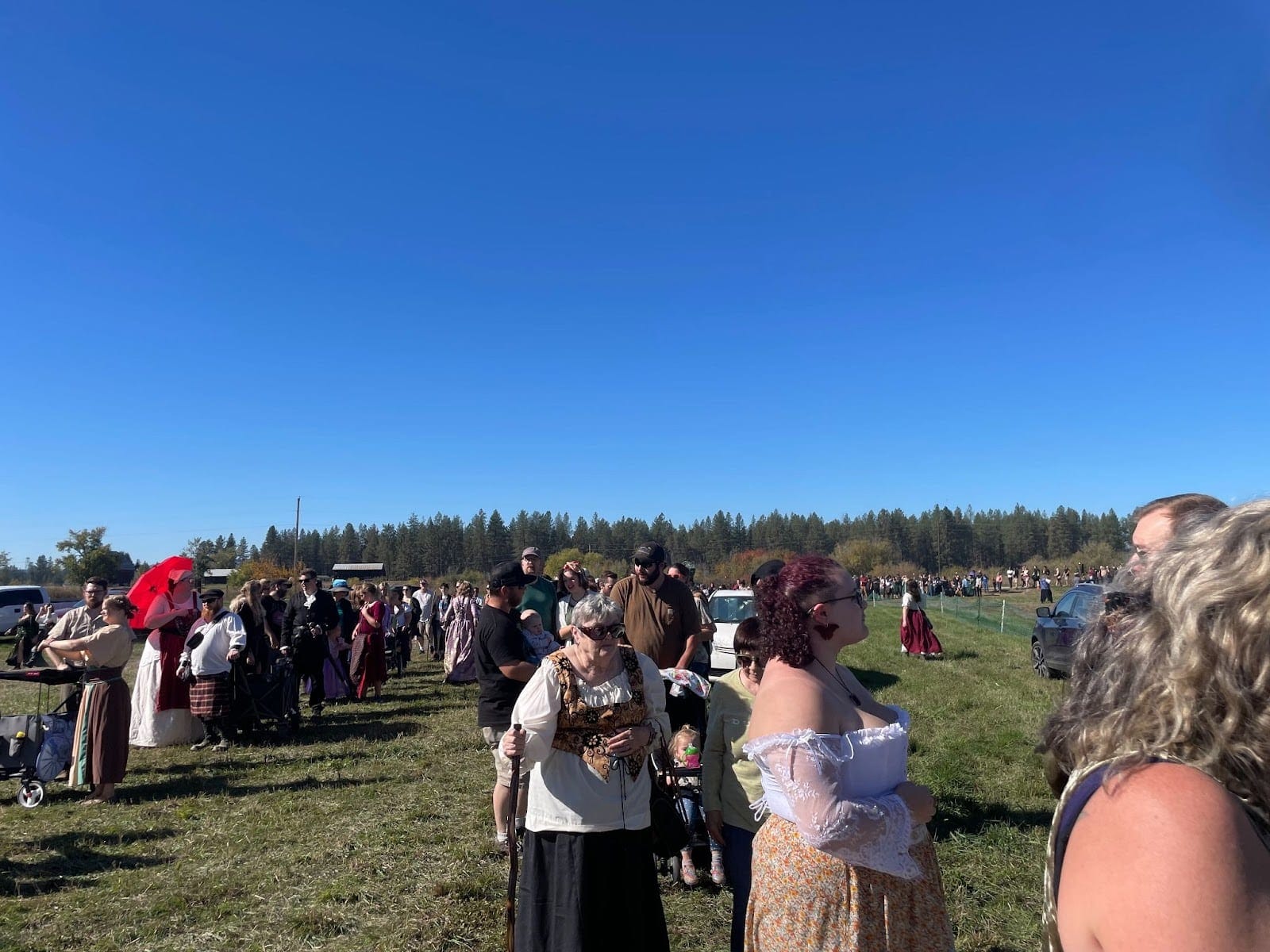
Though the organizers had anticipated a large attendance — Tara Mickschl, the vice board chair and one of the founding members of the Spokane Renaissance Faire, said they’d brought in around 5,000 people in the past and estimated this would be their largest yet — this explosion of popularity was nearly impossible to fully prepare for, especially considering this was Spokane’s first full Ren Faire since before the COVID-19 pandemic. By the end of the two-day event, around 8,000 people had stepped through the gates of the castle and into the world created by the organizers, a 60% increase in patronage.
The performers of the Spokane Renaissance Faire try to be historically accurate in their costumes (aka “garb”), their language, their etiquette and small scenes performed throughout the fair, but they also chose places to lean into the fantastical elements that they know draw people in. Mickschl lovingly described their approach as taking “a lot of artistic license.”
There are fairies and mermaids in the cast this year, which led to interesting bits of roleplay: characters from a more refined background, like Queen Catherine, acted like they don’t see the fae folk, but characters whose backstories included a belief in fairies were free to interact with them. Strolling down the dusty paths lined with vendor booths, it was quickly obvious that the world constructed here isn’t one of historical rigidity or exclusion. It wasn’t even a world that could fit in one book.
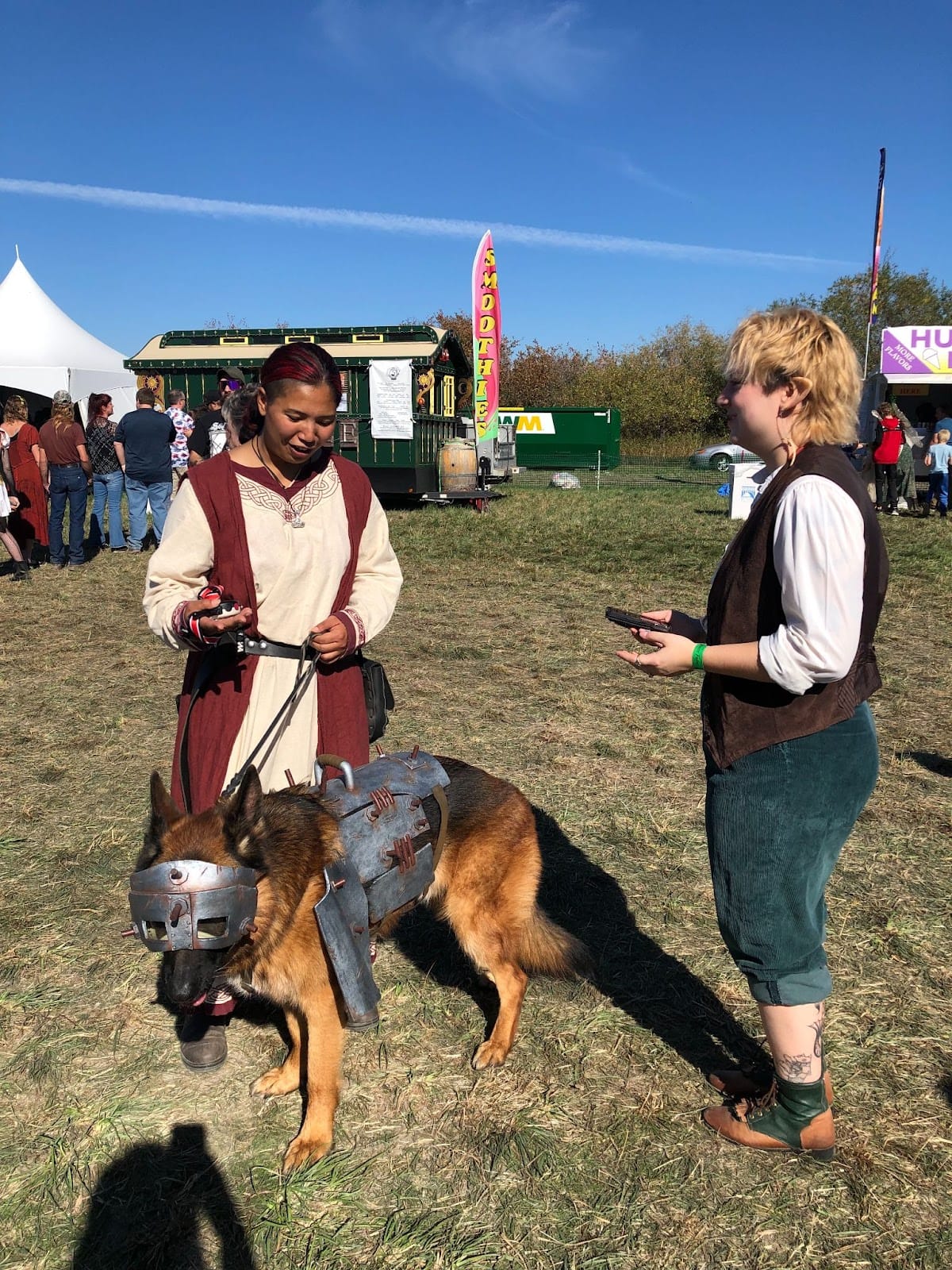
Shrek and Fiona held hands in line for faire food. Knights sweated it out in full suits of chainmail armor, swords hanging off their leather belts. I saw a few Vikings in facepaint, a wolf wearing a full fursuit and Bridgerton-esque embroidered waistcoat, and dogs in dragon wings and flower crowns. I can’t even imagine trying to use the Port-a-Potties in the full length gowns with layers of corsetry, bustles and undergarments I saw some people in.
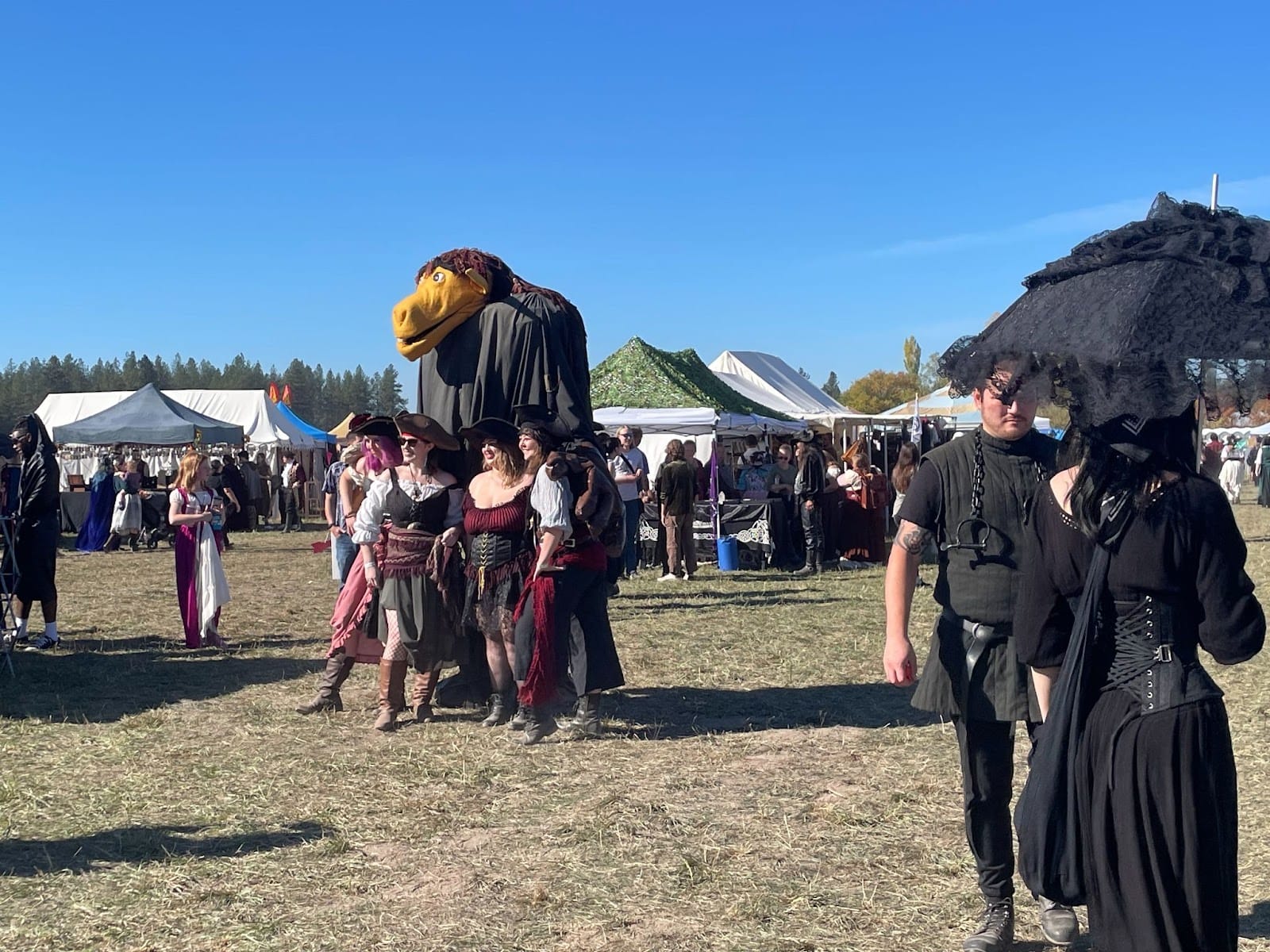
There were other anachronisms too. For every hand-painted wooden sign advertising tarot readings, a huge red and yellow banner protruded into the sky, proclaiming “ATM” or “Smoothies.”
And yet, despite the historical inaccuracies and the long lines to taunt the growing rumbling in my stomach, there was something mysterious and intoxicating about the renaissance faire experience that left me wondering, what is it that pulls together knights in shining armor, corseted fairies, barefoot tarot readers, sweating blacksmiths and folks in fur suits, year after year?
The craft of it all
At first glance, the draw of ren faires could look like a kind of physiological flight response. If the oppressing weight of capitalism and systemic injustice feels overwhelming, fleeing into the escapism of peasant skirts and corsetry, turkey legs and ginger mead, elf ears and swordplay feels like an easy out.
A few attendees said they liked the chance to dress up and slip into another world for a while. One woman told me she likes “any kind of thing where you can walk around and look at booths.” On my way home from the faire, I passed a car of people in long skirts who had pulled over and placed a phone on the hood of their car to video themselves running into the field and frolicking.
But others find much more than pure escapism. Some are attracted to the elements of historical reenactment, including Mickschl, who first stumbled into the world of ren faires through her membership in the Society for Creative Anachronisms, an international organization with over 50,000 members devoted to bringing the Middle Ages and Renaissance to life through research and re-enactment. Mickschl and other performers at the faire spend countless hours crafting their garb and even have standards of accuracy for the types and colors of fabric they can use.
Throughout the faire, there are a few live blacksmithing booths that, besides the bright red fire extinguishers displayed in front, demonstrate historical techniques for shaping horseshoes or sword blades. One tent showed off live birds of prey and a woman with a large leather glove explained the merits of falconry while a large hawk perched on her arm.
For these fairegoers, there is something to be found in the return to a careful practice of craft and creation, of making something with your own hands and showing others its beauty, of taking painstaking steps to build something to a rigorous standard of accuracy instead of purchasing a cheap imitation on Amazon. For the crafts people vending or performing at the event, it’s not just about experiencing this for themselves, but about sharing it with others.
“It's kind of addictive,” Mickschl said. “It's a lot of hard work to put on a faire, but the weekend that we get to come together, it just ends up being such a great time not only for the patrons, but for our people.”
“They provide their own costuming, they come to training, they learn historical facts, they love their characters, there’s a lot that goes into that. And so that weekend is when we get to play and perform for the audience and bring them into our world a little bit.”
Roll for performance
Across the dirt path separating two lines of booths, I met a mermaid.
Cat Kailani, or Mermaid Izira as she’s called at the Faire, is a local performer, and one of the leaders of the Spokane Merfolk Pod. She was resting on the edge of a pool when I approached her, having just finished conducting a mermaid sing-along with a group of children.
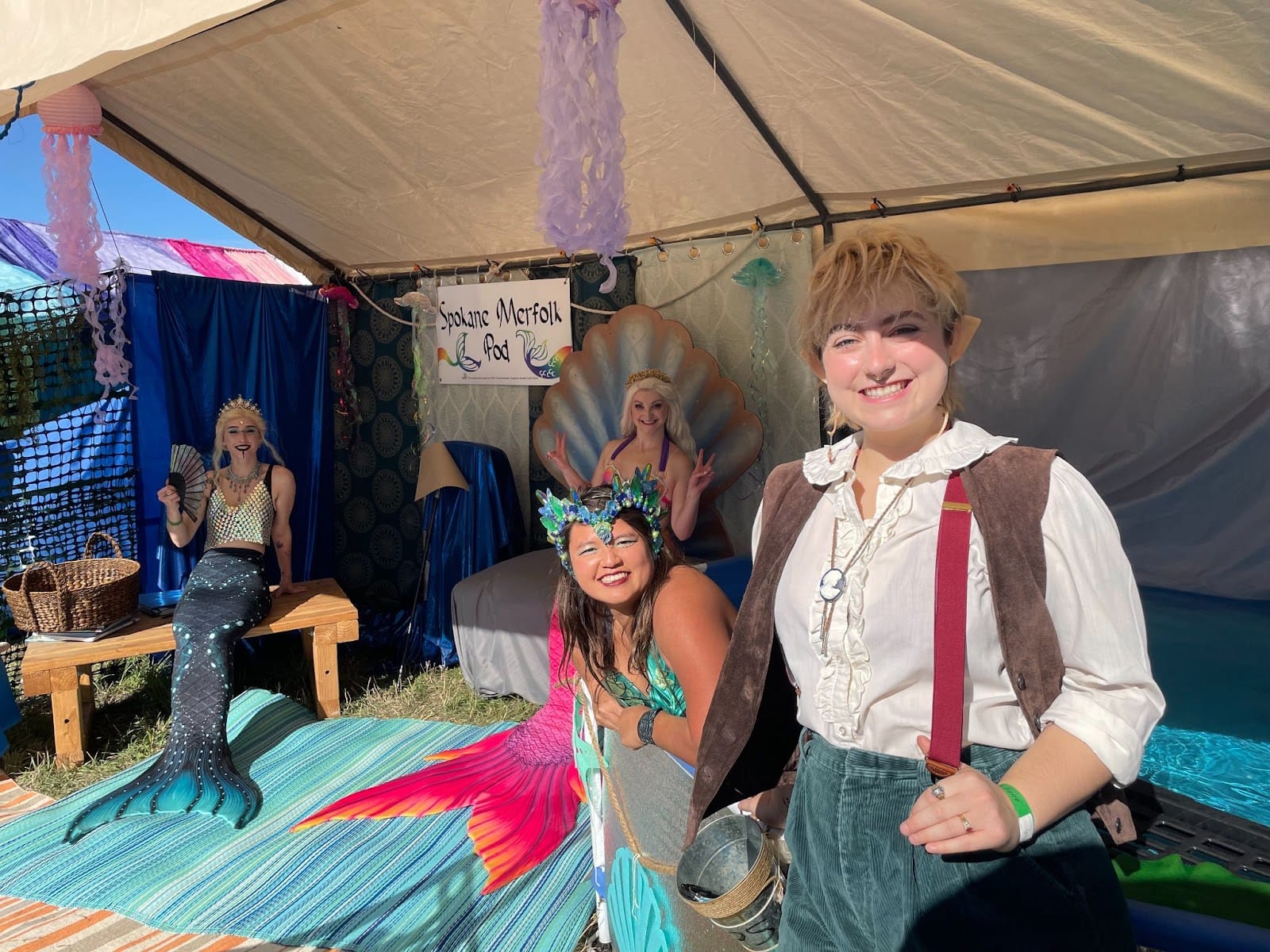
“We get to bring magic to people, seeing the smiles of kids and adults,” she said, when I asked about the draw of ren faire. “It's putting yourself into a different environment and just feeling really magical and just believing in some magic for the day.”
She also pointed to the inclusivity of the faire.
“There's definitely a lot of queer people in the community, like the majority of us. I think it's great. Because it's just accepting, everybody is accepting,” says Kailani (or Mermaid Izira today). “We're putting ourselves out there and being mermaids … And it's just really fun and everybody is really accepting and I love it.”
Kailani is far from the only queer person at the faire — I mean, I was there in hobbit-drag, going full Baggins.
And after the jousting, when I took a break in the mead garden to people-watch and listen to a group of performers sing tavern songs and make dirty jokes, I saw many queer couples holding hands. Some of them were dressed in matching outfits, like the mushroom fairies.
The week before the faire, I called Dr. Linda Tredennick, a professor in the English department at Gonzaga University who specializes in Renaissance Literature and teaches queer theory, to talk about the intersections of members of marginalized groups and fantasy media.
Tredennick mentioned ties between queerness and performance, with performance being used as a safety mechanism. Sometimes, though, that performativity manifests itself more joyfully, like renaissance faire attendance, Kailani’s mermaiding, or the Black ball culture that birthed modern drag shows and continues to be critically important to the queer community
“My ability to perform, my ability to pass, either to pass as straight or to pass as female or to pass as male, that’s a survival skill,” Tredennick said. “So I think there's a really natural sort of historical progression to role playing of all kinds, whether it's Renaissance faire or [Live Action Role-Playing (LARPing)].”
“The queer community has always had this tradition of, if you can’t be accepted for who you are, go flamboyant. We all recognize gender is performative, so let’s be the most performative,” Tredennick said.
This extends beyond the boundaries of the Spokane Renaissance Faire too. When looking at the resurgence of fantasy as a whole, Tredennick says the lack of rules in genre fiction leaves space for liberatory imagining of the future.
“Whether you're talking about something like Afrofuturism, where you simply reimagine the relationship between the past, the present and the future in a way that centers Africa instead of the Caucasian North, or fantasy and role playing games that allow queer people to experiment with new identities and new genders and try that out in a safe, welcoming community,” Tredennick says, “Real liberation requires a space where the existing roles of ideology don't apply.”
Tredennick also mentioned table-top role-play games (TTRPG), a community whose Venn Diagram with ren faire goers seems to look a lot like a circle, and, according to Mickschl, is at least partially responsible for the explosion in ren faire attendance.
Dungeons and Dragons (D&D) is probably the most well-known TTRPG, and despite a history skewed strongly towards white men, it’s recently become something of a safe haven for queer people. There’s not much available player demographic information online — although what is available does show an upward trend of women and younger players — but looking past my queer social circle riddled with D&D enthusiasts, I’ve seen a massive uptick in engagement with and social awareness of D&D, perhaps spurred in part by the game’s appearance in the hit Netflix show Stranger Things, the popular Twitch stream actual play show Critical Role, and the former CollegeHumour syndicate Dropout TV, which hosts another popular actual play show: Dimension 20.
Queer people flock to these sites of fantasy like moths to flame, and Tredennick thinks the answer could be found in that idea of performance.
“Some kind of role-playing gave people a safe space and a permission structure to try a different identity, whether that’s a different gender, a different gender performance, coming out as queer and an opportunity to sort of try our bits and pieces and see what felt good,” Tredennick said. “I read some really fascinating interviews with people saying, ‘I didn't know I was queer. I just set up a roleplaying character with someone of a different gender than mine and discovered it felt really good. I thought I was playing against type, and then I found out, no, this makes me happy.’”
I’d seen a few real-life examples of this, friends who had played “against type” at the D&D table, only to realize their fantasy play had more in common with their real life identity than they thought. One of more famous media examples of this is Ally Beardsley, one of the “Intrepid Heroes” of Dimension 20, who can be seen processing their own queerness and eventual transition over multiple seasons of the show as they went from playing a confused lesbian with religious trauma on a coming-out journey in season one, to trans man and chaos magician Pete the Plug by season three. Their identity and gender performance changed throughout the show too, as they underwent top surgery, took hormones and began to present more masculine, all part of their experience they shared with audience members.
“There's no one at the table who, when you pitch your character, is going to say, ‘But you don't look like that,’” said Beardsley, in an interview with DiceBreaker. “As I'm going through my own gender stuff, I wanted to play a more aspirational character - potentially future [me].”
As I pondered all of this over a bottle of locally brewed ginger mead, characters from The Princess Bride passed by, holding hands. I jokingly asked a group of giggling twenty-somethings in the garden with me if they’re looking for their Buttercup or Westley.
“Both,” one of them replied, as her friends nod in assent. We cheered and downed our cups of mead and sparkling purple pea flower “Mana Potion.”
All’s faire in love and family
In a tent stretched with brightly-colored, gauzy fabrics and littered with floor pillows, I met a queer, polyamorous couple who ran the booth together: one of them does tarot readings, the other sketches portraits. The tarot reader, Theo, is a self-described “recovering fundamentalist” who is reconnecting with her own Celtic spirituality. Theo is a ren faire regular, traveling what she called the ren faire circuit, which treks through the western states, but her partner, Aoife is newer to the scene having just returned to the states after teaching in Taiwan. Many of the other vendors at the Spokane faire do the same, which means they all know each other by name.
As Aoife, an illustrator by trade whose side hustle is illustrating digital comics, put the finishing touches on a portrait of me and my friend as fae creatures, a vendor from across the way came to talk to her. One of their fellow vendors has just left to go to the hospital because she’s having contractions that might be Braxton Hicks or might be labor. Theo chimed in. Her daughter, who is selling jewelry at the front of the booth, is also pregnant.
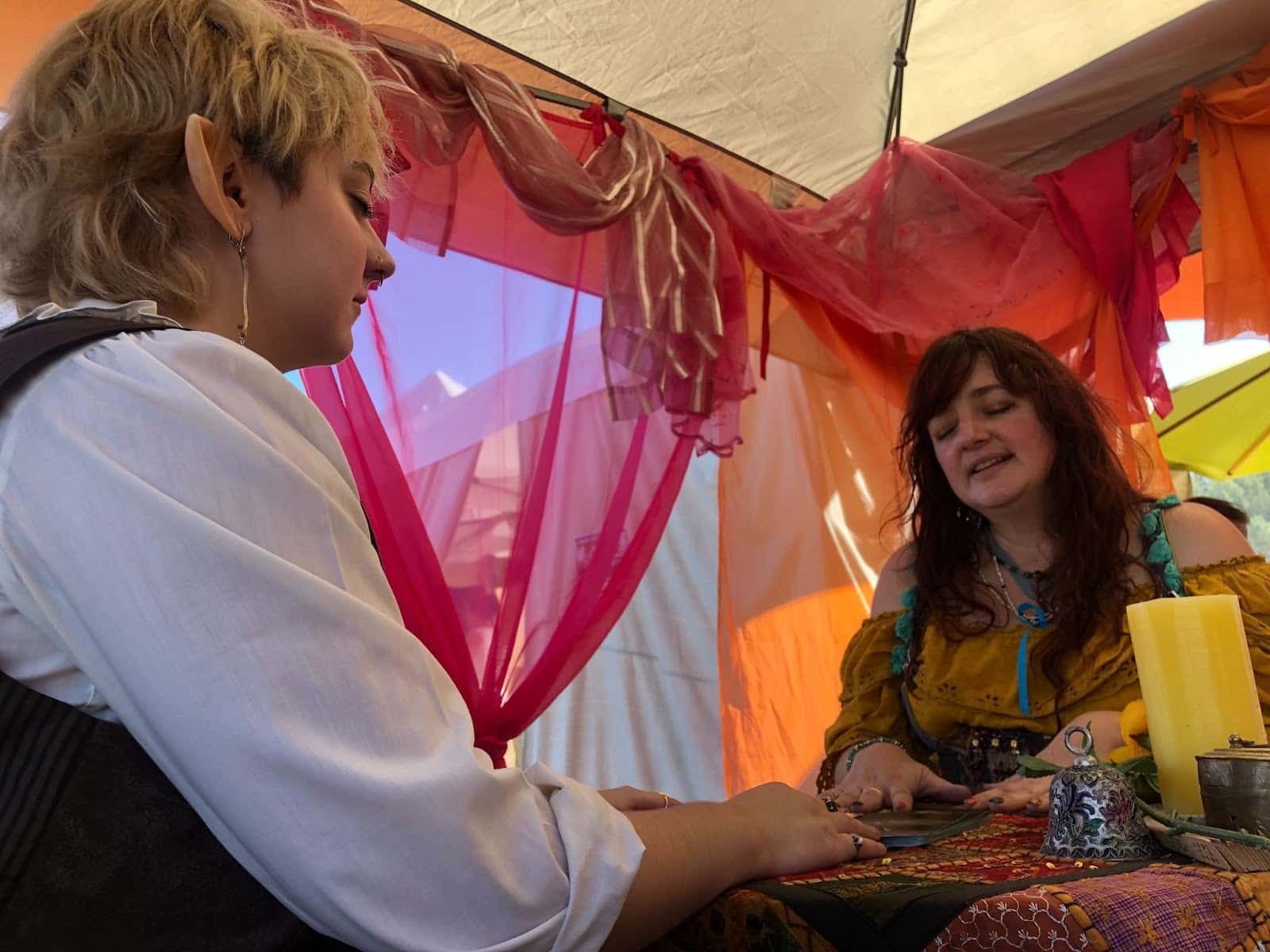
They quickly turned to other topics, like the vendor potluck following the end of the faire. The camaraderie they’ve built is obvious to anyone looking for it — some of these people see each other over and over again every summer, building a sort of traveling community. While this may have been the first faire for Malia, someone who likes dressing up and checking out booths, performers and attendees alike come back year after year, like Mickschl, who has been doing ren faires for over 20 years now, and Theo, whose mother started a renaissance faire in Boise, Idaho.
“It becomes a family. The whole Renaissance Faire, we call it our Faire Family. That can sometimes be a really safe and comforting space for people,” Mickschl said, and for her, that’s also literal — her husband created a jousting team that traveled the faire circuit until his retirement in 2019. “When it all comes together, it all comes together, and everybody just kind of falls in love.”
On a cursory glance, it could be easy to write off the popularity of Faire as a group of diehard fantasy enthusiasts committing to some kind of yearly nerd LARP. But as I interviewed folks at the faire and researched, I learned two things: the community here prides itself on inclusivity, and it’s only growing.
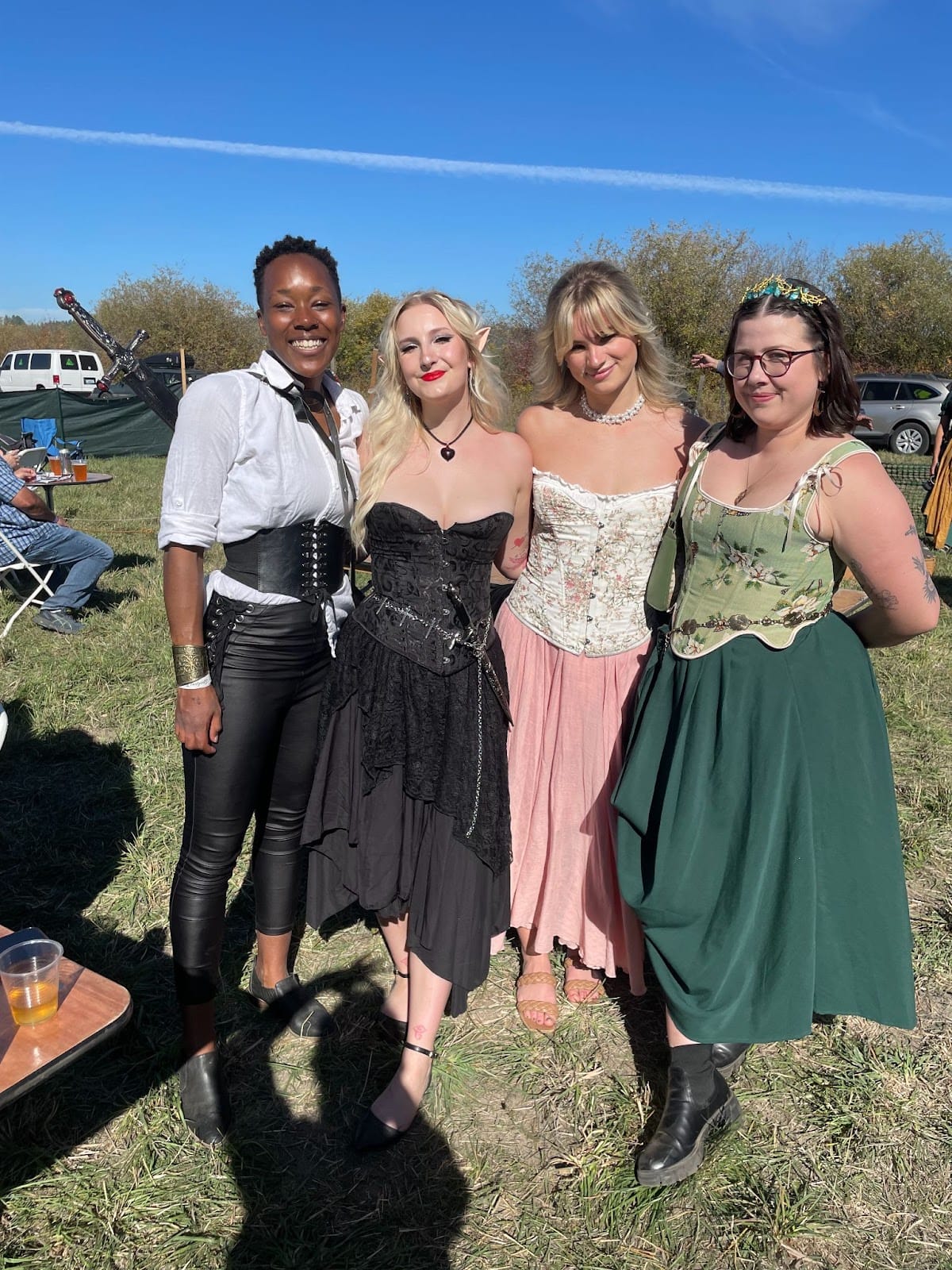
“I’ve never felt safer in a big environment of people,” said Shelby, another of the folks from the mead garden. She’s been to a few faires, drawn in by her love of all things medieval. She loves the community built around shared passion and the willingness of her fellow attendees to jump together into something the outside world sees as a bit nerdy. “You’re being cut bare when you do this. Everyone’s kind of vulnerable.”
“I love dressing up and getting into costume and character,” said Janae, one of Shelby’s friends, who has been wanting to check out a faire for a while. They cut a striking figure, a sword they borrowed strapped to their back. “It’s so inclusive. I don’t feel weird about how I dress or how I identify here.”
A liberatory fantasy
The Spokane Renaissance Faire does not stand alone in its resurgence; in fact, renaissance faires all over our region have jumped in popularity in the last few years. The Sandpoint Renaissance Faire doubled their attendance numbers from pre-pandemic faires with their reopening in 2022, and gained an additional 1,500 patrons this year. The Washington Midsummer Renaissance Faire was originally hosted in Bonney Lake, but grew so rapidly in recent years that they moved to a larger plot of land in Snohomish. A quick scan of social media analytics shows this boom isn’t just regional; #renfaire on Tiktok has 1.5 billion views. On Instagram, the same hashtag pulls 335,000 posts.
The popularity of faires seems to be part of a larger pattern that shows an increased engagement with media of the more fantastical persuasions.
Fantasy novels generated around $590.2 million of revenue, according to the publishing industry statistics website Words Rated, and saw a 45.3% jump in sales from 2020 to 2021, which was the largest increase among all genres aside from graphic novels.
Dungeons & Dragons (D&D), a table-top roleplay game that used to be culturally synonymous with nerdy white men hanging out in a basement, saw a 33% jump in sales in 2020, and is brushing elbows with mainstream popularity following an appearance in the hit Netflix show Stranger Things and the D&D branded film Honor Among Thieves grossing over $208 million in box office revenue. Wizards of the Coast, the creators of D&D, estimated the popular game has around 50 million players, and Twitch alone showed that audience members spent about 71.6 million hours watching content relating to the game.
Baldur’s Gate 3, a Larian Studios role-playing video game based on D&D, had players sink a combined 1,225 years of playtime into the game by the end of the second weekend of its launch.
The data is overwhelming — faires, and the genre of fantasy media as a whole, are having a post-COVID-19 boom. It’s certainly not the first time a renaissance has followed a plague.
There wasn’t a clear or decisive answer as to why in my extensive post-faire research. The call of the fantastical could be escapism. It could be found family. It could also be the draw of something that looks a little bit like liberation.
Though the world of the Middle Ages is one we perceive to be restrictive, and thus, maybe a bad setting for a renaissance faire that aspires to values of community and inclusivity, Tredennick, the Renaissance Lit professor, said it’s more complicated than that. She finds Renaissance Europe to be a fascinating setting for Spokane’s faire, because the realities of it were wildly different from common imaginings.
Because many men of working age had died off in the Black Plague, women joined the workforce at an enormous rate, primarily working as brewers. Scientific minds at the time thought heat at the moment of conception determined the sex characteristics of babies, so pamphlets showing men how to help their wives reach climax — and thus create a maximum amount of heat — circulated widely. Anti-Blackness and ideals about skin color being a visual symbol of good or evil were common, but at the time, race wasn’t conceptualized in the way it is now. Instead, religion, class and nationality served as the primary shapers of categorization and oppression. Gender, is, in the words of Tredennick, “if not exactly fluid, certainly not immutable.”
And if we’re talking history, it’s important to look at the not-so-humble beginnings of renaissance faires themselves — the 1963 Pleasure Faire in Los Angeles, California. The Faire was born out of McCarthyism, the brainchild of English and drama teacher Phyllis Patterson who had left public teaching in part because of California’s mandatory loyalty oath. According to the Smithsonian Magazine, many of the first faire’s volunteers were left-leaning creatives, some of whom had been blacklisted from the film industry for being labeled communists.
The values of the faire itself were radical. Patterson dreamed of creating a gathering place where people would celebrate harvest, buy, sell and trade goods, eat and drink, exchange news, dance and revel in artistic performances. The Pleasure Faire also had ties to independent media, and was a fundraiser for KPFK, a listener-supported radio station owned by the Pacifica Foundation. With a name like Pleasure Faire, it was nearly impossible to detach from images of the Free Love movement of the 1960s, but Patterson also wanted it to be inseparable from the educational elements of history and theatrical performances, and defended the Faire against conservative protestors who wanted it shut down. It was a celebration of artistry, a revelry of rulebreaking, a liberatory experience set bright against the stark landscape of the deathgrip of conservative values of an anti-Communist America.
The Spokane Faire thrusts this time period of Europe into conversation with the wild imaginations of the patrons and performers of the present, resulting in a world where two princesses can kiss in the mead garden, people of color can fight as honored knights of the realm, and a queer reporter dressed as Bilbo Baggins can interview them all about it.
And of course, the space isn’t perfect. The attendees and performers are still overwhelmingly white. Some wear dreadlocks, or have co-opted aesthetics from Indigenous or Romani cultures. One of the vendors is selling coffee out of a brightly painted vardo called “G*psy Java.”
Mickschl acknowledged the whiteness of their current cast, and said the Faire has goals to diversify the cast. The historian in her wants to see time-period accurate garb from all over the world on performers of different ethnic backgrounds. She hopes that despite the current lack of diversity, it can still be a welcoming space.
It’s also impossible to remove capitalism from the equation; there’s an entrance fee, the potential costs of purchasing food or craft from vendors, gas to drive to the venue. Even costuming can reach exorbitant prices, depending on the level of accuracy and imagination.
A poster on Reddit pointed out accessibility issues with the trek from parking lot to venue and difficulty finding water, and commenters on the ren faire’s Facebook page pointed out the lack of shade.
The Spokane Renaissance Faire had its imperfections, but as it grows and people continue to find community, magic and family amongst the sprawl of tents, it could also become a site of real liberation, where folks join together to imagine a future without the boundaries and restrictions of the past and present.


