

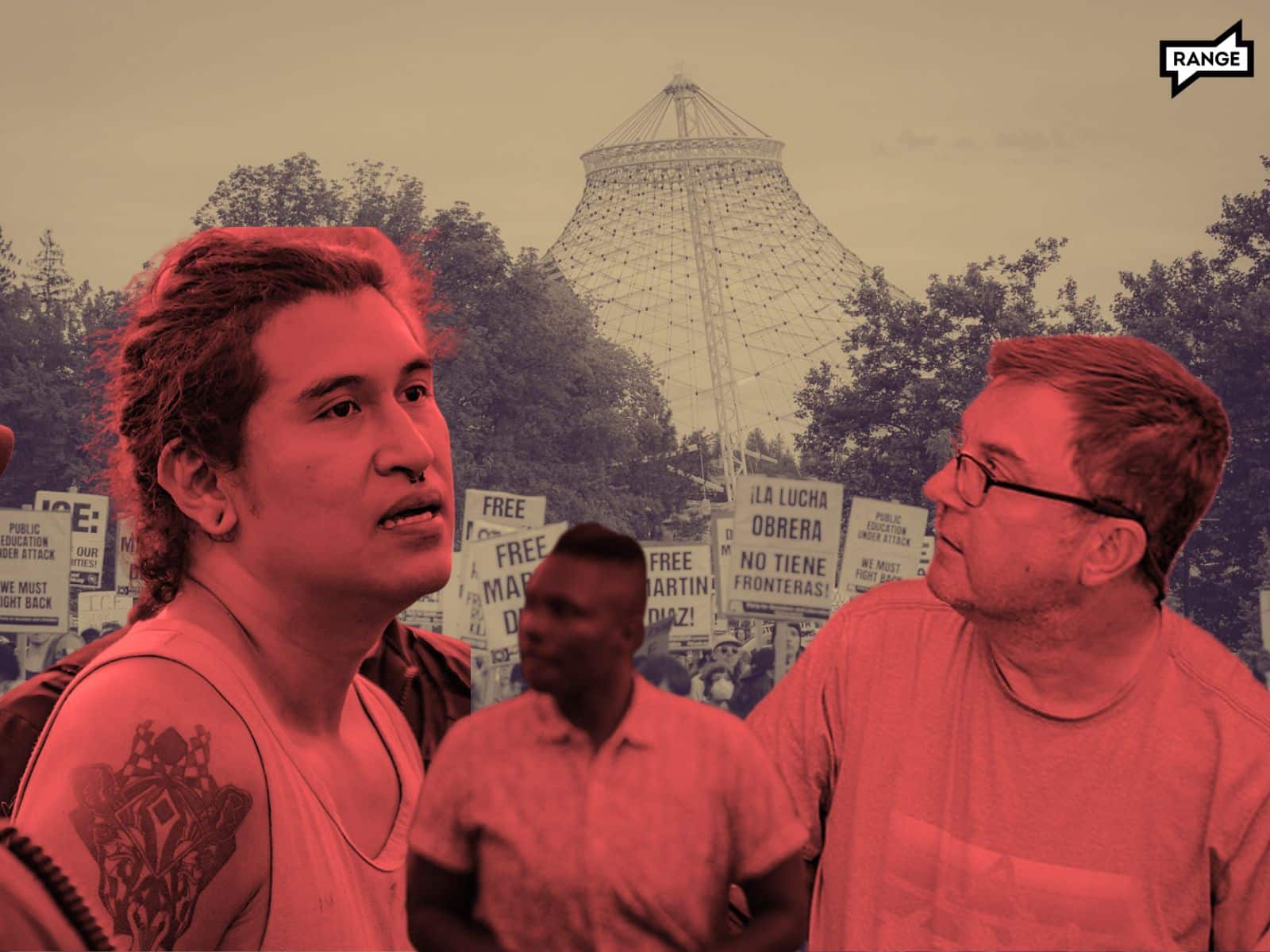
The use of force by law enforcement during the June 11 and 14 protests in Spokane has left our community with lots of questions regarding protesting and immigration rights: what recourse do people have to report excessive uses of force? How does it work when Kootenai County Sheriffs — who explicitly collaborate with Immigration and Customs Enforcement (ICE) — answer a call for aid from Spokane? Was the Keep WA Working Act violated on June 11 when police escorted the ICE van out? What the heck was that green gas law enforcement used?
We got the answers to some of those questions and more when Luke and Val sat down with Spokane Police Department Chief Kevin Hall earlier this month.
Listen to this full interview here.
A lot has changed since this interview, which happened on July 2. Most notably, nine protesters were arrested on the federal charges of conspiracy to impede or injure officers. Two of the nine were additionally charged with assault on a federal officer, employee, or person assisting a federal officer. All of the protesters have pleaded not guilty to the charges and have since been released on conditions such as not using or possessing marijuana.
Read more:
Everything we know about the Spokane ICE protests
Queer BIPOC organizer arrested on their way to Spokane Pride
Where are the protesters’ phones?
Justice Forral pleads not guilty to ‘unlawful imprisonment’ charges from ICE protests
How to take action against injustice today
Editor’s note: Pascal Bostic has lightly edited this written conversation for clarity and brevity. Listen to it in full here.
Luke: As you approach your one year anniversary as Spokane’s Police Chief, what did you enter the job hoping to accomplish and how do you evaluate the first 10 months?
Chief Hall: The 10 months went by very fast. I realized we were coming up on a year and I really needed to take a look at everything that we’ve accomplished and how we’re measuring what I would call “success.”
Going all the way back to establishing my own leadership team, all of my Assistant Chiefs were not in that position previously.
We’re in the process of hiring a Director of Crime Strategies – which is a PhD level, classically-trained criminologist – to be able to come in and evaluate the policy and programs we implement to ensure that we’re getting the impact that we want and that we’re not creating harm. It often gets missed when you want to measure both harm and benefit.
In law enforcement, we traditionally haven’t been very good at that. That’s why I thought it was important for that position to be created and filled. It was something I wanted to do when I first came in here, and it took this long. That’s just the bureaucratic drag of public government. With the exception of the Director of Crime Strategies position, my leadership team is pretty much in place.
We also can look at what has occurred historically and what we can do moving forward to create a better evidence-based, community-oriented policing model in Spokane. Making sure that what we’re doing has some sort of base in research and science is important to me.
There are things we didn’t do great traditionally in policing. I think we’re getting there nationally, but especially in Spokane as we start to change some of our processes and our programs.
Luke: When you talk about documenting and qualitatively or quantitatively measuring harm, what are some indicators of that? What things will you look at?
Chief Hall: One of the examples that comes to mind right away is hotspot policing. Almost four decades of research shows that it works, but there’s also a lot of research that shows that it’s done improperly. It also causes a great deal of harm to the community. We really have to be careful of racial profiling, indiscriminate stops, and just stopping everything that moves as opposed to being far more targeted and focused on what you're doing there.
We’re interested in crime drivers and micro hotspots. We’re not interested in just overall flooding the area with cops who stop everything that moves. That will create harm and quite frankly, affect public trust in what we’re doing. We need to be far more surgical in how we apply those kinds of programs. We need the legitimacy and the trust of that particular neighborhood that we’re in as well.
Luke: As it became clear that Trump was going to follow through on his campaign promises to unleash not just ICE, but a bulk of the federal government on immigration enforcement activities, how did your leadership team prepare? How did the wider department prepare knowing that law enforcement in Washington will be bound by the Keep Washington Working Act?
Chief Hall: It actually was pretty easy because of the Keep Washington Working Act. We’re bound to that state law, so there’s not a lot of change there.
What we had to address was the fear in the community, which was real and tangible.
Not just from folks that were here that were undocumented, but folks who were naturalized citizens, folks who were here on Visas, and folks who were here as asylum seekers. All of these folks who were here legally – at least in the previous administration – were all of a sudden in flux and they weren’t entirely sure how they stood. It was very shaky for them.
All the fear we received from the community groups that we work with throughout the region was real. From the beginning, from January on.
We did a lot of outreach to try and let everybody know that we’re bound by the Keep Washington Working Act, we’re going to continue to be bound by that, and that we have zero engagement with ICE and Border Patrol.
In fact, I have yet to meet any of the ICE or Border Patrol agents that are in town. I talked to them on the phone on June 11th, but I have never physically met with them. We don’t get notified if they’re going to do an operation or go out and arrest somebody. They don't tell us.
There was an odd comment that came out of Seattle that they weren’t going to share that information with us anymore – both Seattle and Spokane – because of media leaks. We were a little confused about that because we’ve never had that contact with them. They’ve never, at any point in time, let us know that they’re doing anything in the community.
Luke: So they’re not talking to any cop at all?
Chief Hall: No. They operate completely independently.
Luke: Tucson wasn’t the first sanctuary city, but it did kind of birth the modern faith-based sanctuary movement in the 1980s. Did anything from your time in Tucson inform your approach and how you’ve interfaced with immigrant communities?
Chief Hall: There were a lot of face-to-face meetings and a lot of trust-building. That was always tenuous and probably always will be. There’s so much historical trauma for a lot of these different populations in public government in general, but in the federal government overall. It’s just constant, ongoing relationship-building and trust-building. Things happen to erode that immediately and you have to start all over again, right? That’s what we did in Tucson. I worked very closely with both refugee resettlement groups and a large asylum seeking population there.
We had to set up centers. At one point in time – I’m not casting shade on Border Patrol – but their detainment facilities were so full. They’d do what we call “street drop-offs.” They would just drop off busloads of these folks on street corners. It’s not a rescue operation, but basically I had my cops go out and buy crates of water. They would sit with these folks to make sure that they weren’t exploited or victimized, and had water and shelter. For the most part, they were being transported to or wanted to go to other places in the country.
Tucson was sort of a distribution point for them, which started several years ago during the first Trump administration. Pima County and Tucson City built a pretty impressive system with brick and mortar facilities to house these folks. There were literally hundreds. They had “travel agents” for these folks, getting them plane tickets and bus tickets to all the different places in the country they wanted to go. That was my background. Working in that space, setting all of that up and being a part of that was all based on what I call “compassionate policing.”
These were vulnerable, marginalized folks who – for the most part – didn’t speak the language in a foreign country. No friends in Tucson, no family in Tucson. They needed a lot of help.
Luke: Whether or not they had entered the country illegally, you’re not in charge of federal jurisdiction. They had just been dropped off on the street corner and hadn’t committed any crimes in Tucson that would’ve been under your jurisdiction.
Chief Hall: Exactly. Because quite frankly, in my 32 and a half years in Tucson, foreign nationals were not the crime problem. They were not the drivers of crime. I was a homicide sergeant for five years there and supervised the investigation of over 300 homicides. One time the offender was a foreign national.
Tucson is 60 miles from the international border. There is a huge Hispanic population or Latino population. It’s very much ingrained in the culture there. It’s just who Tucson is. So it’s a little different than Spokane, but I still believe in the compassionate policing model. These are still Spokane residents, whether they’re here legally, illegally, or on a visa. Whatever it may be, they're living here. They have the same constitutional rights as everybody else.
Val: On June 11th, we had our biggest civil unrest since 2020 and it wasn’t planned. When you were watching the demonstration grow, at what point did you say, “we need to send in SPD?”
Chief Hall: What a lot of folks don’t realize is that we were watching this almost from the beginning. We immediately heard about it. We put eyes on it, and then the phone calls started. Phone calls from the folks inside the building, the ICE agents inside the building, phone calls from the agent in charge in Seattle. Phone calls from the Sheriff, who was also getting phone calls. It very rapidly became something that we couldn't just let simmer and ignore, right? But at the same time, we had some valid questions about the Keep Washington Working Act and what does our participation in this event look like? Am I placing my officers at risk by taking action here?
We eventually contacted the State Attorney General’s office and spoke to them. We worked through the problem and came up with different contingencies.
The point where we finally decided to act – I think it was three hours or more in – where we had been watching this, we began to see a conduct that was unlawful. And this is a conversation I’ve had with many of the participants there. I don’t want to get too far off, but I think it’s important to say that they [protesters] kept saying, “it was peaceful.” I have to point out it was peaceful where you were at, but around the corner, it wasn’t so peaceful. Peaceful doesn’t mean lawful. We have to strike a balance of what’s lawful, unlawful, and peaceful.
Luke: For clarity, are you saying you can act “nonviolently” and still be breaking the law with something like obstructing a street? When you’re defining peace, you’re thinking about levels of violence.
Chief Hall: Exactly.
One of the examples I’ve used is that you can peacefully go up on I-90 and sit down in the middle lane of traffic and protest. That is peaceful. It’s not lawful and it’s not safe.
I have to balance all of that. I have 20 plus people inside this building who say they are not free to leave and they want out. There were a lot of phone calls with the agent in charge inside the building. There were a lot of questions like, “Can you stay there for the night?”
And it was, “No, we can't stay there for the night. We don't have the facilities, we don't have food, we don't have any of that.”
I asked, “Is it possible to release these folks that they want released?”
They said, “No, we're not gonna release them.”
These are all scenarios we were going back and forth on as we're watching this grow. We know another 300 to 400 people are going to start arriving at the Red Wagon. That’s a very short distance and we already pretty much guessed they were going to join them. And that was the question: is this an option that these folks can be let go? And the answer was “no.”
Val: Did they give any reasoning of why they couldn't let the men go?
Chief Hall: No.
Luke: At one point, ICE agents came out and pushed through the crowd. I’m not asking you to do the judge’s job of figuring out if people were actually unlawfully imprisoning/detaining somebody, but they could get out. They weren't actually being forcibly detained in the way that you would think.
Chief Hall: I don't want to go too in depth. These are all open investigations and I don’t want to speculate on people’s cases, but it was the perception of the agents inside the building that they couldn't leave and weren’t being allowed to leave.
Luke: So then the conversation you're having rises to the level of helping them leave the situation?
Chief Hall: Yeah. At some point it became, this isn't going away. It's actually growing. More and more people are coming. They are vandalizing the transportation, the bus, and the van which they needed to transport these folks. So then it was, well, now we don't have any way to get these people out of here. I think at one point they went out to get their cars and the gate was blocked by folks, and that's where that altercation took place. I had to balance, how are we going to do this if I don't take action? Who is right? Are the ICE agents going to take action? I didn't want that to occur. Are other folks gonna be called in? Federal, National Guard, whatever. And I didn't want that to happen either. This is my community and we're responsible for the safety of everybody in it. So, I felt that I had no choice but to act in addressing the situation as it unfolded.
Luke: Under your leadership, what is SPD’s objective when a protest rises to the level of needing to intervene? What is the objective you try to communicate to officers from your perspective as Chief?
Chief Hall: To do it as safely as possible and then to ensure that everybody is protected. That means the community, the people who are demonstrating, and the officers. So doing this in a way that everybody is safe. Protecting First Amendment rights is what we're trying to do here.
When those rights become clouded with unlawful behavior, we have to start making some of those tough decisions and drawing the line. We can be really tolerant. Like following the protests where we basically allowed them to block city streets for hours. It really didn't impact a whole bunch of people. It did impact some business down there, and believe me, I heard from them. But at the same time, if it's safe and it's still protecting people's First Amendment rights, then I'm willing to take that for the good of the community.
But it's always going to be a balance, and it's always going to be, what's safe? What constitutional rights are being protected? Are we reaching it's not as safe as it should be?
Luke: Under your tenure, has SPD substantively changed standard operating procedures for protests?
Chief Hall: To some degree.
We brought in what we call “dialogue policing.” With the exception of Europe and a few places in the States, this hasn’t happened before. You’re embedding uniformed police officers – not undercover officers – into these crowds at these protests. They’re there to create dialogue, to have a chat, and get the vibe of the crowd. It starts before the protest even begins. They contact the organizers and they say, Hey, we're gonna be there. We'd like to help facilitate this and make sure it's safe for everybody.
I have a lot of faith in that model and I think it's going to be how policing and protests occur in the nation’s future. It's had a lot of success in Europe, where it's been done for the past 20 years. I think the biggest substantive change you will see is that we're putting more and more officers on the front end to talk and mingle with the crowd, and to let them know the officers are there to help.
They have helped in many instances. At a previous protest where we first started doing this, an armed individual showed up. It was very concerning to the organizers. The organizers reached out to our folks and we asked, have you asked him to leave? And they said no. They went over and asked the guy to leave, and he left. That kind of facilitation and partnership will prove to be very beneficial for the community.
As far as use of force, I don’t know about any substantial changes. I can't compare it to what happened before since I wasn't here.
I can tell you my philosophy on it is “the least amount necessary.”
We don't want to use chemical agents if we don't have to. And we want to use the least intrusive chemical agent if we have to use a chemical agent. So it's always going to be “the least amount necessary” to achieve the objective. Things like CS gas are very indiscriminate.
Once we throw it, it's in the air and it's going to go in all kinds of different places. It wasn’t a consideration on June 11th because we were very aware of a soccer game. Once we threw CS, it was going to go wherever and we were not going to do that with a crowd of families nearby.
Val: We have unidentifiable masked men driving around without names or badges. It’s really hard to tell. Does it help or hinder local law enforcement to have masked agents running around doing this, legitimate or not?
Chief Hall: My officers will not wear masks. They will not.
There is a legitimate fear about unidentified men – who are armed and masked – grabbing folks and pulling them into unmarked vehicles. I fully understand that fear. What I don't think is conveyed enough is how limited I am in being able to control that by federal agents.
I think we’ve seen a couple of incidents across the country where people were posing as ICE for whatever reason and that's something we will certainly address.
LAPD came out with some new guidelines and directions for their officers on how to engage with ICE operations or perceived ICE operations. 9-1-1 is getting calls.
I'm going to copy a lot of what they did and give that direction to my officers. You're simply peacekeepers. You're there. You preserve the peace, you make sure the identity of the federal agents is who they are, and you're strictly there to preserve the peace and make sure nobody gets hurt.
We can’t interfere with federal law enforcement officers, whether we believe what they're doing is right, wrong, legal, or illegal.
Luke: If someone witnesses a masked man taking somebody off the streets, what should they do?
Chief Hall: Call 9-1-1.
That’s the direction I gave to a lot of these community groups that we met with. Call 9-1-1 if you don’t know what’s happening.
And here's the biggest fear: what if that's an off-duty officer who's witnessing that? What if it was me? I'm going to take police action against that person. In fact, I'm sure all of my officers would. They're looking at an abduction right in front of them. They're going to take police action.
That’s enormously dangerous for the agents as well as for everybody around them. And, if this continues as, as it seems it will, there will be people who will take advantage of that ambiguity and, like you said, kit up and, and do what people do sometimes when they behave very badly.
Val: On June 11th, our reporting team witnessed some Spokane Police vehicles escorting the red van ICE used into the ICE facility. Is that considered aiding ICE? And how is it not a violation of the Keep Washington Working Act?
Chief Hall: That was in order to get the people out because the bus they were going to use was disabled, and then the red van was very quickly disabled as well. The entire goal was to get the people out of the building. All people – agents, detainees, and whoever was in the building.
Unfortunately, what we ended up doing is using our armored vehicles to do that. It was – rightfully so – a little triggering to the folks to see armored vehicles there. But it was the only thing that we had big enough to get those folks into besides another passenger van. It was just the logistics of the situation.
Val: On June 11, a protester was repeatedly slammed into the ground while complying with an officer. On June 14, we saw a protester getting arrested despite following police orders to disperse into the park. What’s the goal of giving orders at these things if people are still going to get arrested or have excessive force used on them, no matter what?
Chief Hall: I can speak generally and not to either of those incidents because I don’t know them, but if whoever witnessed that or the individuals who are involved feel like they were treated unfairly or excessively, I would really urge them to either come to our internal affairs office or the police ombuds office. But in a very general sense, the order to disperse is given after criminal conduct has been observed. And it is deemed safer to disrupt the crowd and have them move on as opposed to keeping them there. In a very general sense, that's the objective.
Val: I know the June 14 protest was kind of never-ending and I can totally see how your officers were trying to stop people from blocking the streets. But it was really confusing when officers were saying “disperse to the park” and started throwing the chemical munitions and/or pepper balls. People were running to the park. What do people do in that situation? Do they just run away? Because in one case, a protester was in the park being chased by an officer. They knelt down and just surrendered, but it sounds like they're getting charged with failure to disperse. They did do the dispersing technically, so that's why I'm confused. How do people follow orders and stay safe?
Chief Hall: That's a fair point. Maybe we need to be more clear about where they need to disperse to or give them an area or a measurement, whatever makes sense to people. There were also people who were not dispersing. I can guarantee you that those people were the primary focus of the officers. And quite frankly, there were people who never did disperse and we just left. That could be a valid tactic. A lot of times they're there because we're there and if we leave, then what's the point?
I don't want to gloss over this point. It’s a fair point. If people were complying and were arrested while they were complying, then that's something we need to address. If those folks are willing to come forward, we can sort of explore what happened and how that went that way.
Luke: At the press conference, you said there weren't any less lethal rounds used. Later, you wrote a letter saying, “actually, that was our mistake. We misunderstood the information.” You took responsibility for that and I wanted to give you credit for that, for sure. How did you realize that force had been used? Was it after action reports? Was it munitions inventories? How did you figure it out?
Chief Hall: It was after action reports.
That was a communication issue on our part that has since been fixed. But in both of these incidents, I was there. I was in the CP and ultimately it all falls on my shoulders. I have no intention of trying to mislead the community.
It was just a lack of information I had at the time. I think we fixed that. That won't happen again. On the following Saturday, I knew immediately and was told immediately.
Val: I’m the Managing Editor at RANGE, so I'm in charge of sending people out to these things and I understand the idea of being responsible for your people. I'm very concerned about my reporters' safety on the ground at these things. At the June 11 protest, my reporter was actually shoved and assaulted by a federal agent or officer even though they were out of the way and they were identifying themselves as press, it's captured on video from multiple angles. Is there any legal recourse for my reporter to press charges against this officer? Or is there any legal recourse for protesters who were assaulted by federal agents? Because it sounds like federal agents are really just able to come into your jurisdiction and commit crimes with no consequences.
Chief Hall: They can do the same thing they would do with SPD. If they felt they were treated unfairly by SPD or if SPD – in their view – had conducted a criminal act against them, they can file a complaint with that agency. If it's a federal agency, they can go to the US Attorney General's Office. They can also go to the police Ombuds, who will help facilitate those contacts. They can't do an investigation, though. They won't forward it to SPD, but they can help facilitate that.
Val: Even though it's a crime and they're doing it in the line of duty, you’re not able to bring charges against a federal officer?
Chief Hall: That's not technically true. We could do a criminal investigation. In this particular case, we would probably defer that to the Sheriff's department.
Val: And the sheriff's department would have leniency to do what they want with that?
Chief Hall: They would have the discretion that all law enforcement has.
Val: Is there a reason why you would defer to the Sheriff's department?
Chief Hall: They took over all of the investigations in this case because of potential conflict of interest.
Luke: We’ve now had two pretty big protests under your tenure less than a week apart. One required a relatively heavy presence and one that – to your point – was a much bigger protest at No Kings that seemed to require less of a response from SPD. What lessons have you, the department, and department leadership learned from these protests? How might it impact the way you guys respond next time?
Chief Hall: The biggest lesson we learned is that we need to continue the communication, which didn't happen on June 11. We had no idea that was occurring. There was no pre-planning. We didn't have the dialogue officers in place. None of that occurred, and all of our other demonstrations in Spokane have had that component and they've all gone off very, very well.
We have to figure out a way to be more adaptable and flexible with spontaneous demonstrations. With that staff, those personnel, it’s a specialty. You need good communicators to do this work and they need to feel comfortable in a crowd.
We need to do that better. One of the things I've been trying to instill for all of my staff – all the way down to the newest patrol officer, all the way up to myself – is we're going to learn from everything we do. Even if we think we did something flawlessly, we're still going to examine it and say, “how do we do it even better next time?”
What exactly do you want us to do when this or that happens? And it has to go both ways. It's not just us talking to protestors and telling them how to behave. It's also protestors saying, well, here's what we want to do. It has to be a back and forth.
There needs to be some mutual respect for what we're trying to do here and what we're trying to do in the end is protect first amendment rights. That’s the oath that all officers across the United States take, is to the Constitution.
We have to have those communications. We have to give expectations to the protestors and then listen to their expectations and what they wanna accomplish. We, as police officers, never want to be the story. If we're the story, in my mind, we failed.
It has to be the demonstration, the protesters. It has to be their story and the message they want to tell. And if police are never mentioned, that's our success.
We have to learn from everything we do.
Luke: Is there anything else you want to mention?
Chief Hall: Like I said, I'm certainly listening to criticisms. We're not always going to do things perfectly and I will own it.
We’ll learn from it. If I don't hear about it, how can I fix it? I think officers hear a lot of complaints and they just get defensive and they're like, “okay, I don't want to hear it anymore.”
I understand that, and I'm sensitive to it. But I, in my position, need to hear everything. If we can get to a place where this is the premier law enforcement agency in the region, if not the state, and we can have that relationship with our community, that’s truly a partnership. Demonstrators and police working together to make sure that everybody's safe and their message is heard.
Luke: And that's your ambition? To be the law enforcement agency that everybody in Washington state looks to?
Chief Hall: It’s not really my ambition.
I would hope that organically happens as we do things here that aren’t exactly “conventional” or “traditional” as we try to push policing into the 21st century in a more positive way.
I went through 15 straight days of riots, not riots, protests in 2020. It was taxing, to say the least. But what I discovered there, and I believe this is for the most part, is that the majority of people just want better policing. That's all they're asking for. In the interest of customer service, why don't we work towards doing that?


