

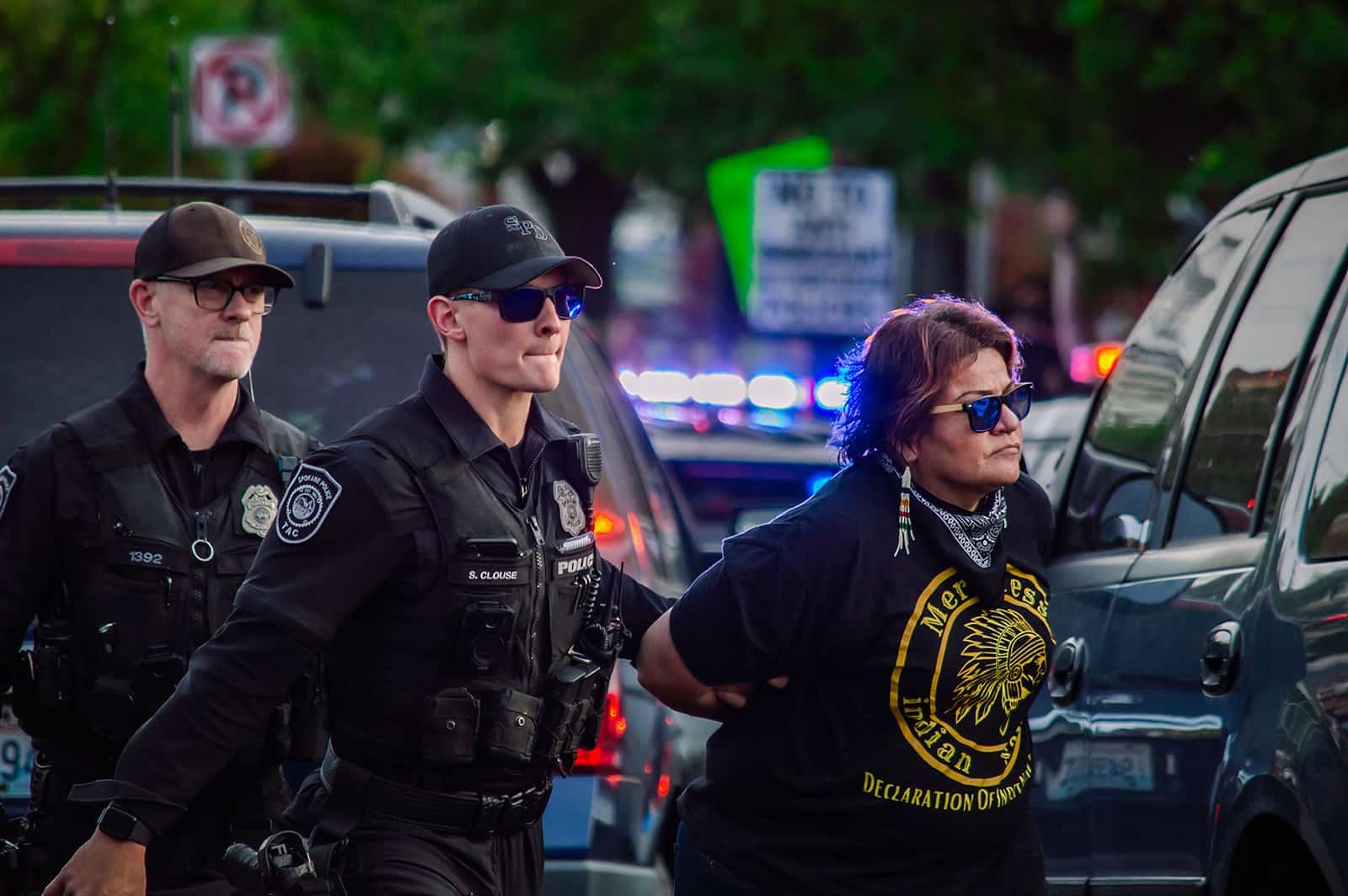
Tatyana Lopez Strauss had never been to a protest before, but she came to the No Kings march in Spokane on June 14, partly to make her voice heard and partly to hand demonstrators water and, if necessary, gas masks. Lopez Strauss is a former medical assistant and said she wanted to help people.
She did not at first think she’d be arrested, but after bicycle cops drove her and a throng of protesters into Riverfront Park and then chased them down, she felt she wasn’t going to escape.
So, having followed the police orders to leave the street, she turned to face the cops, knelt in the median between the park and Spokane Falls Boulevard and put her hands up in a show of peace. If they were going to take her, it wouldn’t be her fault.
“ I was like, we're here on the park, and you're still telling us this isn't enough,” Lopez Strauss told RANGE. “We've followed your rules. What else are we supposed to do? I was like, you know what? Fuck it. This is where I take my stand. ... I was peaceful. I want to set that example because if they have no reason to hurt us, I don't want to give them that reason.”
They arrested her anyway, along with two other protesters who knelt at her side. Eight others were arrested at other locations in the park and along the street.
The police took Lopez Strauss’s wallet and cell phone and almost everything else she and her fellow protesters carried, which is standard when people are arrested. But by the morning of June 18 — four and a half days after she’d been detained — she’d not been able to access her belongings.
Lopez Strauss is among dozens of demonstrators arrested at two protests over the last week and a half. The first protest took place June 11 when hundreds of Spokanites appeared outside the Immigration and Customs Enforcement (ICE) facility on Cataldo Avenue. They demanded the agency release a pair of detained immigrants who were here legally before the city declared the peaceful protest an unlawful assembly and police arrested 31 people. Some also physically blocked ICE agents from leaving the facility with the immigrants. At Saturday’s No Kings march, part of a national protest that saw millions of demonstrators across the country oppose an array of policies being set by the administration of US President Donald Trump, police arrested 11 people, including Lopez Strauss.
In total, police arrested 42 people between Wednesday and Saturday for “failure to disperse” and two for “unlawful imprisonment” from the demonstrations. Some people who were arrested had left their phones in their car or at home or handed them to friends before they were handcuffed. But many others had their phones confiscated. It wasn’t until at least Wednesday, a full week after the first protest, that phones started being released.
Who has the phones?
Between Monday and Wednesday of this week, RANGE spoke with more than a dozen protesters whose phones were seized; they each said some version of I don’t know where it is or when I’ll get it back. Most spoke on condition of anonymity because they feared that speaking publicly about their phones could hamper their legal cases stemming from the mass arrests.
Two protesters arrested at the Wednesday night demonstration told RANGE that when they contacted the Spokane Regional Evidence Storage Facility (RESF), the custodian told them their phones were being held by the Federal Bureau of Investigation (FBI). When they were released, they were told to call an FBI hotline to retrieve their phones. They both said the number went to voicemail. RANGE also called the number and got the same result.
RANGE visited the Spokane FBI field office for comment and was referred to an email media contact in Seattle. That account did not respond to questions by the time of publication.
The Spokane Police Department (SPD) declined to give any information about whether it had turned phones over to the FBI.
“SPD, as a law enforcement agency, has standard obligations to cooperate with other law enforcement agencies,” SPD spokesperson Daniel Strassenberg wrote in an email. “Any questions regarding FBI involvement should be directed to that agency as we have no information regarding their activities.”
Jeffry Finer, a long-time Spokane criminal defense attorney, told RANGE it was conceivable the police handed some of the phones to the FBI. He said everyone should get their property back, but it would take a long time.
One of the protesters who said his phone was with the FBI, Shaun Donnelly, said he visited the Spokane field office on June 18, where an agent gave him more information.
Donnelly told RANGE, “they made it to the part in their process where they know which devices will not be needed for their ongoing investigation and those will now be returned to the police property building,” where protesters could pick them up.
“I was assured that our devices were not searched and that to do so would require a warrant. I was left with the strong impression that a few devices will be subject to a search warrant and the feds are building a case against one or more of the people arrested on [June] 11,” Donnelly said.
“ Any phone that doesn't have contraband on it or evidence of a crime is gonna be returned,” Finer told RANGE. “If the phone has contraband, which for the feds would be a picture of marijuana or child pornography … those phones are gonna be withheld, and the cases would get worked. I think the likelihood of that is probably close to zero, but it's there.”
RANGE does not know the methodology the FBI used to determine which phones to release and which to hold because they did not respond to a request for comment.
For protesters, a week of limbo
Some whose phones were confiscated are artists, some local business owners, some activists, many of whom rely on their phones to make ends meet. Some work in the gig economy, delivering food or giving rides, which is impossible without a smart phone.
RANGE encountered Lopez Strauss at the RESF where she tried to retrieve her phone for the second time. The chain of custody manager at the front desk told her he should have the phone later the same day and to come back.
Strassenberg told RANGE the department “seizes property within the confines of the law and rules of evidence daily. The property is released as soon as possible out of respect for the property owners.” He added the phones would all be returned “once they are no longer deemed of evidentiary value through the investigative process. This is done as expeditiously as possible.”
Finer noted that having a cell phone confiscated for days is extremely impactful for people living in a society that largely organizes itself on the internet.
At least until June 18, Lopez Strauss couldn't communicate or buy food. Her husband is a Marine who’s stationed in another state, meaning that, at least until June 18, she had to fend for herself without her phone or money.
At a court hearing on June 18 several hours after she’d visited the RESF, Lopez Strauss told a fellow arrestee she’d gotten word the facility now had the phones and would start releasing them. The facility, located deep in the warehouse parks on Alki Avenue east of town, is only open Monday, Wednesday and Friday.
RANGE called RESF the morning of June 20, and the custodian who answered said some of the phones had been retrieved by their owners. The person, who would not tell RANGE their name because they were not authorized to speak to the media, was not immediately sure how many phones were released and how many were still in custody.
Strassenberg did not respond to a Friday morning email asking for that information by press time. We will update this story if he does.
Justice Forral, an organizer with Spokane Community Against Racism, was arrested on seven counts of unlawful imprisonment and two misdemeanor failure to disperse charges. Their phone was also confiscated, they said, along with their car and ID.
They were later released without bail after an initial court date but they were arrested a second time as they made their way to the Pride festivities in Riverfront Park Saturday on a new allegation that Forral had assaulted a sheriff deputy. Forral said their wrists were still in pain from a too-tight handcuffing. Forral asserted that SPD held the phones this long not for legitimate investigation but to further punish the protesters.
“They’re just so petty,” Forral said.
“Any allegation that property is seized for punitive measures, in this case, or any other, is patently false,” Strassenberg wrote when RANGE asked about Forral’s allegation.


