


Early in the morning in a conference room in the John A. Cherberg building on the Capitol campus in Olympia, Martina Morris and Jim Leighty began to strategize for their meetings with legislators.
Morris, a former professor of statistics and sociology at the University of Washington, was testing arguments against parts of a bill introduced in the legislature that would reform a police training organization created in 1974.
“Their best argument for that bill is, ‘We just want balance,’ and that sounds so reasonable to most people,” Morris said. “I was racking my brain yesterday, and I tried to think: ‘What’s a good argument against that?’ So let me try one out on you and see what you think.”
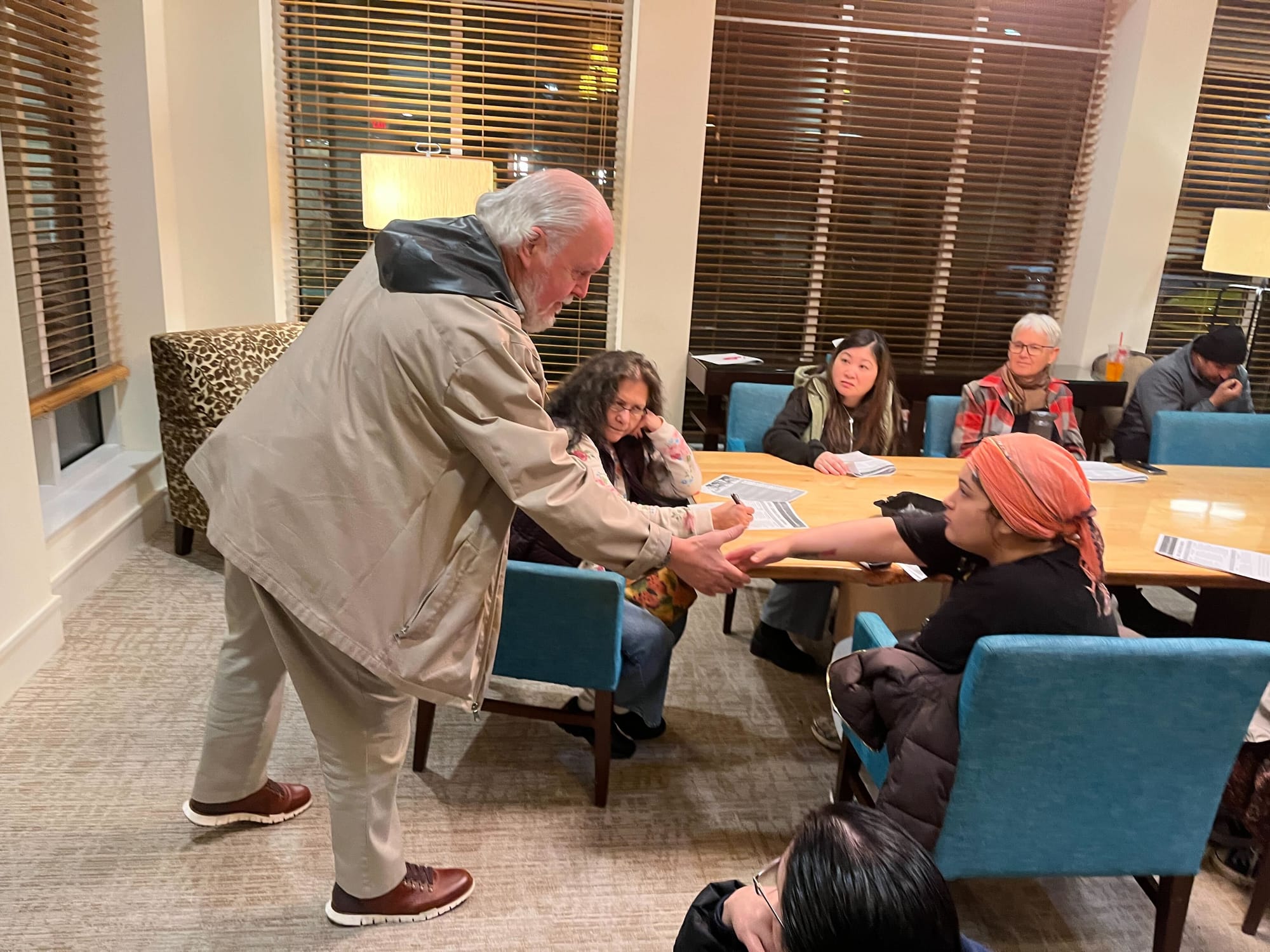
It was Martin Luther King, Jr. Day, and Leighty — who lives in Spokane — and Morris were in Olympia for an “advocacy day,” during which they’d seek lawmaker support for the Washington Coalition for Police Accountability’s (WCPA) legislative agenda. They were joined by about 10 other activists from around the state and the WCPA’s lobbyist Paul Benz. Much of their agenda is embodied in a slate of bills that would impose new restrictions on police.
But this day, killing House Bill 2220 was front of mind.
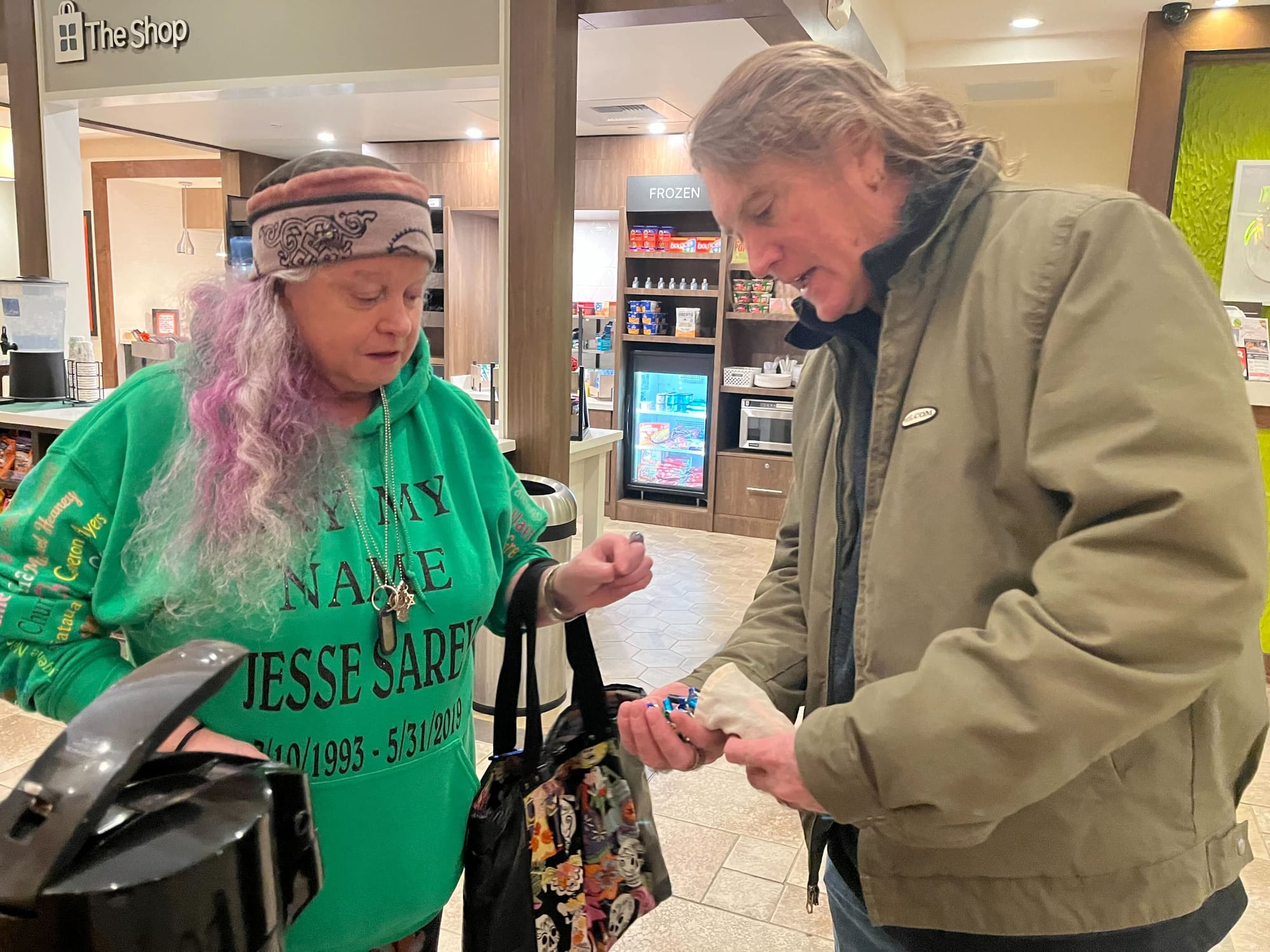
So in meetings with a dozen Democrats in the state Senate and the House of Representatives, the activists introduced themselves: Marilyn Covarrubias, whose son Daniel Covarrubias was gunned down by Lakewood police as he fled in a lumberyard woodstack. Elaine Simons, whose foster son Jesse Sarey was shot dead by an Auburn cop who is now serving a 16-year sentence for murder. Dawn Hegel, whose brother Donald Hegel was killed by the Spokane County Sheriff in 2024.
Then, they made their case.
As currently written, the law seeks to place more police representatives on the board of the Criminal Justice Training Commission (CJTC) and on the hearing panels the CJTC convenes to investigate alleged abuses committed by police officers in the state. These hearing panels have the authority to revoke an officer’s certification, putting them out of a job. The bill would also require the hearing panels to find “clear and convincing” evidence — rather than the existing, looser “preponderance of evidence” — in order to decertify an officer.
The hearing panels, which are chosen for specific cases, are currently made up of five people: two community members, two cops and an expert on policing — normally a university professor. HB 2220 would change the makeup of the hearing panels by adding a police officer, making them six-member boards, split evenly between cops and civilians. That’s the balance Morris was telling Leighty about.
Morris’s argument is that this notion of balance is a gaslighting effort: the board is already balanced. The expert, Morris told Leighty, “has to be non-law enforcement, but they’re also not just a civilian from the street.”
“In the situation where law enforcement stands apart from the community,” she explained, emphasizing that most decisions of the hearing panels have been unanimous, “the tiebreaker comes from a professional.”
The CJTC has convened approximately 10 hearing panels since 2021 and most of them have reached unanimous decisions. The current makeup, because it is an uneven number, allows for a tiebreaker, but the coalition is also worried about deadlock on the hearing panels if the bill were to become law. If three police officers disagree with the expert and two community members, there would be an impasse, and the case would be dismissed with no action.
Teresa Taylor, the executive director of the Washington Council of Police and Sheriffs (WACOPS), which requested the bill, doesn’t see adding another police officer as upsetting the balance. She said that more law enforcement on the hearing panels would make police more confident in the review process and more likely to support the CJTC.
“Officers who are observing this … have to do a calculation,” she said, asserting that police agencies in Washington have a hard time hiring because of the state’s relatively stringent police reforms. They say “‘am I going to be treated fairly in the unlikely event that some circumstance causes me to have a case that goes before that panel?”
Two of four ain’t bad
HB 2220, as written, would not only put more police on the hearing panels. It would also:
- Stiffen the evidentiary standard to decertify a police officer from a “preponderance of evidence” to “clear and convincing” evidence. The latter is much harder to reach.
- Change the makeup of the full CJTCcommission, that convenes the panels to more heavily represent police. (Right now, at least seven of 21 board members come from the law enforcement community.)
- Require the commission to report all training and certifications of police agents in the state to the legislature.
Essentially, the bill’s measures would weaken policing reforms hard won by activists — most of whom came to their work through the unspeakable tragedy of losing a loved one to a cop’s bullet, baton or knee — during the watershed year of 2021. That year, which was marked by the fallout over the Minneapolis 2020 police killing of George Floyd, then-Governor Jay Inslee signed 12 police accountability bills into law. Police lobbies have since fought back to weaken these laws. In 2024, the legislature weakened a police pursuit law, allowing officers more latitude in pulling people over. Such efforts have stuck in the craw of police reform activists.
“You have to babysit the previous laws,” WCPA member Debbie Novak told journalists and community members at a press conference on January 5. “You have to really watch them because there will be things that come up where they try to roll back laws that we already have in place.”
Though it supports the reporting requirement in HB 2220, with some caveats, on the whole, the WCPA wants to kill the bill.
Most lawmakers seemed receptive, though they generally did not make commitments. But the most anticipated meeting of the day was with the sponsor of HB 2220, Representative Mari Leavitt, D-Pierce County. Leavitt is a relatively conservative Democrat who is sponsoring legislation this year that would require stronger age verification to view sexually explicit materials on the internet and another bill that would require convicted sex offenders to tell lawmakers when they move. She has also supported stricter penalties for retail theft.
But Leavitt, sitting in a room with people whose lives had been changed by police violence, gave WCPA a small victory: she planned to strike the provision to require clear and convincing evidence to decertify an officer. She would also get rid of the reforms to the CJTC board itself.
It was a far cry from having Leavitt withdraw the bill or get rid of the restructuring of the hearing panels.
Benz, the professional lobbyist who organized WCPA’s lobby day and guided its activists through the Capitol, told RANGE in a phone interview that he sees Leavitt’s concession as a victory for the nonprofit. He claimed that this victory was possible in part because the WCPA’s eyes are constantly on legislation, positioning the nonprofit in a way to efficiently effect change.
“A credibility point for us is that we just don't work to oppose or pass bills,” he said. “We follow the bill in terms of implementation.”
The ultimate win for the coalition, of course, would be to see the bill die in the House Committee on Community Safety, where it currently sits. This has not happened — yet — but Benz was proud of the coalition’s work. He noted that he and other members of the WCPA had met with Leavitt a number of times before Advocacy Day, and he’s convinced that these meetings were instrumental in Leavitt’s decision to change the bill.
Correction: Elaine Simons is Jesse Sarey's foster mother, not his stepmother.


