


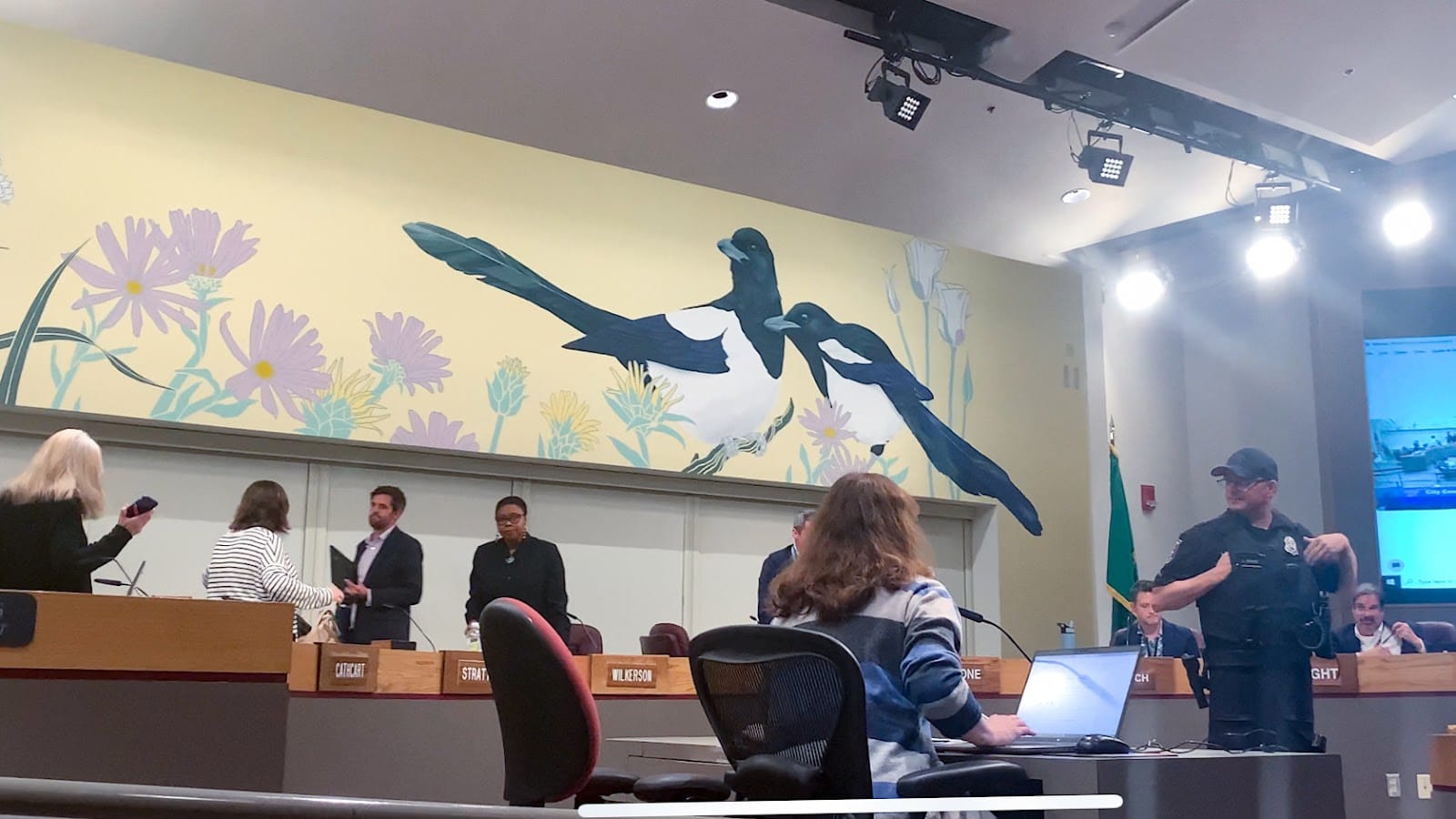
At around 6:34 Monday night, less than 30 minutes into the final Spokane City Council meeting before the election, the seven councilmembers stood from their seats and left council chambers, replaced by approximately 10 Spokane Police officers.
The council wasn’t adjourned due to a threat or a fight (although there would be a brief scuffle later). Nobody pulled the fire alarm.
The inciting act: local activist and organizer Justice Forral reading a transcript from a previous city council meeting.
The scene felt like a post-modern stage play, a one-act of an activist being repeatedly interrupted during public testimony by elected officials for reading a transcript of a different activist being repeatedly interrupted by the same officials.
It was an absurd spectacle, and that seemed to be part of the point: to highlight what Forral and those assembled with them believe is an absurd reinterpretation of a rule that effectively prevents citizens from holding city leaders accountable by name in the open forum of the city council.
The rule in question — that speakers during open forum are supposed to direct their testimony to the council president and not to the individual council members — is meant to preserve decorum and prevent disparaging language or personal attacks.
The rule isn’t new — it has existed at least since before Ben Stuckart began as council president in 2012 — but the way this council interprets it appears to be.
Council President Lori Kinnear declined multiple requests for an interview, and instead issued a statement that read, in part, “As the Council President, I enforce the rule to direct all comments to me while addressing the Council. We have seen past Council meetings where my fellow Council members have been badgered and insulted, and to mitigate these verbal attacks, we routinely enforce the rule to address the Council President and not mention Council Members directly in public testimony.”
Former Council President Ben Stuckart, though, says he interpreted the rule much differently than Kinnear has. (We reached out to former Council President Breean Beggs, who left office to become a judge, for clarity on his application of the rule, but he could not comment due to ethics rules for judges.)
Stuckart says he usually allowed people to reference councilmembers’ positions, opinions and voting records, as long as they addressed those comments to the council president.
Kinnear’s council seemed to be a bit of a free-for-all in the early months of her tenure (she was appointed to replace Beggs in July). Since Oct. 6, however, Kinnear and this council have asked commenters to not mention any names except Kinnear’s at all.
Activists like Forral, along with long-time anti-war activist David Brookbank, Natasha Hill and others, say this new interpretation prevents citizens from holding elected officials accountable by name on the public record.
And so, on Monday, people went about breaking the rule in increasingly absurd ways, culminating in Forral being cut off for reading a transcript of a past city council meeting back to itself.
It was a deliberate provocation. The provocation worked.
With Forral still standing at the podium and time remaining on the clock that ensures community members don’t speak longer than two minutes, Council Member Karen Stratton threw up her hands and Council Member Zack Zappone had begun to stand as Kinnear struck her gavel and declared, “I’m gonna shut the meeting down.”
Forral’s question was left hanging in the air: “How can we hold our public officials accountable if we cannot name them?”
The Somewhat Open Forum
The open forum is the time designated at city council meetings each week for public comment on any issues not listed in that week’s agenda. It has been subject to plenty of controversy in the past, and is a place often used for serious political dissent and, at times, political theater. On Monday, between people protesting the city council decorum rules, a man came up to talk about plumbing regulations. It is also a place stars are occasionally born, as in the case of George McGrath, a gadfly who spent decades harraguing city council members and became something of a local celebrity in the process.
Plenty has changed about the specific rules of the open forum over the years, including the number of speakers allowed at each meeting (it’s currently 15) and the amount of time each person is given (currently two minutes). “It used to be at the end, and folks didn’t like that, so it got moved to the beginning,” Zappone said Monday night.
Across several meetings recently, Council President Kinnear has taken to calling it a “limited open forum,” when questions about the free-speech implications of her interpretation of the direct-address rule. “Not every place even has an open forum,” Zappone said (something RANGE can confirm from our colleagues across the US in the Documenters program).
And while it can be a circus, it is also something that many Spokanites hold dear. The last time a council meeting was abruptly canceled because of unruly open forum commenters, was near the end of Ben Stuckart’s tenure as council president. “I did that once and I was never forgiven for it,” Stuckart told us Monday night. “People were being racist and attacking members of the audience! I was still never forgiven for it.”
People like Brookbank and Forral are regular fixtures at these meetings, but because of a rule that prioritizes speakers who have not yet spoken that month, their time to address their representatives can be even more limited. If more than 15 people sign up for open forum, those who have already spoken that month get left off the list. That means someone’s mic time there could be limited to just 24 minutes a year (it is worth noting people can sign up to speak on individual agenda items at a separate time.) People in the chamber can also be point-of-ordered or removed from the chambers for other actions that fall outside decorum rules, like turning to address the audience while speaking. Audience members can be removed for being disruptive; for clapping, cheering or booing; but also for silent dissent, like holding out a thumbs-up or thumbs-down during comments.
Beyond arbitration of decorum rules, Brookbank said there have also been tech issues and accessibility issues, which have impeded the ability of the public to make comments. Staff isn't always on-hand to help the public use digital media as a part of their statements, he said, also reiterating that those testifying online don't have access to printed materials of things that may have been added to the agenda last minute.
All of this made commenting as a citizen difficult. Then, speakers began getting interrupted by “point of order” any time they used a city council member's name.
Natasha Hill, a local attorney who recently ran for Congress against Cathy McMorris Rodgers, stood in the front row of the meeting, supporting activists as they spoke. When asked about the legality of Kinnear’s interpretation of the decorum rule, Hill said, “I think it’s pretty clear when you read this — the language of the rule and issue — that there’s been a gross misinterpretation that you cannot say a council member’s name.”
“I think this creates legal issues that are just going to cost taxpayers money,” Hill said. “Our council really needs to look at that very closely in order to ensure that we’re getting the democracy we’re entitled to here at the local city council level.”
As for how the interpretation of the rule as it currently exists may or may not have changed, Zappone, Stratton or Oelrich all said there had been no discussion of the rule during Kinnear’s tenure.
Council Member Jonathan Bingle thinks the rule should be repealed altogether, has previously voted against it and plans to advocate against it when the council reevaluates their rules and procedures at the beginning of the new year. For now though, he believes it is the council’s rule, so it should be applied consistently and fairly. That’s why he called a point of order on the speakers and, when the speakers ignored it, the council called a recess and supported adjourning the meeting.
“I think that you should be able to address your council members if it's related to city business, right?” Bingle said, noting that personal attacks against council members are not allowed. “They should be able to look at you and say, ‘Jonathan — or Councilman Bingle or whatever — this is a bad resolution to me.’ They should be able to do that, because that is the business of the city.”
He further emphasized that, “You have every right to come and speak to us. You have a right as an American citizen to address your government, to bring your grievances here, you have every right to do that.” However, he said, citizens don’t have a right to “hijack” a meeting for their own purposes.
“Come next week, speak your piece, based on the rules, and I will happily listen to everything that you have to say,” Bingle said. “And I look forward to seeing you guys on Monday.”
A tale of two actions — one month in the making
On October 9, the council passed Resolution 2023-0091 in support of Israel. The resolution was written by Council Member Jonathan Bingle and voted on just two days after the initial attack by Hamas. It was unanimously approved. The resolution wasn’t listed on the council agenda at the time and still doesn’t appear on it after the fact.
During the City Council Briefing session on October 9, held just a few hours before the legislative session, council first voted to suspend the rules and then to add the resolution to that evening’s legislative session agenda. No public testimony is taken at briefing sessions, and because it wasn’t originally on the agenda for the meeting, interested citizens had almost no way of knowing it would be discussed and voted on.
Resolutions are typically only read once and then voted on, but the public usually knows the vote is coming because these items show up in advance or current agendas (and people read about them in RANGE’s weekly CIVICS newsletter). Because of the rules suspension earlier that day, the usual notification process did not happen.
Giacobbe Byrd, city council director, said that the resolution did not appear on paper copies of the agenda handed out at the meeting, but that there was a note on the public testimony sign-up sheet outside council chambers that it would be discussed and folks could sign up to speak on it. Copies of the resolution were provided near the sign-up sheet for the public to read.
People who were not already attending the meeting that night would have had no advance notice the resolution even existed. When the council got to that item, Kinnear said no one had signed up to provide testimony for it, so it moved immediately to council discussion and vote.
Brookbank said in an interview with RANGE that he found the resolution one-sided, and that when Cathcart read a letter in support of the resolution that had been penned by a woman who lives in Israel but has family in Spokane, it was riddled with inaccuracies and cited misinformation. Brookbank and Forral said there were two citizens attending virtually who weren’t allowed to speak. This didn’t sit well with either of them. So, Brookbank signed up to speak on the resolution during October 16th’s open forum.
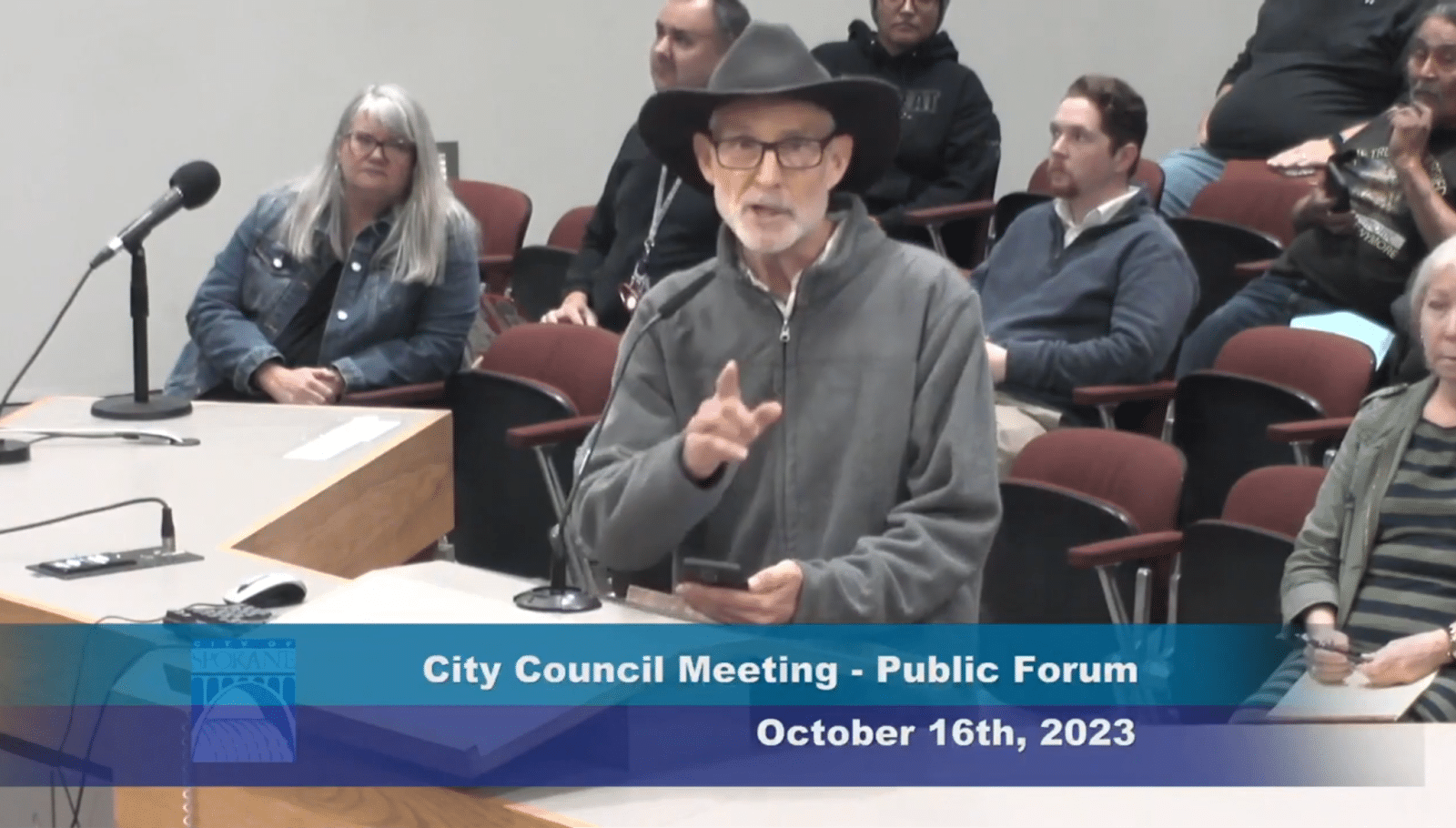
Speaking at the October 16 meeting, between point-of-order calls from Bingle and Kinnear, Brookbank said, “In the last eight days following Monday, the world has emphatically condemned the genocide that several Israeli leaders are calling for. Then, without option for public comment to respond and to address misinformation from the council person, and with no other council person commenting or questioning, the entire seven member council quickly voted unanimously for the resolution. The failure of city council and staff to figure out how to organize the briefing books as well as the agenda item speaking list is unacceptable and undemocratic.”
Brookbank acknowledged he was not completely cut off, and was only interrupted twice by Bingle’s point of order, so his message got across. He strenuously objected to the interpretation of the rule that would not allow a community member to point out which councilmembers sponsored or voted on resolutions like this, “We're concerned about basically, basic democracy,” Brookbank said. “All I was doing was describing business that was before the council on that date of the ninth.”
Brookbank said he’s worried about the ripple effect it will have on the public’s civil engagement. He’s old hat at providing testimony, and still felt anxious as he defended his right to speak.
“I do think those interruptions have a chilling or deterring effect on people,” he said. “Members of the public want to be able to say their piece about matters council is involved in. Open forum is a primary place where that democratic engagement occurs. To be subject to a rule that is illogical, confusing and arbitrarily applied is a deterrent.”
On October 30th, Zach McGuckin used the open forum time to attempt to speak on what happened to Brookbank on the 16th.
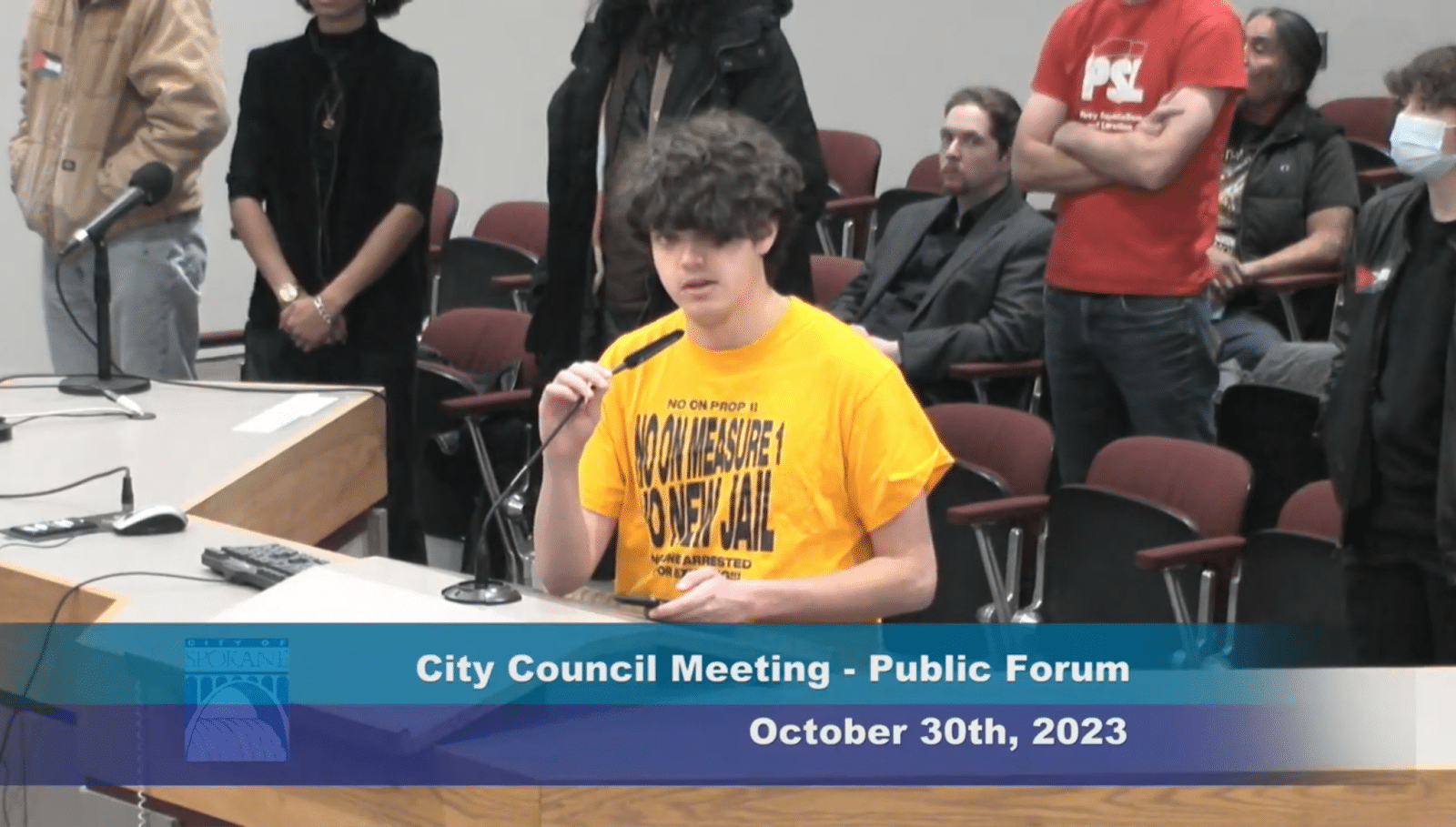
Turning towards Kinnear, McGuckin said, “I’m going to be speaking directly to you about the statements and behavior of a different council member. A couple weeks ago, council member Bingle attempted to silence my—”
That was as far as McGuckin got before Kinnear started to stop him. McGuckin clarified that he was addressing her not Bingle, per the rules of council as he understood them, and Kinnear said, “Please do not address [Bingle] by name, do not talk to him by name.”
“OK,” said McGuckin. “A council member attempted to silence my friend and comrade David [Brookbank], stating that it was disrespectful and against quorum to call Israel an apartheid state.”
Those two incidents led Forral to plan Monday’s action, bringing in Brookbank, who they see as their mentor in activism. Forral’s action converged with weekly action by the Party for Socialism and Liberation (PSL), who have been protesting outside and speaking inside at city council meetings with a goal of ending US aid to Israel by applying pressure nationally to local governments. While it was censorship against people speaking against the pro-Israel resolution that spurred Forral’s action, their goals were different than PSL’s.
Forral, who is part of a dedicated group who attend council meetings nearly every week, was there to preserve one of the few opportunities people have to publicly address their elected officials and to stand for the peoples’ rights to free speech.
“We don’t have political points to score or lose,” Forral said. “We have the issues we care about in the world we share together. We are demanding our voice be heard. Failure to uphold this right is a suppression under our first amendment, is anti-democratic and we can’t hold our elected officials accountable if we can’t name them.”
The rules in recent history
These conflicts have been happening for just about a month, it appears Kinnear’s interpretation of the rule doesn’t stretch back much farther than that.
As recently as September 25, the meeting where council debated whether or not to denounce Mayor Nadine Woodward’s shared stage time with Matt Shea, Councilmembers Zappone and Betsy Wilkerson, who co-sponsored the denouncement legislation, were described negatively by multiple people speaking on that agenda item.
“The city council members, Wilkerson and Zappone, still calling for the formal denouncement slash censure of the mayor should apologize. They should also apologize for making this a political and wasting the time of the citizens, the taxpayers and other city officials,” said a man named Lyle Dach.
He was not interrupted or corrected.
There was a downright comedic exchange between a woman named Neilene DeBoise, Zappone and Kinnear, where DeBoise actually broke the letter of the rule by addressing both Bingle and Zappone directly:
“I like you Bingle, you’re like the smartest man up there,” DeBoise said, then turned her attention to Zappone. “So I found that it was funny that you recite the pledge of allegiance with all of us but you denounce Christians and God himself.”
To which Zappone himself cut in: “Point of order. I think we need to be clear this is not denouncing Christians or God —”
DeBoise: “Yes, it is —”
Zappone: “ — that is very clear in the resolution, we are denouncing Mayor Woodward’s actions.”
Kinnear: “That is correct.”
DeBoise: “You’re denouncing Mayor Woodward for going to a Christian worship service.”
Zappone: ”It’s not denouncing Christians.”
At that point, Kinnear told Zappone to yield the floor. “Let’s let her — you’ve had your say, let’s let her finish,” she said, “And then when we have our moments we can.”
“Do I get my time back?” DeBoise asked.
“Yes go ahead, he paused it,” Kinnear replied.
“I’m surprised you don’t have a statue of Moloch in here,” DeBoise concluded.
Per council rules council members are not supposed to interact with open forum speakers, but they are allowed to correct the record. (Strictly speaking, Zappone should have called for a “point of information,” not a “point of order.”) Kinnear did not ask DeBoise to speak to her directly, but did reprimand the audience when there was a small amount of laughter at the mention of Moloch. (Moloch has been traditionally understood to be a Canaanite God that demanded child sacrifice, though that interpretation of the Hebrew verse has been questioned by modern scholars.)
“I’m going to ask the audience to refrain from laughing or outburst please,” Kinnear said.
The council president did finally step in near the end of public comment, when Gabe Blomgren, who we have written about previously, looked directly at Zappone and said, “I have to say, Zachary, I respect your position and I have to say, Ms. [Wilkerson], you have the right to put this vote forth —”
He was cut off by Kinnear, who asked that Blomgren direct comments to her. He apologized, and later in his public comment, prayed for everyone on the council, declared the council was present for the glory of God, and sang “Amazing Grace.”
The difference for the protesters between Blomgren’s comments and those made by the people advocating for the council to recognize the violence against Palestine is that Blomgren clearly violated the explicit intent of the rule by speaking directly to Zappone and Wilkerson. The comments delivered by Brookbank, McGuckin, Forral and other activists were addressed to Council President Kinnear, but were talking about legislation and decisions and comments made by council members.
It’s a small distinction, but a crucial one, and not just for the activists. Throughout his tenure, former Council President Stuckart says he applied the rule as it was written, “You couldn’t address councilmembers directly when they would come up and yell at Councilman Fagan. Or when George McGrath would go off on Jon Snyder,” Stuckart told RANGE Monday night as the councilmembers were sequestered in their briefing room.
But that never meant, Stuckart said, that people were ever prohibited from referencing a council member’s positions, their legislation or their votes. “You address the council president,” he said, “but if you wanted to say ‘council president, I disagree with this and this that this other council person said.’ That’s totally fine.”
More broadly, Stuckart seemed mystified about why Kinnear was taking this stand now, the day before an election and just weeks before her term ends. “I just don’t understand why, in your last month in office, you’re being so stringent. Why cancel a meeting in the middle of the meeting?”
That’s when Stuckart referenced the one meeting he canceled, which he seemed to both regret and also seemed to think was more justified than last night’s cancellation. “I just feel like canceling a meeting because of an interpretation of the rules feels a little harsh to me,” he said. “Don’t they have the people’s business to attend to?”
At the October 16 meeting where Brookbank was repeatedly point-of-ordered when talking about decisions made by council members, he was immediately followed by DeBoise in the speaking order, who had come back to continue to express her displeasure with council’s denouncement of Woodward.
“I find it nauseating that instead of focusing on important issues our city faces such as crime, drugs, human feces in the street, et cetera, you focus your attention on denouncement: denouncing Bingle for not wearing a mask like a controlled puppet, Nadine Woodward used as a stooge to get at Matt Shea for political agendas,” she said. Despite referring to Bingle by name, no one point-of-ordered DeBoise.
The Peoples’ City Council
Before last night’s city council meeting even began, Forral spoke to a crowd of protesters sign-waving and chanting outside the building to request the council retract the pro-Israel resolution.
“I appreciate y'all being out here. Because right now, it's about bringing this to attention,” Forral said, as they looked towards City Hall. “We can't have a conversation if we ignore issues. We can't bring things up if we refuse to talk about them. If they don't let us talk about them.”
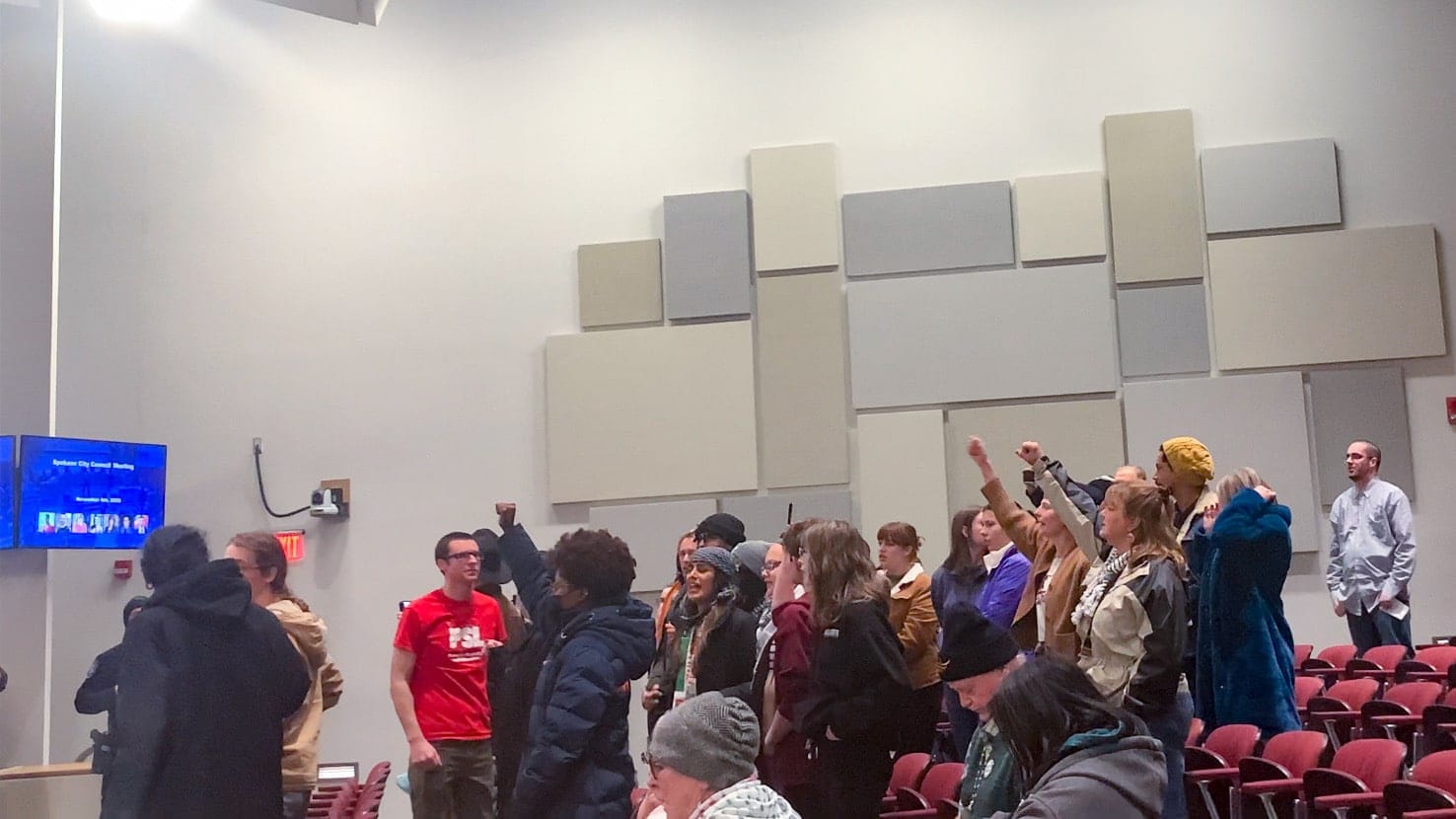
Inside the council chambers, the crowd was largely orderly, with the exception of speakers repeatedly violating Kinnear’s new rules interpretation forbidding them from using council members' names. They stood quietly in support of speakers there with their group. After Forral’s public comment, which ended with council vacating the chambers, there was chaos for a few minutes as shouts of “Free Palestine” and “Ceasefire Now” echoed through the chamber. Someone in a red shirt stamped with the Party for Socialism and Liberation’s logo began to lead other chants: End the Apartheid. End the Bombing of Gaza. End Bombing of Children.
A small tussle broke out as Will Hulings, a former Proud Boy, began to shout at Maher Gheith, who had been standing in the back holding a sign that read “Free Palestine.” Gheith told RANGE Hulings had tried to fight him in the parking lot too.
Then, Forral took to the center of the chambers, standing in the spot traditionally reserved for speakers, but facing the crowd instead of the empty council seats.
“City council, let us speak! Stop funding genocide. Let the people speak,” they chanted, as the crowd repeated their words back to them.
Then, Forral invited members of the public back to the mic to continue the open forum. Speakers delivered their prepared comments to a city council that wasn’t present.
Hulings, who had been watching through the glass outside the room following his near-fight, came back in, shouting that his free speech rights had been violated because he’d come to the meeting to speak on issues and the protestors had taken his turn away. Several members of the crowd yelled back at Hulings, trying to have a conversation or an argument, but Forral hushed them and invited Hulings to speak.
Hulings used his time to criticize protestors for “probably” voting for Joe Biden and for the PSL march in support of Palestine that briefly shut down the streets on Saturday, which spurred arguments from the crowd. Forral tried to find common ground, reiterating that they were listening, and then turning back to Hulings and the protestors:
“I think the issue that a lot of times we have, as individuals, is that we aren't listened to by our council. We're not listened to by our public officials, so we often get frustrated at one another. They don't listen. Who has the power?”
The crowd answered: “We have the power!”
Forral continued, reiterating that they were shut down for talking about the historical council record. The room is filled with chants again. Free Palestine. Free Palestine. Free Palestine.
On the dais, the council members had been replaced by police officers, but the audience spoke freely. For one chaotic night, rules of decorum were thrown out, but public comment continued. It was the People’s City Council.
After the meeting, Brookbank spoke of the optics of the action, of council retreating and police taking their place.
“I think it is very representative of the crisis of democracy, the power of the police, the cowardice of the state in the face of the militarized police state,” he said. “It doesn’t speak well for our city, but it does speak well for the city’s people who came out tonight.”
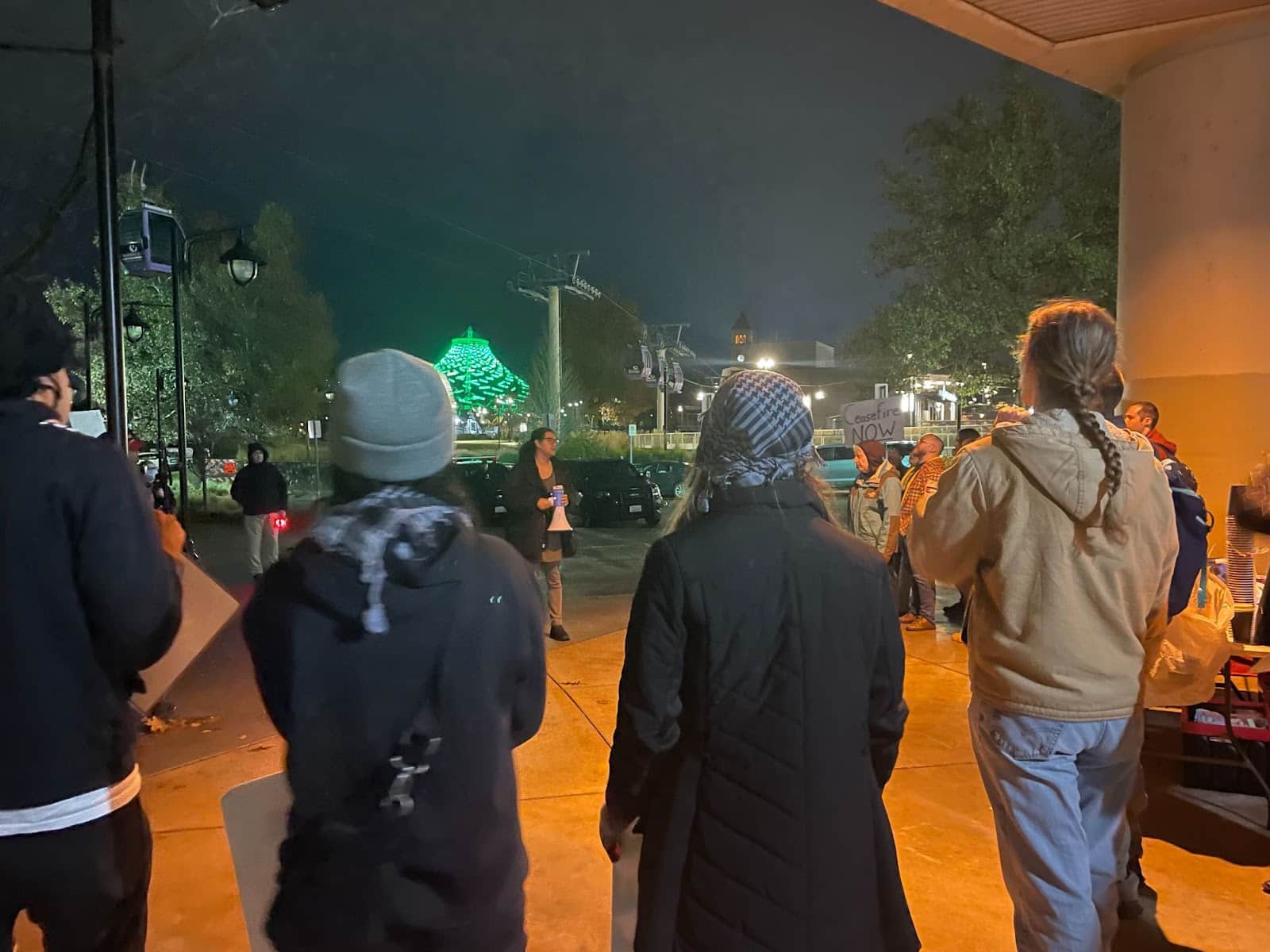
Before the meeting began, Justice Forral looked out at the group of protestors gathered. Some of them were there for free speech rights, some to encourage the City Council to write a new resolution in support of Palestine, some were folks who attend these meetings weekly. Some were there to critique people like Forral.
“What I see is community. And there’s nothing stronger than community,” they said into the megaphone. “There’s nothing stronger than us.”
On Tuesday afternoon, Council communications director Lisa Gardner told RANGE that “going forward, the Council President plans to allow members of the public to identify other Council members as long as they’re directing their comments to her. Council Members may still call a point of order if they believe a council rule has been violated.”
Alyssa Baheza contributed to this report


