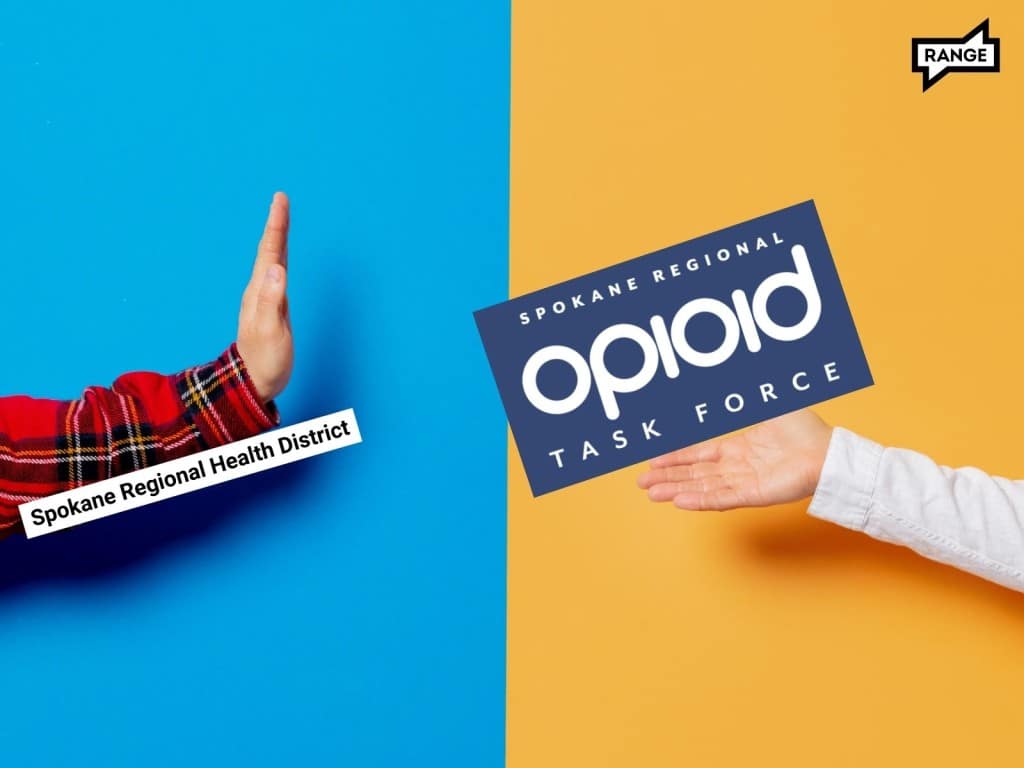
For the last five years, the Spokane Regional Health District (SRHD) has sought to address the deadly, ever-deepening overdose crisis partly through a task force that brought together the disparate professions that engage with opioid abuse.
But not anymore: at the end of this month, the Spokane Regional Opioid Task Force (SROTF), which was funded by money from the Centers for Disease Control and Prevention (CDC) and connected more than 60 local organizations, will no longer exist.
In an internal email to the task force last week, SROTF project manager Greg Dailey announced Spokane County and SRHD will end the program December 29, attributing the decision to a lack of grant funding.
The resulting hole in the local overdose response will be hard to quantify. Much of SROTF’s work involved hard, often invisible tasks, from creating a resource network for recovering patients to boosting knowledge among providers about appropriate treatments for mental illness, pain and addiction.
“You can’t know the value of these kinds of task forces unless you’re actively involved in it and you can see over a period of time the connections that get made … as a result of people being able to share their knowledge and their perspectives,” Dr. Marian Wilson, who did research on non-opioid management through the program, told RANGE.
SROTF stitched together otherwise scattered professions that engage with different parts of the opioid crisis in Eastern Washington: law enforcement, emergency doctors, providers working with young athletes who suffer from sports injuries. It’s a big community with a big crisis that needs the connective tissue that SROTF provides.

Through SROTF, Wilson, a Washington State University (WSU) nursing professor, focused partly on remote access to non-opiate pain care, like yoga, massage, chiropractic care, and physical therapy. She said this is crucial work because, though good solutions to opioid dependency and addiction exist, many patients live far from healthcare centers; lack access to doctors; or manage addictions alongside their pain that make it difficult to function in the healthcare system. The different parts of the response have to be connected.
“There are lots of things we already know are helpful to people with pain,” Wilson told RANGE. “And we also know that they can’t get a lot of those things because either it’s not available in their community or they can’t afford it or their health insurance doesn’t pay for it.”
Dailey and Spokane County spokesperson Pat Bell did not return requests for comment.
The cash shortage apparently stems from changes in the federal grant program that sustained SROTF called Overdose Data to Action (OD2A), which is distributed by the CDC through the Washington State Department of Health (DoH). The grant funding is for local and state governments to better understand the drug crises in their individual neighborhoods.
In August, the CDC reorganized the OD2A fund making less money available to states and creating a separate funding pool for local health jurisdictions, said DoH spokesperson John Doyle in an email to RANGE. Those local health jurisdictions now must apply for OD2A directly from the CDC, separately from states.
“This does create a lapse in funding from September to spring,” Doyle wrote, adding that under the reorganization, fewer local health authorities will have access to the money.
Applications for the local pool became available this past spring, but CDC spokesperson Nick Spinelli said the agency never received an application from SRHD.
SRHD spokesperson Kelli Hawkins did not know anything specific about the fund or why SRHD did not apply, but she told RANGE that when considering whether to ask for public money, the district considers whether spending it would create redundancies. She said that perhaps the agency saw some of what the task force did as doubling the efforts of an opioid roundtable run by Spokane County Health Officer Frank Velasquez.
“Are we already doing the work?” Hawkins said the district asks itself before applying for public funds. “Is a partner in the community already doing the work? … We don’t want to be doing work that somebody else is already doing.”
Doyle said DoH is developing a similar state-level program to provide resources to local health authorities like SRHD, as well as community organizations and Indigenous tribes.
Dailey credited former Spokane County Health Officer Bob Lutz for starting SROTF five years ago and noted in his email that he believed SROTF had made a positive impact on the community: “I truly believe we have made a difference!,” he wrote.
Lutz told RANGE now is not the time to cut programs designed to alleviate the opioid epidemic.
“It was a great opportunity for us to raise visibility around opiate-related issues in Spokane as they were really sort of ramping up, especially around fentanyl,” Lutz said. “And it’s just very unfortunate that the decision has been made to not continue with the task force because it’s good work, and it’s done good work.”
In 2022, 215 people died in Spokane County from drug overdoses; 156 of them, or 73%, were caused by opioids. Nearly two-thirds of those who died were between the ages of 18 and 44. This makes for a 24% increase in overdose deaths from 2021.
The increase reflects a national crisis – in some cases fueled by overprescription and aggressive marketing of the prescription drug OxyContin – that has devastated individual lives and local economies. In few cases, people suffering from injuries become addicted to opioid painkillers and when their doctors will no longer prescribe opioids, they can be tempted to turn to street drugs like heroin, a powerful opiate. Wilson said that while about 8 to 12% of people who develop opioid addiction start it from an opioid prescription, risk factors more significant than pain include “early-life trauma, a family history of addiction, and environmental factors such as peers and family who use drugs.”
When users seek out street drugs, they are often cut with other compounds that make them more lethal. Some of these drugs are even made into pill form, which the CDC says is “especially dangerous because they typically appear as pharmaceutical pills but often contain illegally-made fentanyl … or other drugs, with or without people’s knowledge.”
The National Center for Drug Abuse Statistics says drug overdoses are increasing nationwide by nearly 30% every year – the increase is almost solely attributable to opioids.
Fentanyl is especially harmful in underrepresented communities, including the Kalispel Tribe, whose police seized 18,000 fentanyl pills at a Northern Quest Casino parking lot last month.
The opioid crisis in Spokane is a twin problem to the homelessness epidemic – which was the prime mover of local politics in the November election – and is often invoked in “clean-up-the-streets” rhetoric. It’s not uncommon in downtown Spokane to walk by people openly using drugs like fentanyl on the sidewalks.
“The drug overdose crisis in the United States is constantly changing and complex and is claiming the lives of our parents, children, siblings, colleagues and friends,” said Dr. Grant Baldwin, director of the Division of Overdose Prevention at the CDC’s National Center for Injury Prevention and Control, in the agency’s press release announcing the OD2A changes. “CDC is committed to saving lives and to do this we must continue to provide our communities with the resources they need to stay ahead of and respond to this crisis.”
In the new year, Spokane County will have to look to alternatives to SROTF to accomplish that work.
Dr. Wilson, of WSU, will continue her research through a nearly $700,000 grant she won from the state to train health science students in Washington, create a central resource for patients to manage their own pain and offer programs for doctors to manage chronic pain in their patients.
But she said her new grant application was informed by research she did with SROTF and that the task force’s demise will make such projects more difficult.
“Funding sought for the community can be more competitive when it appears there is an organized coalition working together such as what the SROTF provided,” she said. “I do think that direct access to diverse community members focused on the opioid public health crisis strengthened our projects and our grant work.”
What you can do to help
Naloxone, aka Narcan, can reverse the effects of opioid overdose, including fentanyl, and save lives. In Washington, there is a statewide standing order to dispense Naloxone without needing a prescription and anyone can administer it.
If you use drugs, have family or friends that use drugs, or often interact with people who use drugs, it is recommended to carry Naloxone.
Here’s some resources for where to find it and how to use it:
– Washington State Naloxone Finder
– WA DoH Overdose Education and Naloxone Distribution
– Prevent Overdose WA
– National Harm Reduction Coalition Overdose Prevention and training guide
Editor’s note: We updated this story to clarify the factors that put people at risk of becoming addicted to opioids.