

This story was written in partnership between RANGE and FāVS News, a nonprofit newsroom covering faith and values in the Inland Northwest. Learn more about FāVS’s work here.
A prominent Washington think tank led by former Spokane Valley pastor Brian Noble is urging its members to collect signatures for a pair of ballot initiatives that would restrict queer rights and student privacy in Washington schools.
The measures were initiated by the right-wing policy organization Let’s Go Washington, founded by millionaire hedge fund manager Brian Heywood, and are supported by the Family Policy Institute of Washington (FPIW).
The first, IL26-638, titled “Protecting Fairness in Girls’ Sports” (PFGS), would ban transgender girls from playing public school sports and would require girls who want to play school sports to prove their biological sex through a doctor’s examination of their genitalia or genetic test.
The second, IL26-001, titled “Strengthen Communication Between Parents and Schools” (SCBPS), would restore parents’ rights to access the school records of their children who are younger than 18, to be notified when medical services are provided to their children and to opt them out of certain classes, including sex education.
FPIW does much of its work through its organizing app, which provides resources for members to order copies of the ballot initiatives to their homes so they can collect signatures in order to get them on next year’s state ballots. FPIW counts a membership of about 400,000, when its 39 strategic partners are factored in, across Washington state, according to Noble, who is president and CEO.
Transgender rights advocates say these initiatives threaten the privacy not only of transgender students but of their cisgender peers, too.
“What is missing from this conversation is a focus on youth autonomy,” said Chandler Náire-Briseadh, an intersex and transgender Spokanite who advocates for queer youth. “Let’s Go Washington has painted these initiatives as attempts to address parent versus school conflict, when in reality, our focus should always be on the rights of students to determine how their education unfolds.”
FPIW is headquartered in Lynnwood, north of Seattle, but Noble, who has formerly served as the CEO of Peacemakers Ministries, a sheriff’s chaplain, chair of the Spokane County GOP and pastor at the Valley Assembly, lives in Spokane County.
Noble said in an interview he thought SCBPS would make good progress by ensuring parents are aware if their children are transitioning. An ideal policy, he said, would go a step further and make it illegal for parents to seek gender-affirming care for their children. He characterized such health care as child abuse. This is contrary to many studies that have established gender-affirming care significantly reduces gender dysphoria, depression and suicide risk for transgender youth.
Most often, gender-affirming care for children amounts to social transitioning, like asking people to use preferred pronouns and dressing according to the conventions of their gender identity. It can sometimes include temporary hormonal treatments like puberty blockers, which are used to treat an array of conditions including gender dysphoria, and, in extremely rare cases, surgery.
Republicans also often cite European countries’ bans and limits on gender-affirming care for minors in recent years. But the picture there is much more nuanced, showing stricter eligibility criteria for such care and how to approach gender-affirming options for minors within research.
As for PFGS, Noble said the requirement to provide proof of a girl’s sex before she can play school sports was “too intrusive,” but in any case was an unfortunate requirement for a society that has evolved to recognize transgender people.
To qualify for the ballot in 2026, each initiative would need to garner 308,111 signatures. This is table stakes for Let’s Go Washington, a well-heeled organization that has succeeded in getting initiatives onto Washington ballots during several recent election cycles. Last year, the organization focused four initiatives on taxing and environmental issues, three of which failed.
This year, it appears to be changing its focus to culture war issues rather than ones that hit voters’ wallets. In national elections last year, such issues proved fertile for Republicans across the country, including the presidential victor Donald Trump, who campaigned partly on vilifying policies and government programs that benefit queer communities.
No sports for transgender girls
PFGS would require that a student “who elects to participate in individual or team competition activities intended for female students … shall provide … a statement signed by the student's personal health care provider that verifies the student's biological sex, relying only on one or more of the following: The student's reproductive anatomy, genetic makeup, or normal endogenously produced testosterone levels.”
The initiative does not include what it considers normal testosterone levels are for girls or address how testosterone levels in girls fluctuate throughout the menstrual cycle. It doesn’t say anything about boys’ sports.
Katelyn Burns, a transgender journalist who is trained academically in sports management and writes about transgender communities in the U.S, said this is the first step toward erasing transgender people from the public square altogether.
Burns noted that polling suggests allowing transgender athletes to play in sports designated for the gender they identify with is broadly unpopular in the U.S. But if folks trying to ban transgender people from sports are successful, that will bleed into other areas of life for them.
“If they can get trans women to be considered men in athletic events, then they can easily go in and define them as men in other parts of the law because they’d have this precedent,” Burns said. “If we consider them men in athletics, why not in bathrooms or why not in changing rooms or why not in employment?”
Much of the rhetoric used to make a case against transgender girls playing sports revolves around the idea that transgender girls have physical advantages over cisgender girls. This can be true in the sense that transgender girls tend to have larger bodies and longer limbs.
A booklet available on the FPIW website describes the biological differences in terms of average metrics, comparing male and female lung sizes, upper and lower body strengths and the size of their hearts. It explains “even when height and body size are matched, men typically have 12% greater lung volume relative to body mass.” This is because males assigned at birth have an average lung capacity of 6 liters versus a female, who has, on average, 4.2 liters of lung capacity.
But Burns said it’s not that simple. She used the analogy of two cars, one big, the other small, with the same size engine. The engine has to work much harder to move the bigger car. The hormones that are generally required for transgender girls to compete in sports function in a similar way, Burns said.
“It's not gonna zip off the line,” Burns said.
A study sponsored by the International Olympic Committee last year — which Burns wrote about for MSNBC — articulated this disadvantage.
Noble, for his part, said the idea that people can transition from one gender to another is a fiction because he defines gender according to chromosomes, which cannot be altered. He believes even if someone lives their life outside of the gender they were assigned at birth, they are still either male or female according to their biological makeup.
Both sex and gender are generally considered to be more complex than that. Most people who study gender and sex describe a clear delineation between the two terms. Gender consists mostly of a set of social traits historically associated with sex — though social progress has worked against these assumed characteristics, women have traditionally been assumed to have long hair, are accepted wearing dresses and make homes rather than livings. Men were supposed to be physically strong, wear pants and be breadwinners.
Noble lamented that society now recognizes transgender people in the way it does compared with a historical society that simply assumed people played the gender roles prescribed on their birth certificates.
“I think if we were to have just kind of common sense like in the old days, we wouldn't have to do all this. … Their values are winning,” he said, referring to people who support queer communities. “Our values are losing.”
He said it’s a necessary evil to exclude transgender students from school sports.
“I would say it's too intrusive,” he said of the initiative his organization is promoting. But he added that there’s really no other way to make sure transgender girls are banned from school sports. “I think that's a fair way to make sure that women have a place to compete.”
The Washington Interscholastic Athletics Association told The Seattle Times early this year that it estimates only five transgender children play in public school sports across the state, out of an estimated population of a quarter-million student athletes.
‘Love is not love’
During the last two decades, the US has enshrined meaningful queer rights — including the right for gay people to get married and for queer people to enjoy workers’ protections — into law.
The Trump administration is trying to work against some of this progress. In February, for example, Trump signed an executive order rescinding federal funding for any jurisdiction that allows transgender women to compete in sports.
Locally, some school boards have urged the state of Washington to ban transgender girls from sports and tried to limit their ability to use the restroom that matches their gender identity.
This backlash is largely embodied by ascendent Christian nationalism, the idea that a specific version of the Christian worldview — which leans heavily on exclusion of queer people and Muslims from positions of social influence — should rule society.
Noble still sometimes preaches at the Valley Assembly, though he stopped being paid in 2023 so he could work in other arenas, first in partisan politics as chair of the Spokane County GOP, and then in public policy leading FPIW.
When he does preach, he is charismatic about it.
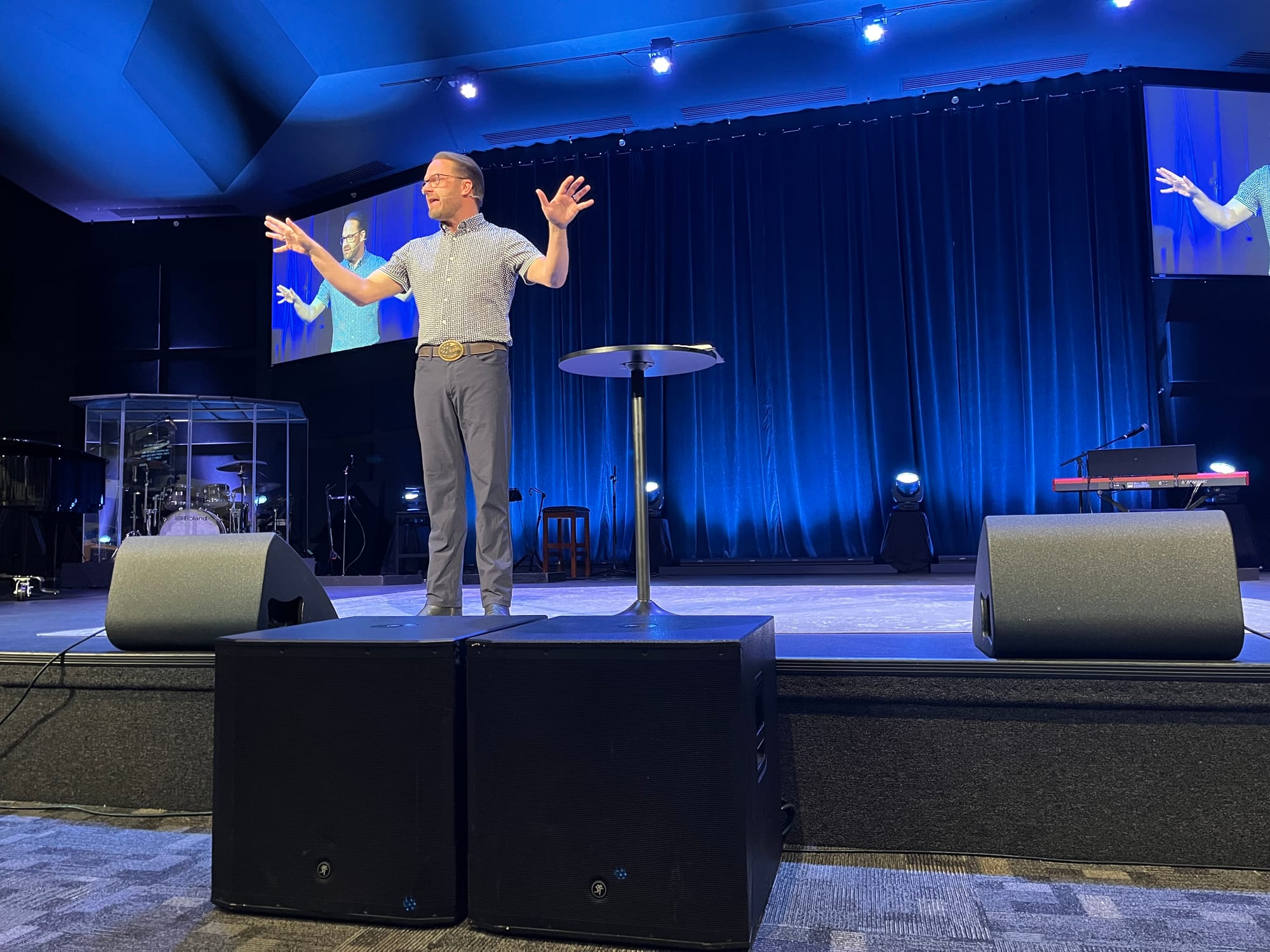
During a Sunday sermon he delivered Nov. 9 at his old church, he was fully on. Striding back-and-forth across an area rug on the church’s black-painted main stage, Noble preached from 3 John, first emphasizing verse 4 of the book’s single chapter, which reads: “I could have no greater joy than to hear that my children are following the truth.”
That phrase “the truth” carried a special definition and weight. Noble set up an unscripted skit with audience volunteers illustrating how someone can be unaligned with Jesus and therefore on the path to hell. The boundaries of God’s good graces were the edges of the carpet, and volunteer Molly was off the carpet.
Molly, obstinately refusing to give up her sinful ways and walk onto the carpet, was a “knucklehead.”
The audience was cracking up, but Noble was alluding to something very serious: queer love.
“Love is not love,” he preached. “If I'm just able to say, love is love, and then you can have whatever definition, at some point, your love is not gonna be matched up with my love. If I have a lion and a rabbit in the room, the rabbit's love is ‘I want to cuddle with the lion.’ The lion's love is, ‘I want to eat the rabbit.’”
Volunteer Lyle tried to call Molly back to the carpet but was unsuccessful. So he did something wrong: he went to Molly, representing a church that affirms queer life — and risking the salvation of his own soul in the process.
Not a Christian nationalist
Noble said he’s offended when people call him a Christian nationalist for one reason: because he is not one. His definition of Christian nationalism is the belief that Jesus Christ will, at some point, come to earth for a 1,000-year reign, and Christians exist in the world to prepare it for his coming kingdom, meaning they must seize control of the government in order to create an environment suitable to Christ.
According to this understanding of Christian nationalism, queer relationships are forbidden, Islam has no influence in the public square and Christ, rather than voters, dictates policy.
Noble’s ideal society is slightly different — and therefore not Christian nationalism.
In his vision of Christianity, the faithful will be swept into Heaven, what he defines as the rapture of the church, in advance of a great “tribulation,” and Noble wants as many people on that ride as Christians can convince to accept Christ.
“I love people and do not want them to experience that wrath of God during the tribulation,” he said Nov. 13 in a text message.
Some of that work is done through interpersonal evangelizing of the type he implored the congregation to do at Valley Assembly with his carpet skit.
“I want us all to begin to pray for our neighbors and those around us,” he prayed at the conclusion of his sermon, as congregants gathered around the stage in an altar call.
Another part of that work, for Noble, is accomplished through public policy, by keeping certain identities out of the public square. FPIW is far from focused solely on the Let’s Go Washington initiatives.
Brad Payne, the chief lobbyist for the think tank’s policy arm, said he has worked across the political aisle with Democrats in Olympia to push legislation in many realms.
In an interview, Payne highlighted his support of Rep. Lauren Davis, a Democrat of Shoreline, when she was trying to keep people accused of crimes in jail before their trials, to strengthen impaired driving laws, to tax marriage licenses to fund more robust domestic violence response, among other criminal justice-related items.
But Noble is clear about the policy world that he wants to create, which, whether he defines himself as a Christian nationalist or not, resonates with the effort to prepare the earth for Christ’s alleged 1,000-year reign.
“ I believe all legislation is someone's morality,” he said. “It's someone's law written upon their heart. So I'd just rather it be mine.”


