

In the wake of the 2024 Presidential Election, there were thinkpieces galore on the gritty partisan details, voter turnout break downs, the national Red Wave and how Washington did or didn’t fit the pattern and trying to answer the question of why exactly Kamala Harris lost.
That’s all interesting, sure, but now it’s our turn to add two-cents of post-election analysis in classic RANGE fashion — hyper-local and a little late.
Like most counties across the state, Spokane County rejected Initiative 2117, which would have repealed Washington’s Climate Commitment Act, killing the state’s cap-and-trade program and ending a significant new source of transit funding.
Statewide, 62% of voters wanted to keep cap-and-trade. In Spokane County, Initiative 2117 still would have failed, but the race was much closer, at 54% wanting to keep the program.
That tracks with what we would expect in our famously purple county, where local elected bodies show the score: progressives hold a 5-2 majority on the Spokane City Council, but are a 2-3 minority on the Board of County Commissioners, which represent the whole county.
Initiative 2117 results roughly follow this pattern at a first glance, but when we zoom in to look precinct-by-precinct, a more interesting pattern emerges.
The precincts that voted against Initiative 2117 aligned pretty well with the boundaries of progressive, metropolitan Spokane, but they aligned even more closely with the boundaries of Spokane County’s Public Transit Benefit Area (PTBA) — a special taxing district that partially funds Spokane Transit Authority (STA) and includes all of Spokane City, but also includes unincorporated parts of the county and other, more conservative towns and cities like the Valley and Liberty Lake.
Data visualization by Jun-Kai Teoh.
Of the handful of rural precincts that voted to keep the progressive cap-and-trade program, all but one fell within the boundaries of the PTBA. A few precincts in more urban areas, like Liberty Lake and Spokane Valley, were won handily by Donald Trump but their voters still voted against the initiative. (Find full precinct voting records here.)
What does this mean for Spokane?
We aren’t math geniuses, but the data shows people who live within the PTBA — and therefore have access to public transit services — were more likely to vote to keep a progressive tax scheme partially funding transit, regardless of their other ballot decisions, like Trump or Harris; Al French or Molly Marshall
To check this assumption, we conducted a very unscientific poll of voters across various social media platforms — Reddit, Twitter, Bluesky — and got wildly different answers. Scroll for a few of the responses:
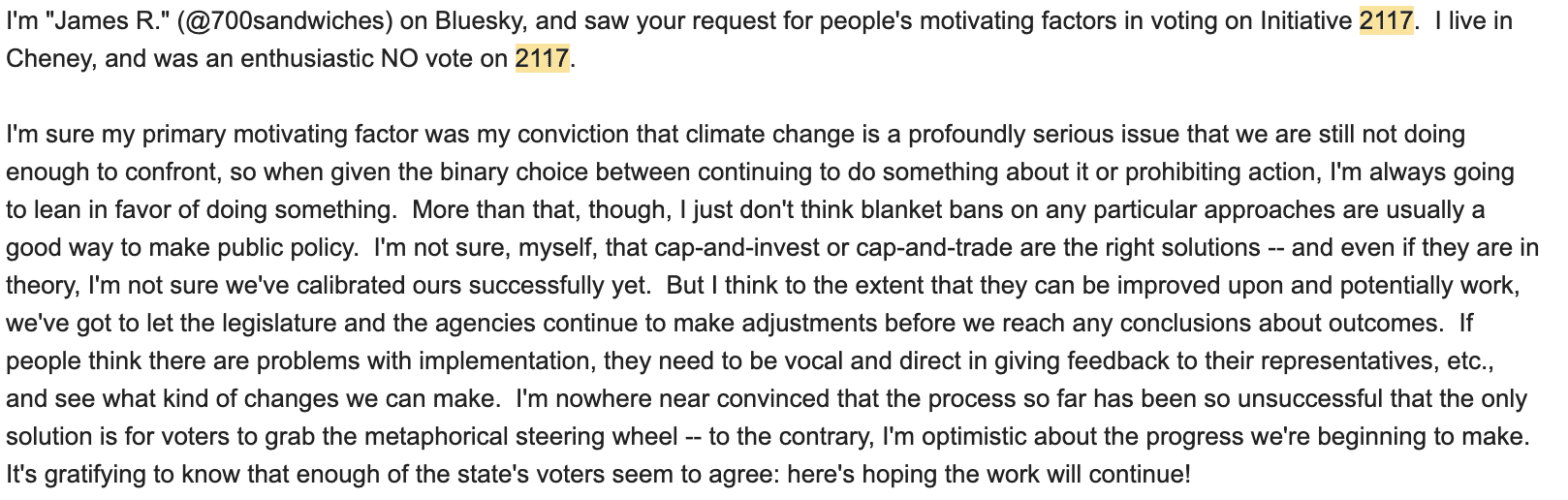
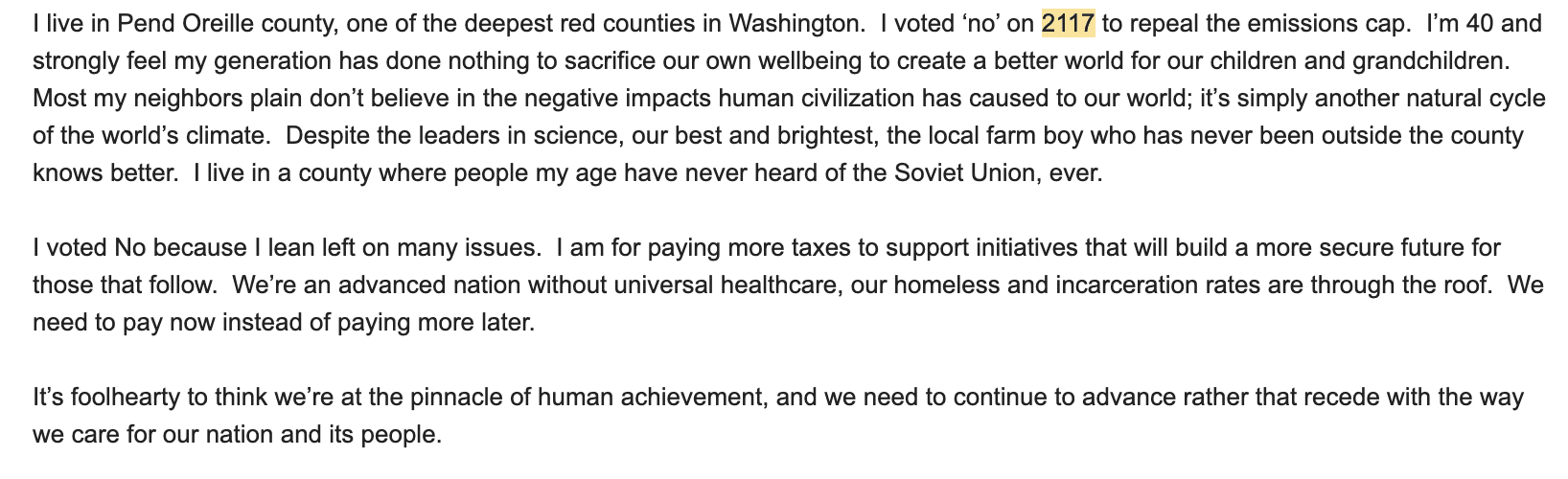

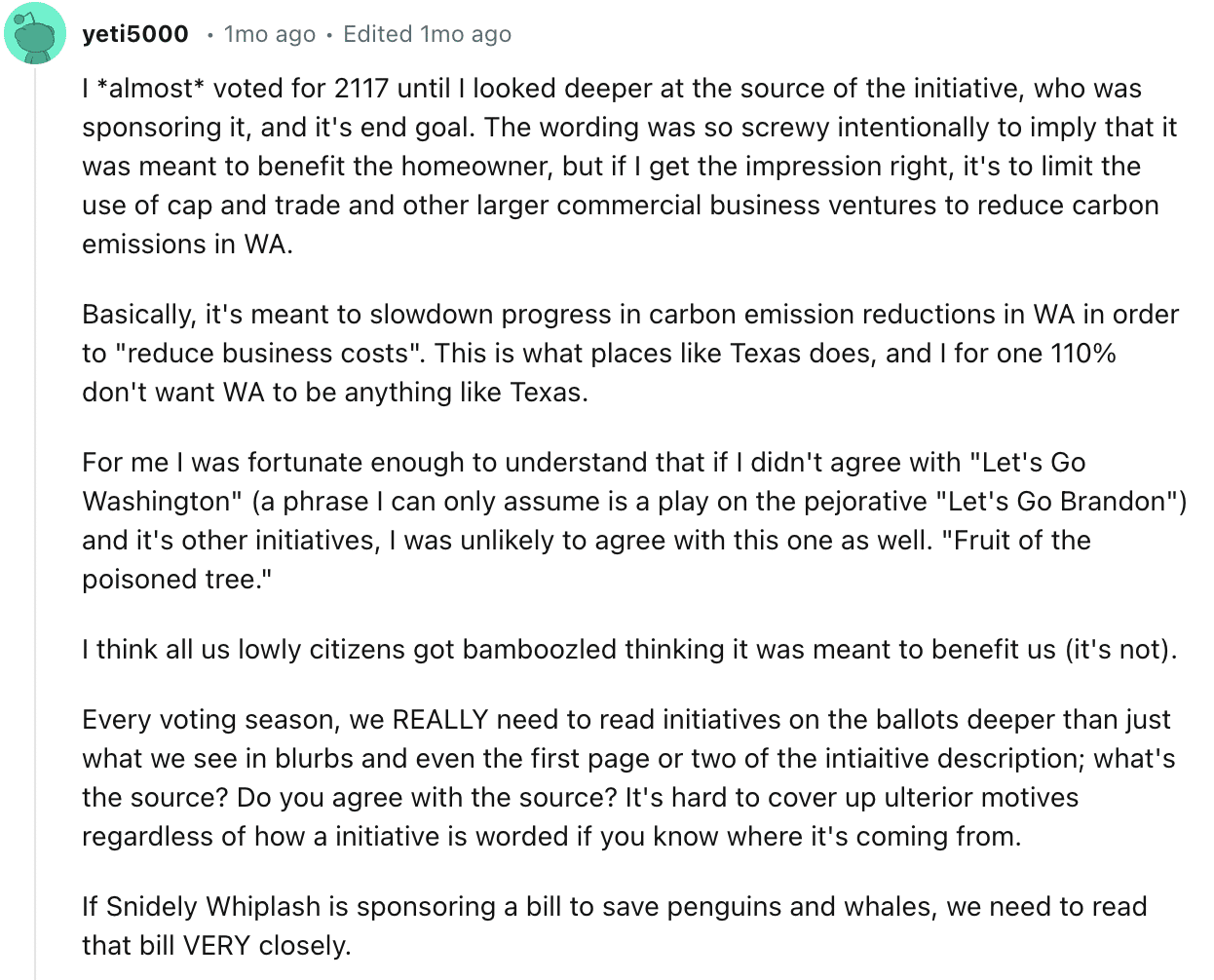
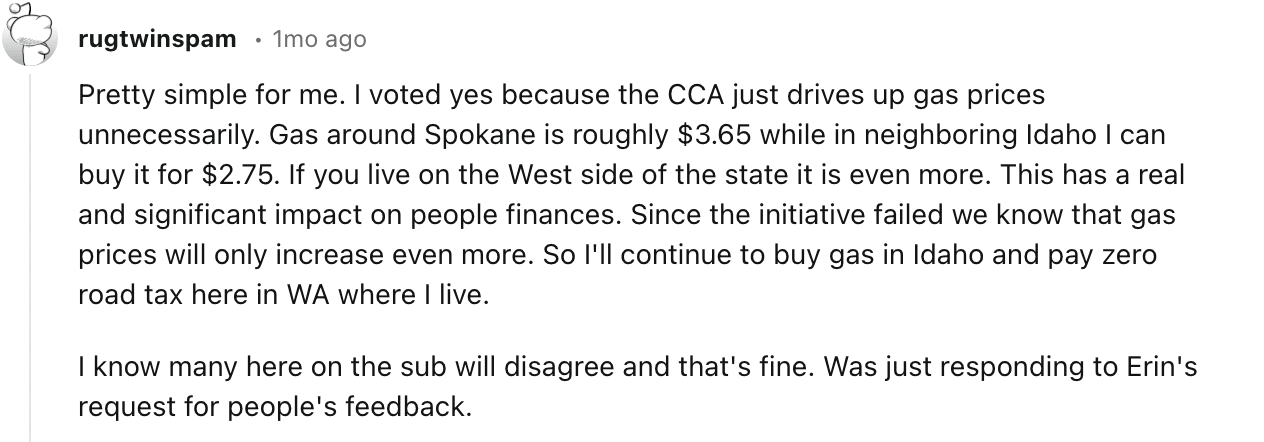
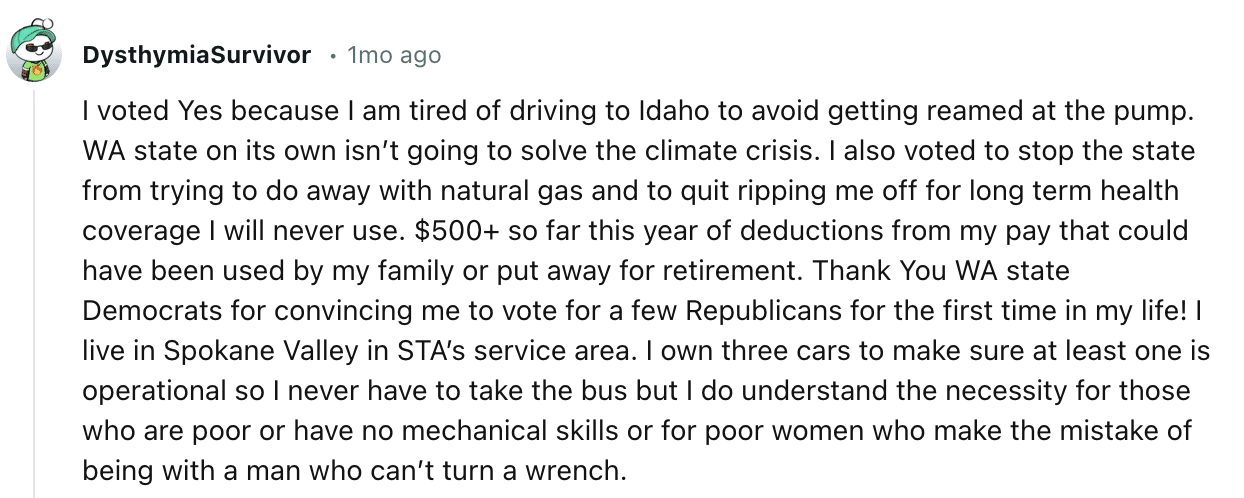
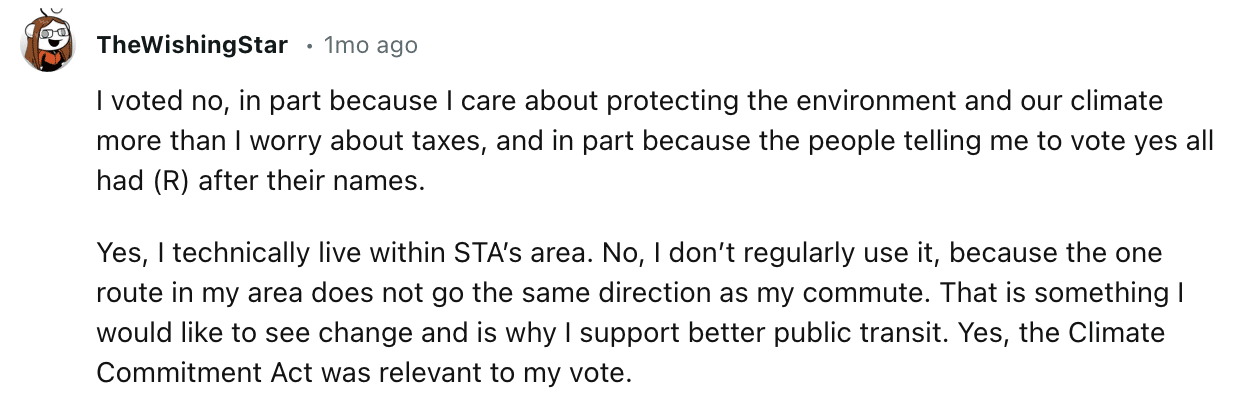
The random sampling of social media users we polled largely didn’t mention transit as a factor in their vote (although when we asked follow-up questions, some of the voters were transit riders). When we asked local urbanists and transit advocates, though, the funding for local transportation and clean energy played a much more front-of-mind role in how they voted.
"I voted against Initiative 2117 because the last thing we need in 2024 is decreased funding for transportation,” wrote northwest Spokane resident and transit advocate Sarah Rose in a message to RANGE. “Change is uncomfortable, especially when it requires doing hard things, like re-thinking how people move throughout a city and state … I think of carbon taxes a lot like eating our vegetables, it's not something we necessarily want to do right now, but if we don't we will certainly suffer greater consequences later.”
Our Transportation and Urbanism columnist Lauren Pangborn, who also lives in northwest Spokane, voted no on 2117 because “we need to provide viable transportation alternatives for our residents for the sake of our economy, our environment, and the health of all Spokanites. Projects like the Division BRT line and Safe Routes to School are both funded by the Climate Commitment Act and provide the transportation alternatives we need.”
Spokane Reimagined founder Erik Lowe and Spokane Valley resident said that the CCA’s funding for STA was a huge part of his vote against 2117: “It would have completely destroyed the funding mechanisms for public transit and active transportation in Washington. Spokane Transit Authority would have had to significantly scale back plans for the Division BRT and other high performance transit. While the agency couldn’t make a statement for or against the initiative, the numbers staff presented to the STA Board of Directors in the event 2117 passed were dire. I don’t think it’s a coincidence that ‘No’ votes in Spokane County mirrored the boundaries of the Public Transit Benefit Area.”
While the minds of voters are vast and unknowable (almost as vast and unknowable as the minds of women and fish) and it’s hard to pin election results onto one specific thing, we do know that voters residing within STA’s service area were more likely to see clear and defined benefits of the Climate Commitment Act that Initiative 2117 would likely have ended.
STA’s popular Zero Fare for Youth program, for example, was paid for by a grant from the state — which in turn was funded by proceeds from the state from the carbon credit auctions. Karl Otterstrom, one of the agency’s two interim co-CEOs, told RANGE that, because of careful budgeting, STA wouldn’t have had to make immediate cuts if Initiative 2117 had passed, but it would have impacted long-term planning and meant cuts down the road.
Otterstrom said that the precinct-level results reminded him of data from eight years ago, when STA successfully ran a sales tax measure on the ballot the same year Trump was elected to his first term. Even in pro-Trump precincts within the PTBA, voters largely supported the new tax, even though it cost them money.
Most people don’t want to pay for higher gas prices, Otterstrom said, but when there are clear benefits laid out like green energy and better transit, voters across the political spectrum have shown a willingness to take a small hit to their wallet.
Soon, Otterstrom’s theory will be put to the test again.
That .02% tax, which voters authorized in 2016 by a margin of 55.79%, will need to be renewed again in 2028 before the end of Trump’s second term.
“The fact that [rejection of 2117] ties so well within the STA boundary,” along with high ridership recovery post-COVID19, “is another indicator of support in the community,” Otterstrom said.
“ We all benefit from public transportation and another car off the road,” he added. “We believe it indicates ongoing trust in STA and we're committed to delivering on that trust.”
Editor's Note: This story has been edited slightly to add more context about the PTBA.


