

Editor's note: Today The Guardian published a story including former Gonzaga professor Andrea Brower, who for her Palestine solidarity activism was subjected to an investigation. After 7 months, the investigation found the charges to be unsubstantiated, but even after that, Brower felt the university was still attempting to silence her. We’re publishing a companion to the Guardian piece: Words she wrote accompanying her resignation in protest last month. — Luke
Two years ago I was hired for a tenure-track position as the lead instructor in a Solidarity and Social Justice program at Gonzaga University. My job description opened with “scholar activism” and specified working with students in their social justice pursuits. This new position came after five years of adjuncting and lecturing at the university on poverty wages, earning as little as $23,000 per year with no benefits for the same workload as a full professor: a 3-3 teaching schedule and “voluntary” research and service. Reaching tenure track was a welcome shift to a less precarious position that finally covered childcare bills, and I had high aspirations for what I might create as a lead instructor and mentor in an explicitly social justice program. Soberingly, I have come to the conclusion that it is not possible to do the work I am called to do in this world — and the job I was hired for — at Gonzaga University.
I came into academia through grassroots movements and a deep activist commitment to “the common good … humanism … solidarity with the poor and vulnerable, and care for the planet” — Gonzaga’s stated mission. When my activism was distant from the university, it was embraced, celebrated, and packaged into a neat commodity that could be marketed to the growing number of students interested in social justice. This changed as my activism got closer to the institution and I started to speak about treatment of adjuncts, skyrocketing administrator salaries, the university’s investments in fossil fuels, and the extensive challenges faced by students of color.
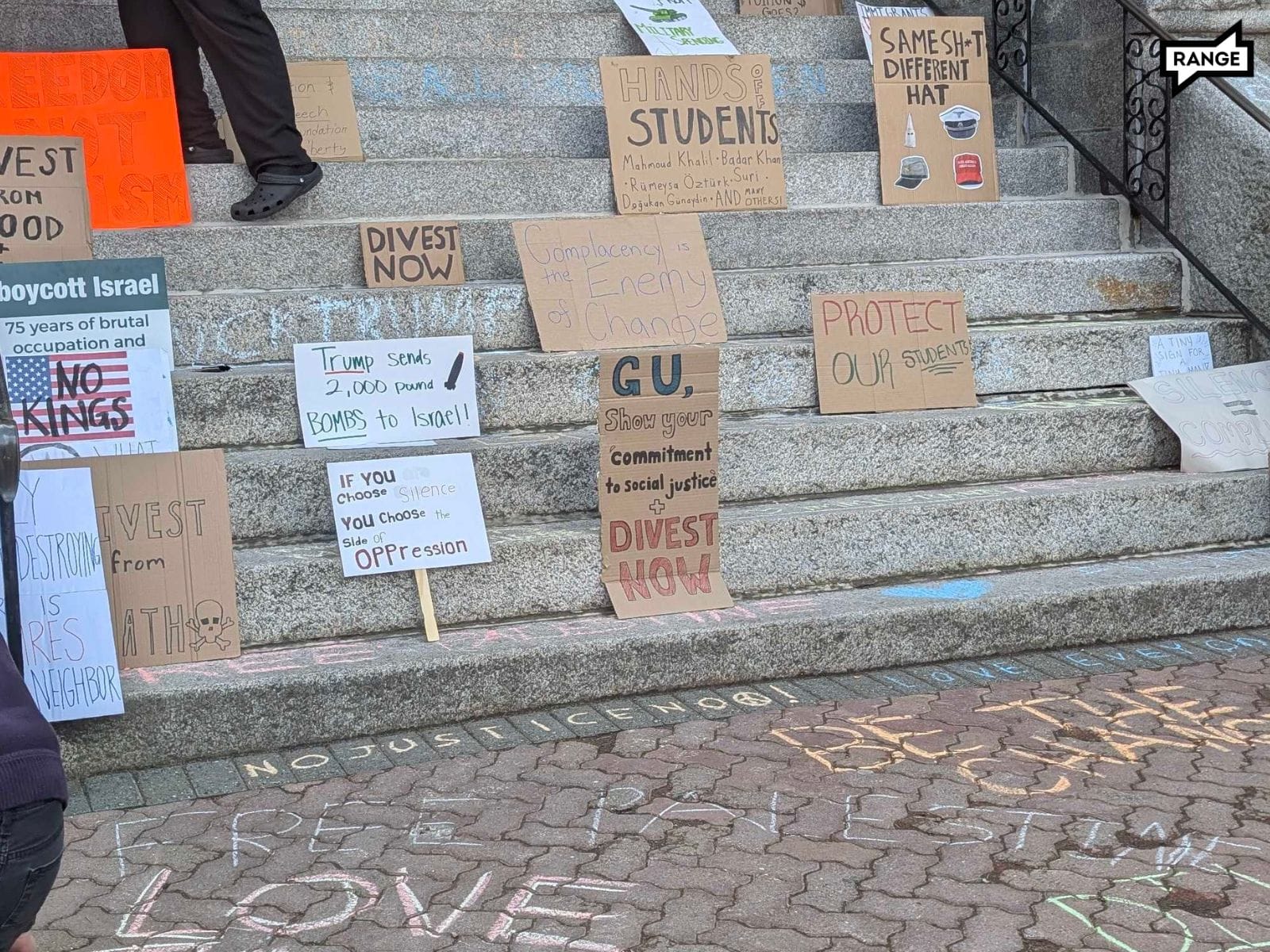
When I began to participate in student actions for Palestinian human rights and spotlight the university’s partnership with weapons manufacturers, I quickly became the target of a constant stream of harassment. Peace signs were ripped off my door, campus security was caught stalking around my office taking pictures, angry and threatening emails became a norm, intentionally false accusations about me were posted to the entire faculty listserve, and my character was repeatedly slandered. Merely for speaking about Palestinian suffering, I was charged with extremism, Holocaust denial, supporting terrorism, immorality, anti-intellectualism, and spreading KKK propaganda.
Separate from me personally, the administration also signaled their increasing willingness to repress critical thought and dissent on campus. In 2024, administrators instituted a draconian anti-protest policy, condemned peaceful student protestors, endorsed the white Christian supremacist and professor-doxxing organization Turning Point becoming one of the largest student groups on campus, and allowed faculty who were planning educational events about Palestine to be bullied into canceling such events, including a panel featuring a Palestinian professor later nominated for the 2025 Nobel Peace Prize.
The attacks on me culminated in a "Harassment and Non-Discrimination Policy Complaint” filed by a faculty member that I have never met. The person who filed the complaint against me bragged to other colleagues about their intent to use such policy to shut down voices for Palestinian human rights. They targeted me as part of a much wider, highly resourced effort to weaponize Title VI non-discrimination law to silence critique of Israel. The administration declined to tell me the details of the allegations, and after one interview at the start of the investigation, I was informed by the university that I would not be able to participate in the process while on a pre-approved medical leave. In essence, I was on trial without knowing the specific charges against me and without any representation from myself or a lawyer.
The investigation dragged on from December 2024 through July 2025, a time period in which an authoritarian-aspiring federal government took over and began abusing Title VI civil rights law in their efforts to deport and intimidate Palestine solidarity activists. When I asked my university if they had considered this changing political context and what they would do to protect me, they responded a week later with a link to mental health counseling.
After more than seven months, I was finally presented with the specific allegations against me. I was told that attending a student protest that used the word “genocide” to describe Gaza (consistent with the UN), and forwarding an open student letter against the university’s protest policy to our faculty listserve, were alleged to be antisemitic actions. The allegations were rightfully found “unsubstantiated,” and could have reasonably been dismissed immediately as a blatant political attack.
Though I definitively won the investigation and the investigator found every allegation against me unsubstantiated, I was told that I would still face “intervention” from university leadership, and then was supplied a list of vague, completely unevidenced and uninvestigated claims in reaction to my Palestine solidarity activism.
The intent was clear: to silence me even though there was no legal or evidenced grounds on which to do so.
I do not know the precise claims that the university constructed against me because they have refused my requests to see these in writing. What was read to me included that I purportedly lack understanding of Israel and Palestine, that I am not sensitive to the feelings of Jewish students and faculty, and that I create conflict on campus.
It is not my “lack of understanding,” but my fundamentally different position than people who defend the current mass slaughter and much longer history of attempting to eradicate Palestine and Palestinians. In this, I stand with and work closely alongside many Jewish students, faculty, and community members who also take the position of rejecting all interrelated forms of oppression, including oppression wrought by Israel. For their criticism of Israel, many have come under intense – one Jewish student called it “hellish” – pressure at Gonzaga.
Jewish students have also faced pressure to report, and I quote, “anti-zionist and antisemitic” professors and classroom conversations. The intentional conflation of antisemitism with critique of the Israeli government, genocide, and zionism is wearing thin across the country and world, but there remains a forceful, highly-resourced effort for Jewish people especially to comply. Having differing opinions and perspectives on the question of Palestine and Israel is one thing — but to so blatantly and punitively silence any and all discussion of the suffering of Palestinians is quite another, especially when it is done in the name of, and largely to the detriment of, another historically persecuted group of people.
As for the accusation that I “create conflict” on campus, there is an element of truth in this — a truth that I stand tall in.
As a scholar of social movements, I understand that social change is never handed down from on high — it comes through struggle, disruption, challenging structures of power and ideologies undergirding them, and yes: conflict. I am immensely proud of my students, who have been making beautiful trouble on campus. My work with them has been the most meaningful part of my experience at Gonzaga.
Some of my colleagues have expressed concern about the political attacks against me, but equally counseled that, given the imminent threats to higher education from the Trump administration, the best response is to stay quiet, not draw attention to our university, and comply in hopes that we might avoid the wrath of a fascist-aspiring regime.
While I sympathize, I strongly disagree.
What are we actually preserving in higher education if we are contorting ourselves to fly under the radar of fascism? If we cannot speak honestly, clearly, and loudly about the genocidal starvation of children — or at minimum support our brave students who are — what is our role as scholars? Universities have fraught histories as both institutions that reproduce dominant class structure and ideology, and institutions that seed liberatory thought, imagination, hope, and resistance. If we concede the latter, what are we left with?
Now is not the time for quiet. Now is the time for a bold new vision for higher education that is accessible and emancipatory, and now is the time to fight for that vision.
Now is the time to press our demands on administrators, who for far too long have facilitated the corporatization of universities that has left us so vulnerable to fascist assaults. While it is easy to point fingers at shameless authoritarians — and we absolutely should — it is more complicated to reckon with the fact that largely “liberal” administrators paved the road for the situation we are now in; and “liberal” administrators and faculty alike are participating robustly in the extreme, McCarthyist repression of voices for Palestinian humanity. Such reckoning actually puts us into conflict with the racist imperial capitalist project that drives the destruction of Palestine, and undergirds reactionism and liberalism alike.
While my resignation may be interpreted as a win for reactionary forces, my role in the struggle for collective liberation is simply moving outside of the walls of the university. I will continue to write, teach, and struggle for collective freedom and peace, but I will do so unfettered by institutional policing of emancipatory thought and hope, as the battle I am called to wage is not for the soul of this university, but for the future of humanity and the earth.
I offer to all past and present students continued support in their social justice pursuits, and a non-affiliated, uncensored study group through the Fall semester.
The struggle at Gonzaga is far from over, and it is students that are leading the way. If Gonzaga is to be a place that offers anything meaningful to the intellectual project, to the students and workers that make it what it is, to its humanistic and social justice mission, then it would do well to listen to its compassionate and wise students who are embodiments of that mission.


