

This story was published in partnership with the University of Washington’s Center for Human Rights, who provided data analysis.
In May, a sheriff’s deputy in Texas searched 83,345 Flock cameras across the nation looking for a woman who authorities alleged had given herself an abortion. The Johnson County Sheriff was considering prosecuting her for the death of her fetus.
New records obtained by RANGE prove that some of those cameras belong to the Spokane County Sheriff’s Office.
After the US Supreme Court ruled that states could criminalize abortion in 2022, Washington has continuously committed to protecting access to reproductive healthcare, including abortions. Washington law “prohibits the interference with a pregnant person's right to choose to have an abortion prior to viability or to protect the person's life or health.” It also prohibits extradition and law enforcement compliance with out-of-state agencies who may seek to prosecute abortion seekers for receiving a procedure that is legal in Washington.
Locally, the Spokane City Council passed an ordinance in April stating their strong belief in “the right of individuals to seek, obtain, provide, or facilitate gender-affirming care that is legal in Washington State.”
None of those well-meaning sentiments prevented the Johnson County deputy from asking Spokane County’s Flock camera system — along with thousands of other networks across the country — to find a woman driving a Land Rover with Texas plates. The reason listed in the query: “had an abortion, search for female.”
News broke in October — following a report from the University of Washington — that Flock cameras in Yakima and Prosser had been searched by the Texas deputy, who is identified in the search logs as “J. Smi.”
After that report came out, Spokane County Sheriff John Nowels told The Spokesman Review that he ensured the county Flock data was “locked down” after the reports of the Texas officer’s nationwide abortion-related search. He didn’t mention that the Texas sheriff deputy had used Spokane County’s cameras in his search.

The search made on Spokane County cameras.
In an interview with RANGE on November 24, Sheriff Public Information Officer Mark Gregory said that the SCSO noticed that the cop from Texas had searched their cameras for the woman after 404 Media’s story broke. Gregory thought there was more to the story than what the media reported.
“My understanding was the young lady was actually ill or if she was potentially suicidal,” Gregory said. “As far as I’m aware, the actual reason for the search had nothing to do with an abortion at all other than he entered in as the reason for the search, but I’m not an expert on this particular story.”
Though the Johnson County Sheriff’s Office later claimed the search was for a welfare check and Flock Safety echoed those claims, records obtained by the Electronic Frontier Foundation revealed that deputies had opened a “death investigation,” for her “nonviable fetus.” (Since then, Johnson County Sheriff Adam King has been indicted on felony counts and charged with aggravated perjury for allegedly lying to a grand jury in an unrelated sexual harassment and whistleblower retaliation case.)
Flock Safety told SCSO that no responsive records were returned from the search on Spokane County cameras, Gregory said.
Still, that particular story and subsequent media coverage were a catalyst in SCSO realizing “other people can see into our system,” Gregory said. By the end of May, SCSO had turned the national look-up feature off, Sheriff John Nowels claimed.
SCSO records we received show that searches were made using Spokane County cameras by authorities across the country right up until the last day of the records we received. Below is a screenshot of the network audit, which shows a sample of the searches made on June 23.
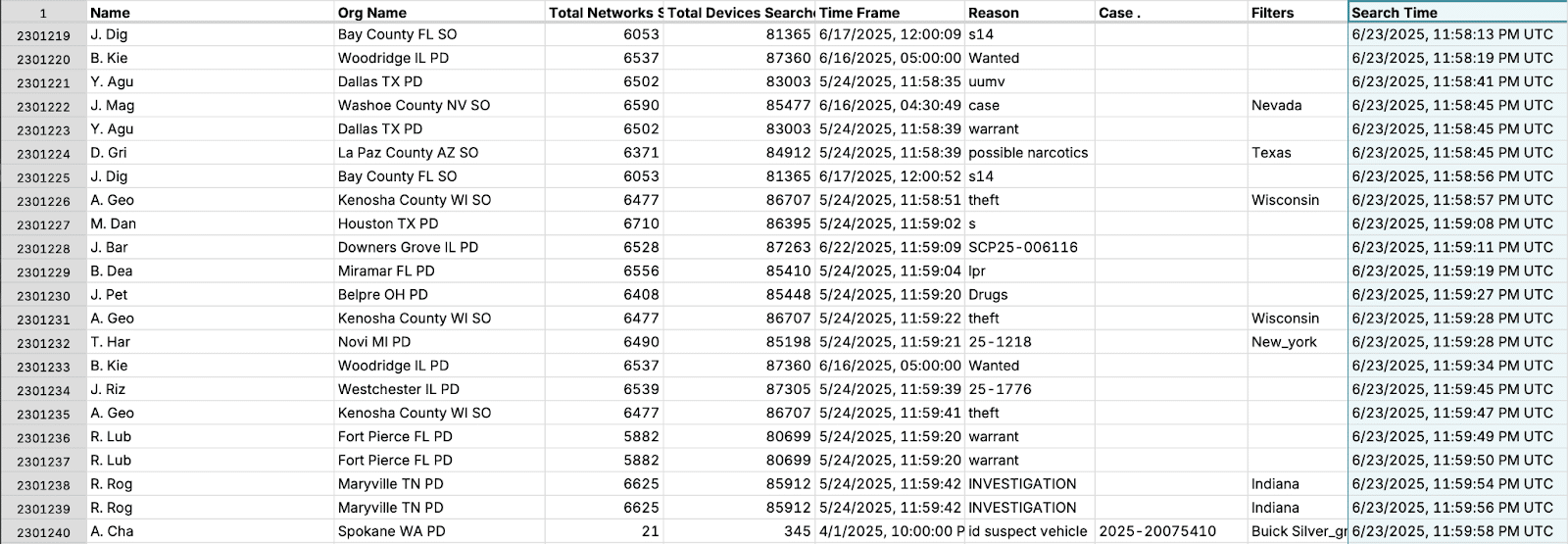
When pressed about the June searches in a second interview on November 25, Gregory said the May timeframe may have been inaccurate, and some searches could have been made as late as June. Gregory said the sheriff’s office didn’t know the exact date it had turned off the national look-up feature, but maintains it has been turned off now. The only agencies that can now access the county database are within Washington State and a few agencies from Idaho who have explicit data-sharing agreements with the Spokane County Sheriff.
What is Flock and who else has access to these cameras?
Flock is a surveillance technology brand that sells a specific brand of Automated License Plate Reader (ALPR) that are used on a subscription basis by law enforcement agencies across the state.
The cameras constantly log photos of any car that drives past them, whether that driver has potentially committed a crime or not, which is then stored for up to 30 days in a database owned by the law enforcement agencies. That database can then be searched by whoever has a direct log-in to it, or any agencies that it has been shared with. Read more about Flock cameras in our region and where they’re located here.
The Spokane Sheriff’s network currently has more than 60 Flock cameras operational within the county, including mobile Flock cameras mounted on vehicles that move around the area.
As of July 3, 2025, SCSO had authorized 227 users to log in to their network directly, including officers from Idaho (and Kootenai County specifically), a user with an FBI email account and a gmail account labelled just spokanetemp@gmail.com.
From January 1, 2025 to June 23, 2025, 2,301,239 searches were made on SCSO’s Flock Network. Just 110,069, or 4.8%, of those searches were made by the SCSO, the Spokane Police Department and the Spokane Tribal Police Department.
Gregory said that SCSO does quarterly audits of the searches made on the network. To his knowledge, no deputies in Spokane have ever been disciplined for misuse of the Flock system.
“We have a very well-defined and articulated policy on how we use that data, when it’s released, when it’s not, what we’ll search for and what we won’t,” Nowels said. “Everybody who searches the system, they have to identify what case number they’re using or what reason they’re actually querying the data. You can’t just go in on a free-for-all. There has to be some reason you’re accessing the data.”
“Had an abortion, search for female” is not a valid reason for a search under the SCSO policy, Gregory said, because abortion is not a crime in Washington.
Flock can only be used to search for things related to crimes, he stressed.
Despite how well-defined and articulated the policy is, though, in practice, Flock does not lock out searches that offer inadequate justification to search.
In RANGE’s review of the “reason” and “case” number fields of the provided search data, we found over 289,000 searches with no case number at all and, under reason, some variation of the word “investigation.”
None of those searches is in compliance with the SCSO policy, but they went through regardless.
Additional reporting contributed by Aaron Hedge.
For information on this investigative series, why we're reporting it and what's coming next, click here.


