

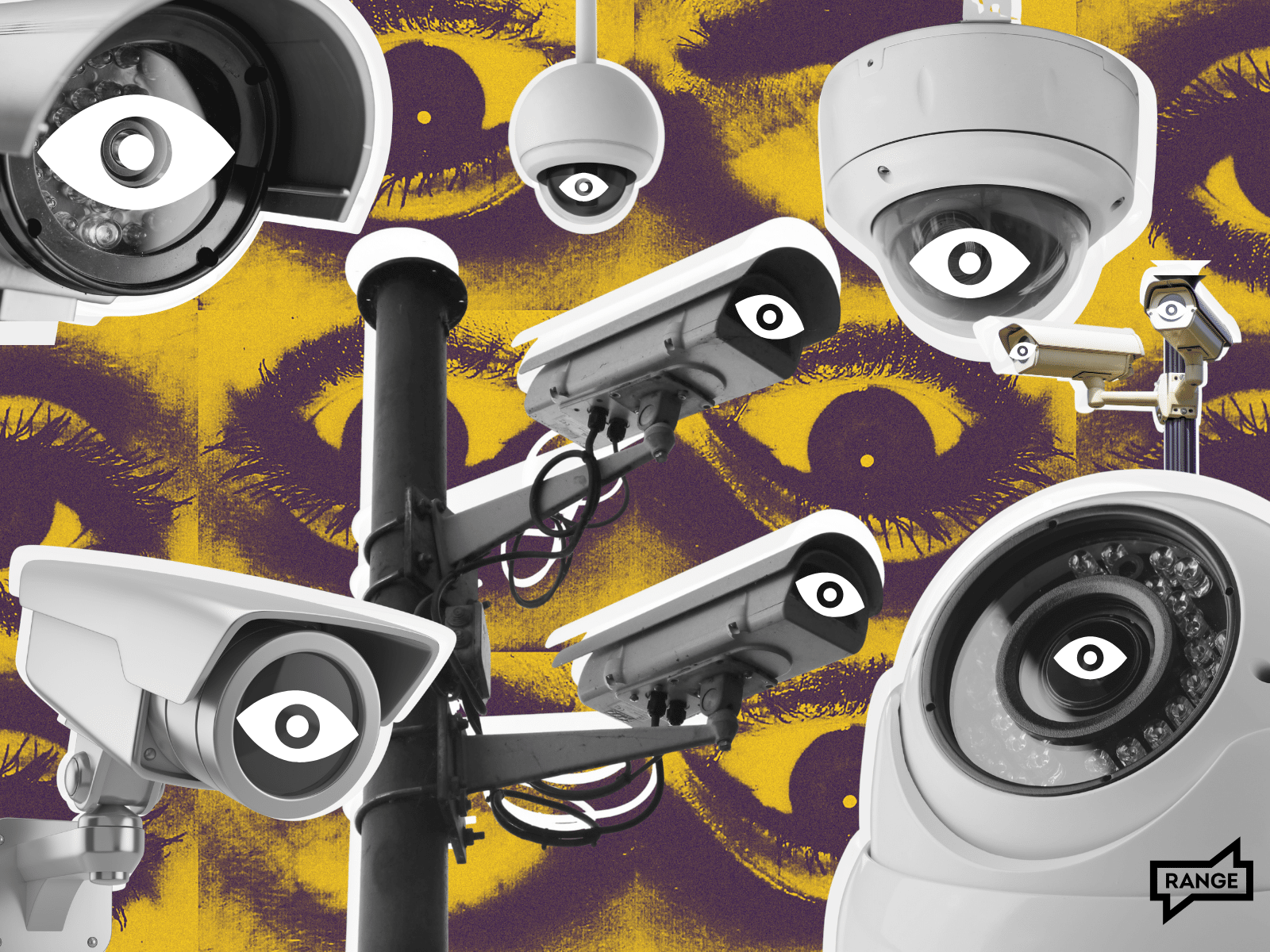
When you enter or exit Spokane County on almost any major road, your car’s color, make, model and license plate number are automatically captured by at least one camera made by the surveillance technology company Flock Safety.
That data is stored for at least 30 days in a database accessible by law enforcement agencies across the state, and in some cases, the nation.
With nearly 100 Flock cameras currently operating in our county and more than 30 additional cameras set to roll out soon in small cities across the region, Spokane County is quickly becoming a well-embroidered square in the quilt of Flock surveillance that blankets the country.
The databases created by Flock and similar Automated License Plate Reader (ALPR) technology have created a nationwide network that has been used for everything from its intended purpose — solving serious crimes — to helping cities surveil majority Latino communities, red-state detectives to track women seeking reproductive healthcare across state lines and police officers stalk their exes and even each other.
At the federal level, anti-surveillance activists fear this technology will empower federal governments to hijack local data intended to solve serious crimes and use it to find and detain law-abiding immigrants. And As President Donald Trump’s administration has carried out mass deportation policies across the country, those worries have proven well-founded. It seems every week there is new reporting revealing new ways Customs and Border Patrol (CBP) and Immigrations and Customs Enforcement (ICE) are using the nationwide Flock network — and other surveillance tech — to track and detain immigrants.
In some cases, this has happened in “sanctuary states” that forbid the use of local resources or data-sharing to assist in immigration enforcement.
While Flock has blocked nationwide access to local cameras in Illinois, California and Virginia to stop violations of the law in those three states, Washington has not made the list so far — which means federal agents may be able to access Flock cameras in Spokane County. The company also committed this week to stop cooperation with federal agencies, which was happening in states with sanctuary policies without law enforcement agencies’ knowledge — including Illinois, which was supposed to have been previously pulled from national look-ups.
Other Washington cameras have made national news, like in Yakima, where its Flock network was accessed by a Texas cop hunting for a woman who detectives suspected left the state to access reproductive healthcare. But so far, Spokane has largely flown under the radar when it comes to Flock cameras (pun intended). DeFlock, a community project that maps surveillance devices nationwide, shows 28 cameras in the county. Eyes on Flock, a similar project, has no data available at all for Spokane County cameras.
We wanted to get a fuller picture on the state of surveillance in Spokane, so we dove into publicly available Flock contracts across the county, mapping coordinates of known cameras and requesting public records on the search history, authorized users and sharing settings of the regional Flock networks. We’re still waiting on a few records requests at various county agencies, but here’s everything we know so far.
How does Flock work?
Flock Safety is a surveillance tech company with a variety of products — like ALPRs, video cameras, gunshot detection devices and mobile security trailers — and subscription-based software.
Locally, most jurisdictions buy into FlockOS, real-time crime center software that connects to ALPR cameras purchased by the contracting agency.
Unlike the city of Spokane’s red light and speed cameras — which snap pictures when a car driving by triggers them by driving too fast in a school zone or blowing through a red light — Flock cameras constantly log the data of any car that drives past them, whether that driver has potentially committed a crime or not.
The data is then dumped into a database owned by the law enforcement agency that purchased the FlockOS subscription. It’s kind of like Dropbox for surveillance tech: the agency owns all its images, but pays a subscription fee to the software that is hosting them and giving access to tools to process or sort through those images.
FlockOS, which is the subscription purchased by the Spokane County Sheriff’s Office (SCSO), Cheney Police Department and likely Liberty Lake Police Department, provides real time alerts. For example, if a license plate associated with a suspected kidnapping passed a Flock camera, law enforcement in that jurisdiction would get an alert.
They can also search for specific plates, which may be suspects in open cases, or general searches of specific cameras near crime locations to see if any case-relevant vehicles have appeared in the database. In order to make a search, the person searching has to provide the system with a reason they need the information.
At the base level, FlockOS allows agencies to create hotlists of vehicles they want to receive notifications about, connect to and search private cameras (with the permission of their owners) and store collected data for 30 days.
Each Flock network gets control over a variety of other features. Here are some decisions they have to make:
- Statewide sharing — will they allow all agencies across their state with FlockOS subscriptions to search data collected by their cameras?
- Nationwide sharing — will they allow all agencies across the country with FlockOS subscriptions to search data collected by their cameras?
- Agency-level sharing — Which individual agencies will they give access to search their network? This can be done on an individual basis or more generally, like every agency in a certain mile radius.
- Data transparency — how transparent will they be about their data collection and privacy standards? The FlockOS software allows each agency to create a public facing Transparency Portal that displays information like how long data is stored for, searches prohibited by agency policy, or even exactly which searches have been made and when. Just how much data is publicly available without the aid of a public records request is up to the individual agencies.
Who has Flock cameras in Spokane County?
The biggest owner of Flock cameras in the county is the county itself: the Spokane County Sheriff’s Office, which was one of the earliest adopters of Flock in the region. It inked its first contract to install more than 30 cameras in 2022 as part of a pilot project that was then transformed to a sole-source contract.
Now, they have more than 60 cameras in their network.
Through contracts approved by the Board of County Commissioners, we found exact intersections and coordinates for 49 of those cameras. We found approximate locations for another eight cameras. SCSO also has two mobile Cameras on Wheels (COWS) and six radar trailers that can be placed anywhere and moved throughout the city. The SCSO network also includes three privately owned cameras whose owners chose to share their data with the county; they’re all placed in Lowe’s parking lots.
Spokane Valley, which contracts with SCSO for policing, approved a contract in February of this year to spend almost $500,000 of American Rescue Plan Act (ARPA) dollars on a five-year contract to install 26 ALPR cameras across the Valley. These cameras would be part of SCSO’s network. We’re waiting on a records request to confirm whether or not these cameras have already been installed, and if so, at which intersections.
As of June 2023, 16 Flock cameras had been installed in Airway Heights, which were used in January 2025 to identify a man suspected of stabbing someone. His license plate was flagged in a Walmart parking lot by a Flock camera. (The Walmart Foundation also funded Airway Heights’ camera network). Reporting from 2023 showed Airway Heights was sharing data with both Liberty Lake Police Department and SCSO.
Liberty Lake also had cameras as early as June 2023, when they were used to arrest a man suspected of attacking and strangling a woman near a trailhead. According to data turned over to RANGE in a public records request, Liberty Lake now has 19 cameras placed across the city.
Cheney is a bit behind the trend, having just approved a $52,000 contract to get eight Flock cameras in March 2025. Those cameras have not yet been installed, but Cheney Police Department gave RANGE the list of intersections they’re slated to be placed at.
Noticeably absent from the list is the city of Spokane. Back in February, Spokane City Council approved a proposal from the Spokane Police Department (SPD) to place at least 30 Flock ALPR cameras at intersections across the city — and more if the funding became available.
This contract sparked pushback from local advocates concerned about the expansion of surveillance in the region, who started a petition asking the city to pause the installation.
When the proposal passed council, SPD had already prepared a list of intersections and had the funding lined up: a $100,000 grant from the Washington Auto Theft Prevention Authority (WATPA) and about $20,000 in departmental funding.
But between February and August, no cameras were installed. It wasn’t necessarily the activists that killed the contract — it was good ol’ fashioned government inefficiency:
When asked about the February council approval to spend the WATPA money, SPD Police Chief Kevin Hall said the “funding stream evaporated,” when it was clawed back after the city did not use it in time.
“We could not coordinate the purchase and installation in time,” Hall wrote. SPD spokesperson Daniel Strassenberg told RANGE the city has no current plans to purchase a Flock system.
Who can access FLOCK cameras?
While Spokane city can still access at least some of regional Flock network cameras through a login that was created when they were planning to contract with the company, Hall suspects that access will soon evaporate like the WATPA funding stream when Flock realizes the city has no real plan to purchase cameras.
Then, they’ll have to look into getting access to SCSO’s network if they want to continue searching Flock’s license plate databases.
This leads into a larger question: just who exactly can see what data collected by Flock cameras?
There isn’t a simple answer — because each network can customize its data sharing settings, who can see your license plate information depends heavily on which Flock camera picked it up.
Further complicating the question, access isn’t just decided by the list of agencies who opted in to data sharing; it’s also determined by who in those agencies is an authorized user with a personal log-in to the network.
Take the Spokane County Sheriff for example: we don’t know if they’re opted in to state or nationwide lookups because SCSO spokesperson Mark Gregory hasn’t responded to multiple requests for comment. And the sheriff’s public Transparency Portal makes little information available (compared to other jurisdictions nationwide, which tell you opt-in settings and even searches made). We haven’t received that installment of our county public records request.
But we do know that there are currently 227 authorized users — accounts allowed to log directly into SCSO’s Flock portal to search license plates, according to data we received from one of our records requests.
Most of those users have emails associated with SCSO or Spokane Regional Emergency Communications, but a few stood out to us, especially those associated with outside agencies.
Multiple law enforcement officers based out of Idaho, which has no sanctuary laws prohibiting the use of state resources for immigration enforcement, have access to make searches on SCSO’s network: a crime analyst from Post Falls and two crime analysts from Coeur d’Alene. An IT guy from Spokane County has his own log in, as do a Washington state Department of Corrections employee and a clerk for the Newport Police Department.
One user has an FBI email address. Another email is just listed as spokanetemp@gmail.com with no name or identifying information attached. We have a public records request in the queue at the county to find out exactly what searches these accounts have made and when, but general accounts with no specific person tied to them can make it tricky to figure out exactly who is making what searches.
We have requests for information on data-sharing settings and authorized users open across the county, and we’ll regularly update this chart with information as we receive it.
!function(){"use strict";window.addEventListener("message",function(a){if(void 0!==a.data["datawrapper-height"]){var e=document.querySelectorAll("iframe");for(var t in a.data["datawrapper-height"])for(var r,i=0;r=e[i];i++)if(r.contentWindow===a.source){var d=a.data["datawrapper-height"][t]+"px";r.style.height=d}}})}();
What are the safeguards?
The widespread use of Flock cameras and access to the data collected by them has many privacy advocates on edge.
On its website, Flock stresses the importance of data protection and peoples’ constitutional rights to privacy.
“Flock has designed our systems in a way that respect[sic] both the spirit and the letter of the Fourth Amendment and guard against unreasonable search and seizure,” its website reads. “Flock’s platform supports law enforcement in upholding the Fourteenth Amendment and due process, ensuring equal protection of the laws.”
There are supposed to be safeguards built into the Flock software: data can only be stored for a limited amount of time, each jurisdiction gets control over who can search their data and each search has to be tagged with a reason for the search, which allows for audits of the data.
But as detailed reporting from 404 Media has revealed over the last few months, those safeguards don’t work, especially when it comes to protecting immigrants’ data. In the most recent news, CBP actively searched data from Colorado under a federal “pilot program” that gave nationwide access to the agency. Flock paused the program after the news broke.
Federal agents have also used shadier methods to gain access to local Flock networks, like a DEA agent who used the log-in of a local police officer to search records in Illinois and police in Oregon who made searches on behalf of ICE. Like Washington, Colorado, Oregon and Illinois have sanctuary state policies banning police from sharing data with federal agents for the purpose of immigration enforcement.
It’s also difficult to audit networks to ensure that searches are being used properly. While SCSO training material gave examples of good search reasons, which would include a case number or other link to a specific crime, and bad searches, like “investigation,” “crime,” “x,” “nanananananana,” and “My Ex Girlfriend,” it's unclear how often local networks are audited to ensure that all searches are actually tied to a specific case.
If no audits are regularly conducted, misuse could easily fly under the radar. For example, a Spokane County Sherrifs officer could search for an immigrant’s license plate number for ICE, put an irrelevant case number in the search field and no one would know — unless the search logs are being carefully analyzed.
What can you do?
If the state of surveillance locally freaks you out and you’re itchy to do something about it, there are some options:
- Advocate to the Board of County Commissioners and cities’ respective councils for local jurisdictions like SCSO, Airway Heights and Cheney to create Transparency Portals and to publish the largest amount of data possible. Examples of jurisdictions with more data included on their Transparency Portals include California cities El Cajon and Alameda — which includes a file of their most recent audit, and Albany, Oregon.
- Push local jurisdictions to keep their data out of nationwide look-ups, which can easily be exploited by federal agents. This can be done by reaching out to the respective jurisdiction’s city council.
- Call your state legislators and advocate for legislation regulating Flock settings statewide. You can ask them to require maximum public transparency, minimum opt-in settings and regular publicly available audits.
Note: We have open public records requests with Spokane County Sheriff’s Office, Liberty Lake Police Department, Cheney Police Department and Airway Heights Police Department. We’ll update our Flock reporting as this information comes in.
Additional reporting contributed by Lauren Pangborn.
For information on this investigative series, why we’re reporting it and what’s coming next, click here.
If you have tips about Flock, reach out to erin@rangemedia.co or bikeroutehelp@rangemedia.co.


