

This story was published in partnership with the University of Washington’s Center for Human Rights, who provided data analysis.
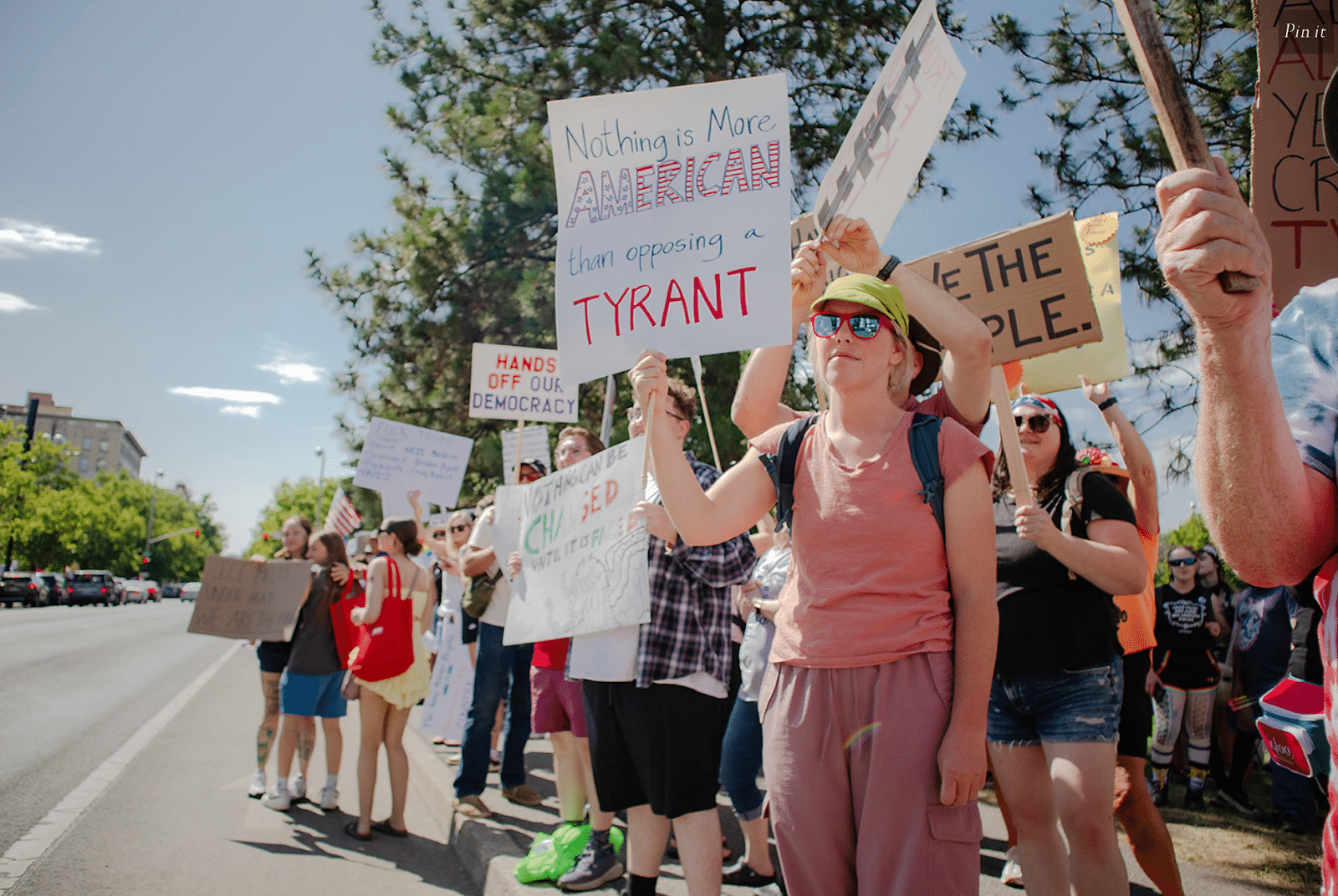
From the smoke-choked June 11 protest against Immigration and Customs Enforcement in Spokane to the packed parks and sidewalks at multiple No Kings protests, 2025 has been filled with people exercising their right to protest the US government.
As protestors lined streets across Spokane with signs proclaiming “Fuck Trump,” “Stop the War on the Poor,” and “Arrested on Wednesday, back on Thursday,” they were met with police responses including the deployment of chemical munitions and dozens of arrests. At others, protesters were met with a dialogue-focused response team at the Spokane Police Department (SPD).
But whatever the forward-facing police response was, behind the scenes, the Spokane County Sheriff’s Office (SCSO) had been quietly using Flock cameras for months to surveil protests, where people took to the streets to exercise their rights. Many of these searches were made in connection with smaller, less intense protests early in the year. SPD also made one search in connection to a “suspicious vehicle” near a protest.
Earlier this year, we requested a network audit of all searches of the SCSO Flock network made between January 1, 2025 to June 23, 2025, which shows the requesting agency, the search reason they gave, any case number attached, when they searched and how many networks and cameras they searched from.
On February 17 — President’s Day, and the date of nationwide “Resident’s Day” protests against Trump’s attacks on immigrants, BIPOC people, queer people and federal workers — hundreds of people gathered in the snowy Riverfront Park to hear from speakers and march through downtown.
The same day, SCSO tactical analyst Katie Johnson made two searches for “SPD protest.” Her first search combed through 470 cameras across nine networks, while her second was more extensive, searching 1,299 cameras on 74 networks. No arrests were made in conjunction with that protest, and Johnson’s search provided no details on why it was necessary.
The SCSO network audit records do not specify which networks were searched.
In March, searches in connection to protests ramped up.
A Spokane Police Department officer searched 197 cameras across eight networks for a red Hyundai — with the search reason as “suspicious vehicle near protest,” — after the March 4 for Liberty protest on March 4th. However, the search was specifically looking for results from February 4, a full month earlier, when folks had gathered in downtown Spokane to protest Elon Musk.
Officer Daniel Strassenberg, spokesperson for SPD, said that the search was "related to an ongoing investigation into a series of incidents at different demonstrations involving criminal activity. Some of these incidents were initially recorded as protests, while others were documented as harassment."
"During the investigation, two individuals were identified as suspects in criminal activity associated with these events, and the red Hyundai was believed to be connected to them," Strassenberg wrote in an email to RANGE. "As a result, multiple misdemeanor charges, including coercion, harassment, and stalking, were later submitted to the prosecutor's office for charging consideration for both suspects."
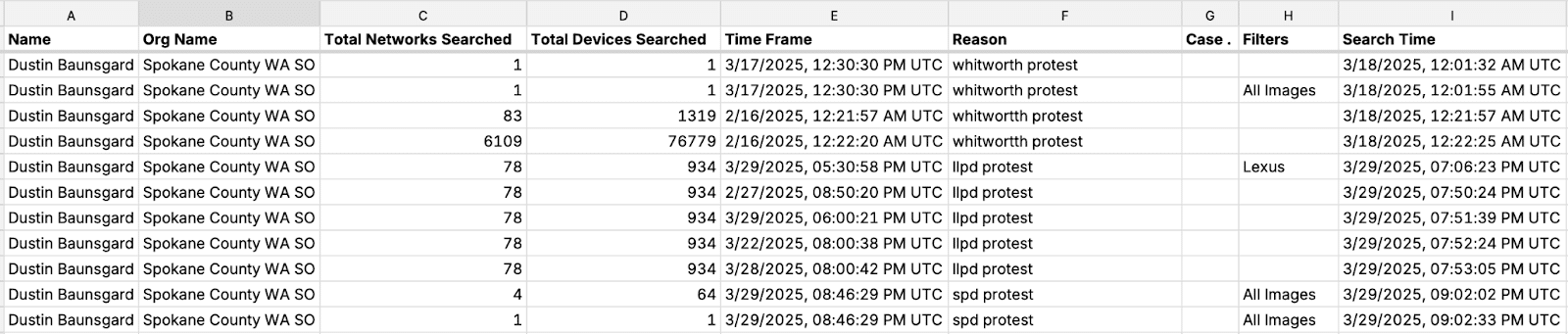
Two weeks later, protesters attended Congressman Michael Baumgartner’s Town Hall at Whitworth University, and SCSO analyst Dustin Baunsgard searched four times, searching over 75,000 cameras across 6,109 networks, for vehicles at the protest, using the search term “Whitworth Protest.” Public records released to Flock watchdog Rose Terse show the only incident report filed in connection with the protest was a parking violation.
On March 29, Baunsgard made another seven searches, this time for a Lexus related to “LLPD protest,” likely referring to the Tesla Takedown protest scheduled that day at the Tesla dealership in Liberty Lake.
Then, on June 14 and 15, after the No Kings protest planned for the same day as Spokane Pride, SCSO’s Johnston made eight searches across 1,142 cameras related to the event.

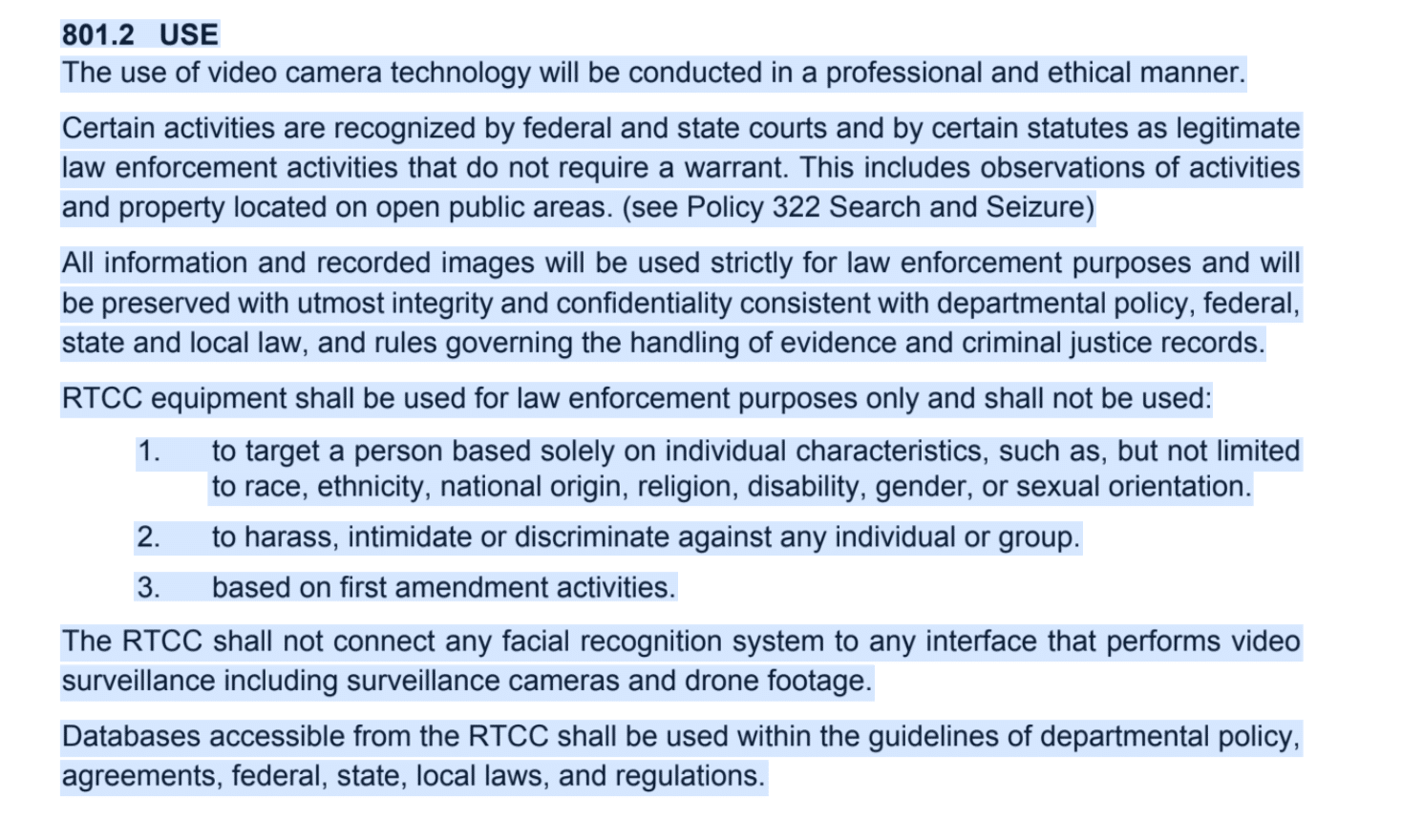
According to the SCSO’s policy manual, any equipment used by the Real Time Crime Center (RTCC) — which includes the Flock cameras — shall not be used “based on First Amendment activities.”
On Tuesday, we provided SCSO with questions about these searches and a deadline of 2 pm on Thursday. They did not respond. If we receive a response following publication, we will add it in.
We sent SCSO Public Information Officer Mark Gregory the following questions:
- Were you aware that the county Flock cameras were searched by SCSO employees for protestors? Do you have any other context for why searches were made with solely the reason “protest” given? We're including a screenshot of the searches below.
- What was done with the information gleaned in the search? Did it lead to any arrests or citations or is it being used in any cases?
- Do you feel that searching for protestors on surveillance technology like this erodes trust in local support of free speech rights?
- The RTCC manual states that Flock cameras shall not be used “based on First Amendment activities.” Would you consider these searches to be against policy, given what's outlined in the RTCC?
Nationwide searches on Spokane cameras
Local officers weren’t the only ones searching Spokane cameras for protesters.
These kinds of searches are part of a national trend uncovered by the Electronic Frontier Foundation (EFF), which obtained datasets showing that more than 50 agencies across the country made hundreds of Flock searches connected to protests.
Other law enforcement agents who searched data from SCSO cameras included:
- An officer from Shenandoah, Texas who searched Spokane County’s network and 5,584 others for “protest” four times on February 26, 2025.
- A Georgia officer who searched Spokane County’s network and 6,261 others for “protest” on March 11, 2025.
- An Indiana officer who searched Spokane County’s network and 6,401 others for “protest” nine times on April 19, 2025.
- A Florida deputy who searched Spokane County’s network and 6,507 others for “protest” on May 8, 2025.
- An Arizona officer who searched Spokane County’s network and 5,934 others for “protest” twice on May 23, 2025.
Last week, when we interviewed Gregory and Sheriff John Nowels about the national look-up feature, they first said it had been turned off in May, then in a subsequent conversation said they didn’t know the actual date but it was “spring.” Then in a phone conversation on Tuesday, they said those previous answers were "generalities," and it could have been turned off as late as July. That afternoon, we again asked them:
- Last time we spoke, you weren't sure when national look-up access got turned off. Have you been able to find a concrete date for that?
As of publication, no response has been provided.
Dave Maass and Rindala Alajaji of EFF also originally reported three of SCSO’s No Kings-related searches that appeared on network audits for other agencies they reviewed.
“In some cases, law enforcement specifically targeted known activist groups, demonstrating how mass surveillance technology increasingly threatens our freedom to demonstrate,” Maass and Alajaji wrote in their piece. “Everyone should have the right to speak up against injustice without ending up in a database.”
What is Flock and who else has access to these cameras?
Flock is a surveillance technology brand that sells a specific brand of Automated License Plate Reader (ALPR) that are used on a subscription basis by law enforcement agencies across the state.
The cameras constantly log photos of any car that drives past them, whether that driver has potentially committed a crime or not, which is then stored for up to 30 days in a database owned by the law enforcement agencies. That database can then be searched by whoever has a direct log-in to it, or any agencies that it has been shared with. Read more about Flock cameras in our region and where they’re located here.
The Spokane Sheriff’s network currently has more than 60 Flock cameras operational within the county, including mobile Flock cameras mounted on vehicles that move around the area.
Additional reporting contributed by Aaron Hedge.
Editor's note: This story has been updated to reflect a statement from SPD received after the time of publication.
For information on this investigative series, why we’re reporting it and what’s coming next, click here.


