

Nearly 100 surveillance cameras from the technology company Flock Safety watch major roads across Spokane County, capturing photos of every single vehicle that drives past and tracking the movements of everyday people. Spokane County is not alone: as many as 80 cities across Washington have Flock cameras.
Data from Flock cameras has been used to hunt a woman who had self-administered an abortion – in fact, RANGE has found that the officer who searched for that woman also searched Spokane County’s Flock records – and to track people attending the peaceful No Kings protests.
Border Patrol and Immigration and Customs Enforcement (ICE) have had access to the cameras’ data through official and unofficial channels, according to a University of Washington report, even though the Keep Washington Working Act (KWWA) makes it illegal for police departments to assist federal agencies with immigration enforcement. Several cities in Washington claim they did not realize federal agencies had access to their Flock systems until the aforementioned UW report was published. And despite KWWA, Spokane County shares its data with Kootenai County, which means an Idaho cop could in theory search Spokane data as a favor for a buddy who works for ICE.
Across the country, people are fighting back. Individuals like Jose Rodriguez and advocacy groups like The Institute for Justice and the American Civil Liberties Union are filing lawsuits. Elected officials feeling the pressure from angry constituents are cancelling their contract extensions with Flock and even turning off their cameras mid-contract.
Why we should be taking them seriously
The Spokane County Transparency Portal, which is configured by the Spokane County Sheriff’s Office (SCSO), is actually getting less and less transparent as the backlash and lawsuits around the country pile up. Between April and June, the sheriff’s office removed several data points from its transparency portal, including the number of vehicles detected in the last 30 days, system access history and its acceptable use policy.
We asked SCSO why these changes were made, but they have not yet responded. We will update this story if they do.
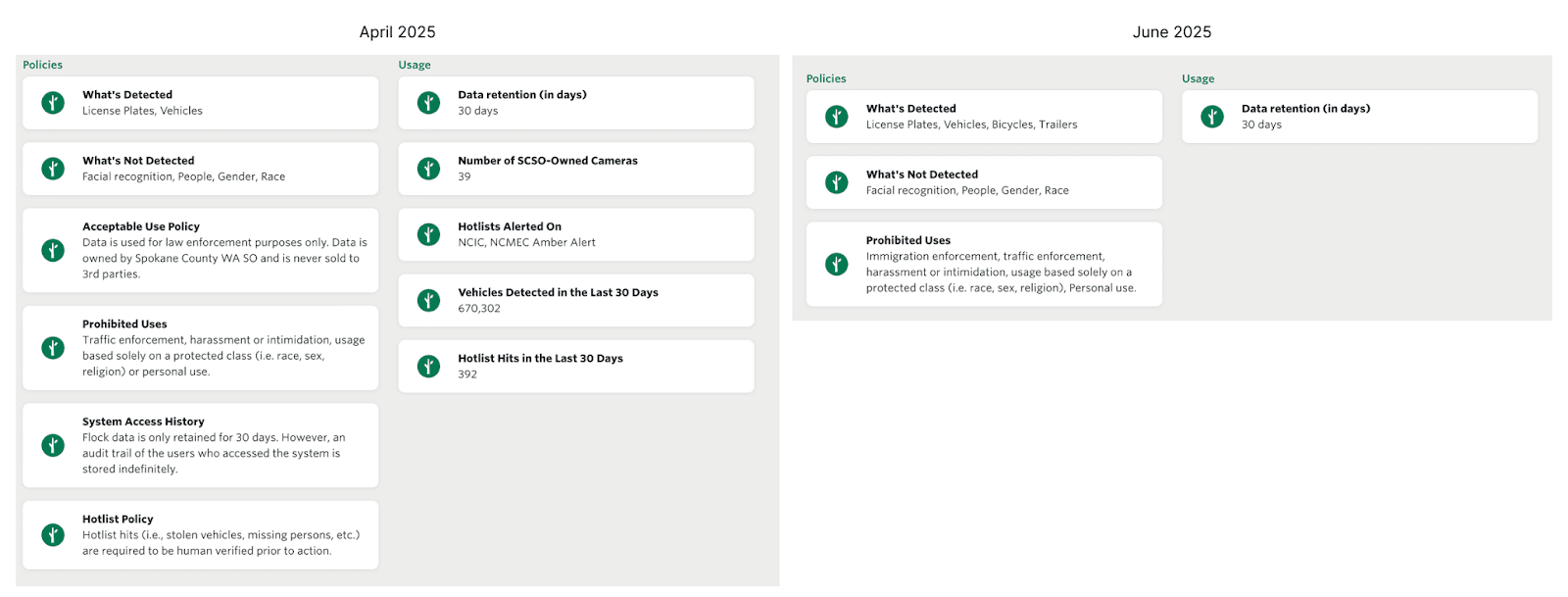
Spokane County Transparency Portal in April of 2025 (saved by the Wayback Machine and accessed by RANGE in June of 2025) and the same portal, just two months later. It’s not clear why so much data was removed.
Sometime after RANGE took the left screenshot, all Flock transparency portals were blocked from recording on the Wayback Machine, so we can no longer track the portals’ changes over time.
Washington municipalities Everett, Richland, Tukwila, Mount Vernon, Renton, Lakewood, Yakima, Lynnwood, Selah, Puyallup, SeaTac, Ellensburg, Edmonds, Lake Stevens and Arlington all have considerably more info on their transparency portals than Spokane County does. In fact, all Washington state transparency portals I looked at have more data points than the Spokane County one.
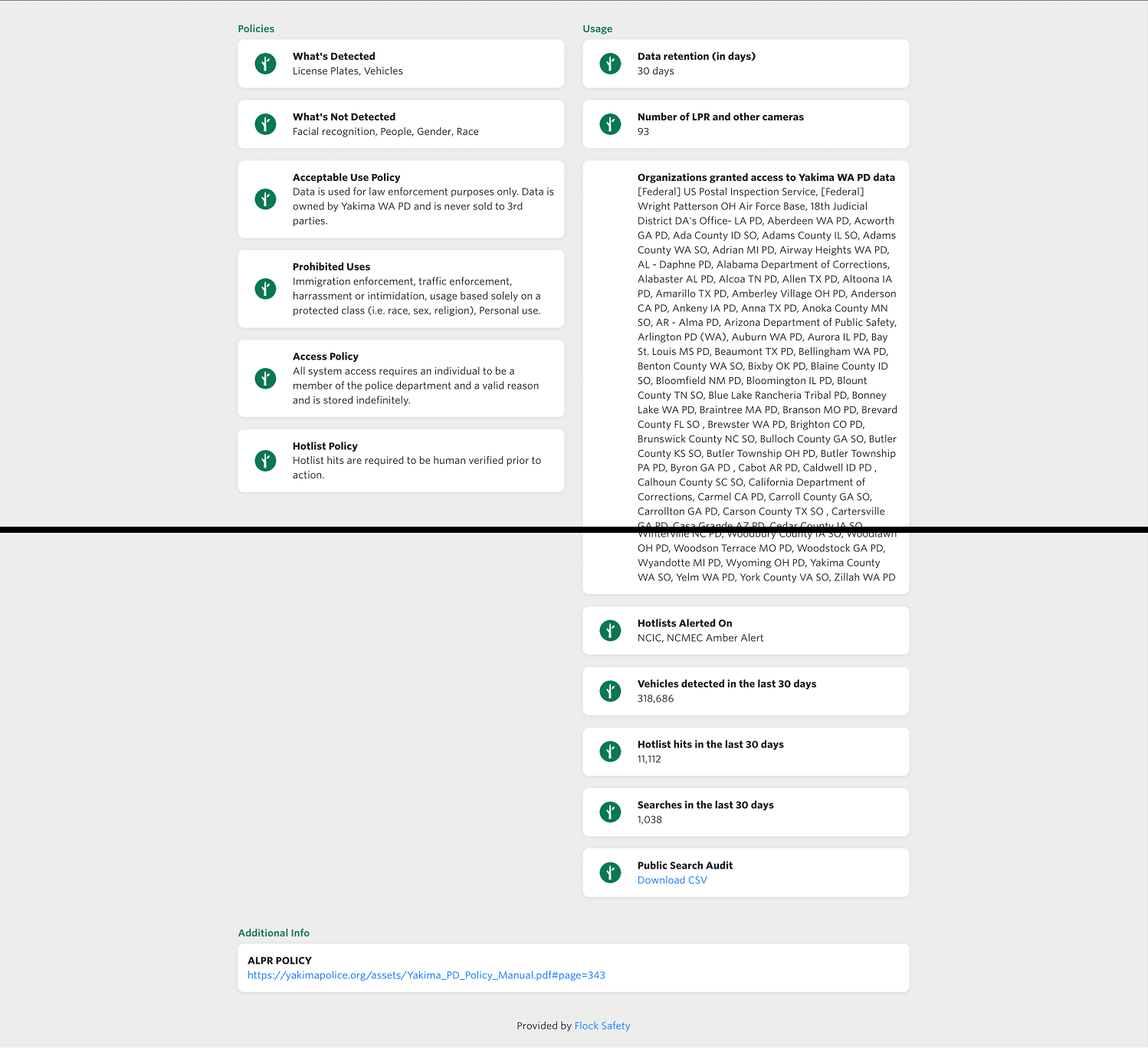
Here’s Yakima’s Transparency Portal. The image has been cropped as the list of organizations who have access to Yakima’s data is approximately one mile in length.
Garrett Langley, CEO of Flock Safety, touted in a blog post the system’s features that allow police leadership to run regular audits of search histories and encourage recording robust justifications to run a search, but cops regularly enter less-than-detailed search reasons and rarely enter case numbers, as reported by RANGE. According to the CEO’s blog post, the Flock system even has the ability to have a drop-down menu of search reasons, though the myriad misspellings in audits we’ve seen indicates that feature likely isn’t automatic. Advocate group Eyes on Flock found in its nationwide data compilation that the three most common search reasons are “investigation”, “invest” and “inv.” It’s likely that any jealous man stalking his ex-wife’s new boyfriend or a cop doing a favor for an ICE officer could simply enter “investigation,” and that search would blend right into any audit run.
Worse, some department’s legal counsel are even recommending leaders not run audits at all due to what would come out during public records requests — because of course, you can’t find evidence of misuse if you don’t look for it!
While RANGE has managed to get audit data from Spokane County’s Flock system via public records requests, Arlington and Everett have outright refused to provide the data. And Flock has recently given its clients the ability to strip search reasons from the audits they use for public records requests.
Information security is another concern. Flock logins are being sold by Russian cybercriminals online and dozens of police departments haven’t enabled multi-factor authentication, a simple layer that keeps things secure even if a username and password are compromised. This leaves the terabytes of sensitive data stored by police departments vulnerable.
While Flock prefers to position itself to the public as simple cameras that snap harmless still photos of license plates in public places, the software that stores and searches the data is functioning more like a tracking device placed on your car. The software can construct models of all your movements: it can know that on weekdays you drive from Country Homes to the Valley and back, except on Wednesdays when you head to Liberty Lake.
It goes beyond not having an expectation of privacy in a public space — what would be obvious to anyone who happened to be at the same intersection as you on a given day — with the network of cameras on most major roads entering Spokane County and the software behind them, it’s like they follow you as you drive. And it doesn’t just compile the data of those suspected of crimes, it compiles the data of everyone who passes the cameras. It’s illegal for police to install a tracking device in your car without a warrant, but the system behind the cameras is doing essentially that.
The data Flock collects, stores and analyzes isn’t limited to license plates: it picks up on paint colors, items in truck beds, bike racks and more. Flock users can search for “green pickup with driver's side door damage.” Flock was also planning to roll out video recording this year, rather than the still images it has been limited to so far.
Lastly, the American Civil Liberties Union (ACLU) has pointed out that Flock systems are starting to go beyond just investigating suspicion to generating suspicion, like flagging cars that appear to be traveling together.
What can be done?
For now, there are no permanent cameras in the city of Spokane. While the Spokane City Council did approve of the purchase of some cameras in February, that purchase has since fallen through. So don’t go asking Spokane city councilmembers to remove the cameras or kill its Flock contract; the cameras in Spokane County are largely outside the city (with the exception of a few placed at Lowe’s stores and a few atop sheriff’s vehicles that can be parked anywhere) and all outside the city’s control.
However, here are things you can do:
- Advocate at the state level by emailing your state legislators.
Flock plans to work with the Washington Legislature to water down public records laws. Tell your legislators you have no interest in a less transparent government.
California has a law that prevents license plate reader data from being shared out-of-state. Similarly, Illinois passed a law that severely restricts data sharing out-of-state. (This could cut down the sidedoor access — explained here — that would allow a Kootenai County cop to search Spokane’s data as a favor for an ICE officer, for example.)
While KWWA prevents local and state law enforcement from assisting with immigration, Illinois prevents its license plate data from being used to help other states hunt those seeking abortions.
Illinois has also passed a suite of regulations going into effect in 2026:
- mandated annual audits of searches performed
- mandated reporting of license plate reader camera effectiveness
- misusing data from these cameras is now a misdemeanor
Washington could follow in the footsteps of California and Illinois by passing privacy protections at the state level.
- Pressure your county commissioner — or city council member if you live in Cheney, Airway Heights or Liberty Lake — to kill their contract with Flock. This may feel far-fetched, but advocates were successful in getting Redmond, Lynnwood, Eugene, Skamania County, Wenatchee and Olympia leaders to suspend their usage of the cameras. This is the approach the ACLU recommends. (Spokane County’s original Flock contract is also set to end in December 2026.)
Alternatively, pressure the county to use Flock’s upcoming feature that requires a case number for every search and to beef up its Transparency Portal.
You can also make public records requests of Flock training materials, organization audits (searches made by local police) and network audits (searches made by non-local police of Spokane County data). Great examples of records requests can be found here.
- Support those covering Flock and fighting legal battles
Keep our local coverage of Flock cameras going by supporting RANGE with a one-time or recurring donation.
Subscribe to 404 Media. Those folks are doing incredible, data-dense, unrelenting investigatory work on Flock that is bringing to light many of the details I’ve listed here.
Support the Electronic Frontier Foundation or the ACLU, both of whom are investigating Flock and regularly take on legal fights to protect our privacy.
For information on this Flock series, why we’re reporting it and what’s coming next, click here.


