

“5-2,” isn’t just how tall this RANGE reporter is — it’s also how the vote at Spokane City Council meetings frequently breaks down.
On one side of these votes is a progressive super majority. On the other side are conservative council members Michael Cathcart and Jonathan Bingle. They also happen to both be representing the constituents of Council District 1, which encompasses much of downtown and stretches up towards Mead and out towards Spokane Valley, with Division Street serving as the dividing line between Districts 1 and 3.
Cathcart and Bingle could find themselves in the minority on a vote yet again next Monday — this time on a piece of legislation that would set the council’s rules for the next year and possibly put them at a further disadvantage.
There are some undeniably good changes in the rules, especially when it comes to public testimony and transparency: the council would hear your opinions at committee meetings, and written testimony from people who can’t attend meetings will be included in the agendas for all to see. But the packet also includes a few curveballs that Bingle and Cathcart say would severely hinder their ability to advocate for the needs of their constituents (this reporter included), like changing the day of the meetings and requiring three people to sign off on legislation before it could be brought to an evening council meeting — effectively killing their potentially unpopular pitches in darkness with far less public input.
For a breakdown on the potential changes and the arguments for and against them, read on.
Public Testimony Policies
First, we’ll cover the things that directly affect you (the public) and how/when you can give your opinion to the Spokane City Council, which was an extremely hot topic earlier this year. Proposed changes in this year’s rules could make testifying even easier, giving you more opportunities to speak and a longer run-up period to familiarize yourself with the items up for a vote.
The Pros
- You would be able to testify at committee meetings! One complaint we’ve heard frequently is that by the time an item makes it through committee and up to the legislative session meetings, it’s too set in stone. Because public comment is currently only taken at legislative sessions, it’s a lot harder to change anything based on public opinion. By taking 15 speakers for two minutes each at every committee meeting, the council would be able to incorporate feedback earlier and more efficiently.
- The council is also going to make it easier for you to know in advance what’s coming up by publishing advance agendas two weeks in advance and simplifying the amendment process to ensure the final posted agenda would reflect all changes. We think this will increase transparency about the process so you (and we) are never surprised by what’s up for a vote on any given day. Council Director Giacobbe Byrd has high hopes for even further improving this process in the next few years by simplifying agendas, integrating the testimony sign-up process with the council website and sending automated text messages to alert people if the item they signed up to speak on has been deferred or amended.
- If submitted correctly and in time, written testimony would now be included in the final agenda packets, which can be viewed online by everyone. Currently, written testimony is just distributed to the council members for review. This would add more accountability and transparency about how the public feels about the city’s policymaking.
- To get the city in compliance with state law, public testimony would be taken on board and committee appointments, which creates another opportunity for input.
The Con
- The big (and maybe only?) con in the rule changes around testimony is that instead of three minutes to testify on each legislative item, you would only get two minutes. Folks already frequently run out of time to make their point in the three minutes allotted, and losing 60 seconds would make it harder for people to share how legislation will impact them. It would, however, probably make meetings shorter, especially since an unlimited number of people can sign up to testify on legislative items — unlike Open Forum, which is limited to 20 people.
‘Tuesdays are for tacos’
Gadfly George McGrath’s “Bridge to Hookerville.” Steve Eugster’s manure-bag-protest of a potential City Hall garden. The chaos that ensued when Council President Lori Kinnear gavelled a meeting to a close early after activists committed the cardinal sin of reading quotes from earlier council meetings at the podium.
All the greatest hits of Spokane City Council meetings have one thing in common — they happened on a Monday night.
For as long as anyone can remember, council meetings have always been scheduled on Monday nights. There are some exceptions, like the recent Thursday morning reschedule of a meeting cancelled due to violent threats, but by and large, Monday night council meetings are a tradition that have spanned more than six decades.
In February, that could all change.
If passed in its current form, the new council rules would change regular legislative session to Tuesdays at 6 pm and committee meetings to Tuesdays at 11am. What’s currently called Briefing Session — a review of agenda items where council receives reports from staff and can make changes to that night’s agenda — would move from Mondays at 3:30 pm to Tuesdays at the same time. It would be renamed “Agenda Review,” and staff members would only be required to attend and brief on relevant items if council requests it.
This change came after public complaints that too many of the Monday meetings were getting cancelled due to city holidays, and the internal realization that frequent Monday Spokane Public School District cancellations led to childcare hardships for council members and staff alike.
The council considered Wednesdays or Thursdays as alternate dates, council member Kitty Klitzke said in a heated Briefing Session this week, but that conflicted with the meeting schedules of key regional boards: The Community, Housing, and Human Services Board meets on Wednesdays and the Spokane Regional Health District and the Spokane Transit Authority meet on Thursdays. So, Tuesday was the best option for the majority of the council. But best for the majority may be nearly impossible for one member of the council’s conservative minority, and the change has the Bingle and Cathcart concerned it may be more nefarious than wanting to avoid scheduling conflicts.
“Every single council member has known that for three years that a particular council member from my district — of course my district — cannot make the meetings,” Cathcart said during the Briefing Session. “Is that truly not intentional?”
Six of the seven current council members could make Tuesdays work, but Bingle, one of two conservatives on the council, could not. Because of his wife’s work schedule, he is the primary childcare provider for his family on Tuesdays.
Bingle knew what he was signing up for when he ran for office — after all, the Monday meetings are a longstanding tradition — but switching midterm to a new day is an unfair ask, Bingle said. If council wants to switch to Tuesdays, they should set the date for after the next election cycle so anyone who runs knows what they’re getting into.
But for council second-in-command Zack Zappone, this isn’t a fair argument: if Bingle is the only one with a conflict, why should six council members have to kowtow to the needs of one?
“Has he actually exhausted every opportunity to be there?” Zappone said. “I’d love to see his campaign schedule and see if he didn’t do any events on Tuesdays.”
The story isn’t “progressive majority ices out conservative by choosing the one day he can’t attend,” Zappone argued.
“The story is that workplaces aren’t accommodating to childcare, which is unaffordable. And council members don’t make a lot of money, so that’s hard,” he wrote in a text message to RANGE. “I had a similar experience earlier this year at Spokane Transit Authority, and the meeting went on without me!”
Zappone said that other constituents have expressed a preference for Tuesdays, like Anne Martin, the director of Greater Spokane Progress, who wrote in an email to him that moving to Tuesdays would “give us more time to review and provide feedback on ordinances, and engage our members for a Tuesday legislative session.”
But Bingle’s not the only one who has become accustomed to Monday meetings — we’re down there nearly every week live-posting.
Beyond council members, the media and frequent testifiers like Justin Haller and Will Hulings, volunteers from the MAC Movement also make Monday meetings a habit. Every week, members of the group post up outside Spokane City Hall handing out water, snacks and other necessities to anyone who needs it. Sometimes, chalk artists from the group draw detailed portraits or write political slogans on the concrete in front of the building. Often, members will come in and testify about the realities facing unhoused people on the streets of Spokane.
Dave Bilsland, one of MAC Movement’s members, speaks often at the council podium. This week, he told council that the proposed time change wouldn’t just impact members of council; it would also deeply impact unhoused people who know that they can get resources every Monday. Even when the council was cancelled because of threats of violence, people living on the streets still came to city hall looking for snacks and water, Bilsland said, because they had no way of knowing about the change to the schedule.
And, Bilsland added, “Tuesdays are for tacos.”
Besides just routine and tacos — council meetings have been on Monday for at least 65 years, according to copies of the old Spokane Gazette reviewed by Cathcart’s office, there’s another key consideration to the date change: the Spokane Board of County Commissioners (BOCC) already meet on Tuesdays.
The city’s proposed schedule wouldn’t directly conflict with BOCC, but it would require someone who wanted to attend all the committees, briefing sessions and legislative sessions of both bodies to sprint back and forth between the buildings all day long.
Klitzke thinks the day sync up may not be a minus, especially for the civically engaged (though we feel confident this won’t positively impact the working class): "They could go to the county in the afternoon and then the city in the evenings, if they wanted to do Civic Day on Tuesdays."
The Three-Body Problem
The other big change in the rules is a little technical, but could have big impacts. Currently, potential pieces of legislation get discussed in committee. If they have two sponsors, they can move on to the final phase: appearing on the agendas of two evening council meetings, where they receive an unrestricted amount of public testimony and then get voted on at the second of the two meetings.
Items don’t often fail; usually, if they have enough support to make it to the meeting, they have enough support to pass. That’s not *always* the case, though. With just two conservatives on the council, Bingle and Cathcart can still ally to push legislation through committee and onto the evening agendas, though pieces solely sponsored by the two of them frequently fail or are indefinitely deferred.
But, even when their ideas are defeated handily, they’re still debated in public. The council still gets to hear public testimony on the legislative items, which could hypothetically sway council members’ votes.
And regardless of the political affiliation of any members of the body, the current two-sponsor rule empowers the members of any one council district to surface issues that may be important or relevant just to their constituents, like the development moratorium in Latah Valley.
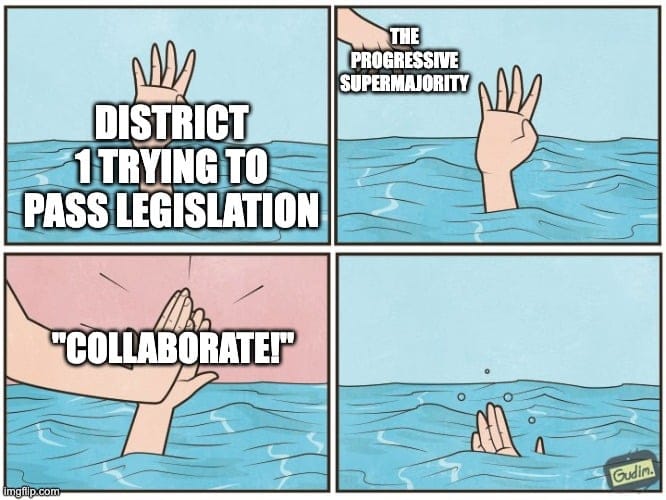
If the progressive supermajority gets their way and passes the current draft of the rules, items would now require an additional sponsor to move out of committee and into the council meetings.
Zappone told RANGE the change will prevent people from making decisions in a silo, and is in line with how state and national legislative bodies make decisions — things die in committee if they aren’t likely to pass on the floor, or if they don’t have the political support to move forward.
“[Bingle and Cathcart] have to realize that elections have consequences,” Zappone said. “If a group wants to get something passed, and they’re in the minority, they have to work with the majority.”
Former city council member Karen Stratton was a part of increasing the requirement from just one sponsor to two back in 2019. She told RANGE she thought two was the perfect number because it created a balance and showed collaboration, but didn’t shut any one district out.
“The constituents should not have to pay the price when our ‘nonpartisan’ council plays politics,” Stratton said. “Nobody wins.”
Council members Klitzke and Paul Dillon are championing the change for other reasons. Klitzke thinks it will keep public meetings more civil, ensure legislation is “fully baked” by the time it goes for a vote and stop council members from putting forward legislation solely, “to make a point because they want to have an argument.” Dillon states that it “will foster more collaboration.”
Bingle says “that’s crap.”
“On contentious issues, there will be no collaboration,” Bingle told RANGE. “The majority can pass something along party lines. I cannot. I am forced to collaborate.”
Cathcart thinks the proof is in the pudding: the rule change proposal was written without he or Bingle’s input and has only two sponsors; none of those sponsors are outside the supermajority.
“The only compromising or collaborating they have to do, and frankly have been willing to do, has been amongst themselves.”
Editor's note: This story has been edited to correctly reflect which board meets on Wednesdays and add additional context to a quote from Klitzke.


