

“We had a guest speaker today talk to us about immigration and US Customs and Border patrol! The students LOVED every minute of it,” the post read, accompanied by a picture of a guest lecturer in a Border Patrol uniform sharing slides with a class of Santa-hat wearing kiddos.
The text and images (which have since been deleted) were posted by a Spokane Public Schools teacher to ClassDojo, an app used by parents and teachers to communicate about lesson plans and learning goals, painting a gleeful picture of a fun activity just before winter break.
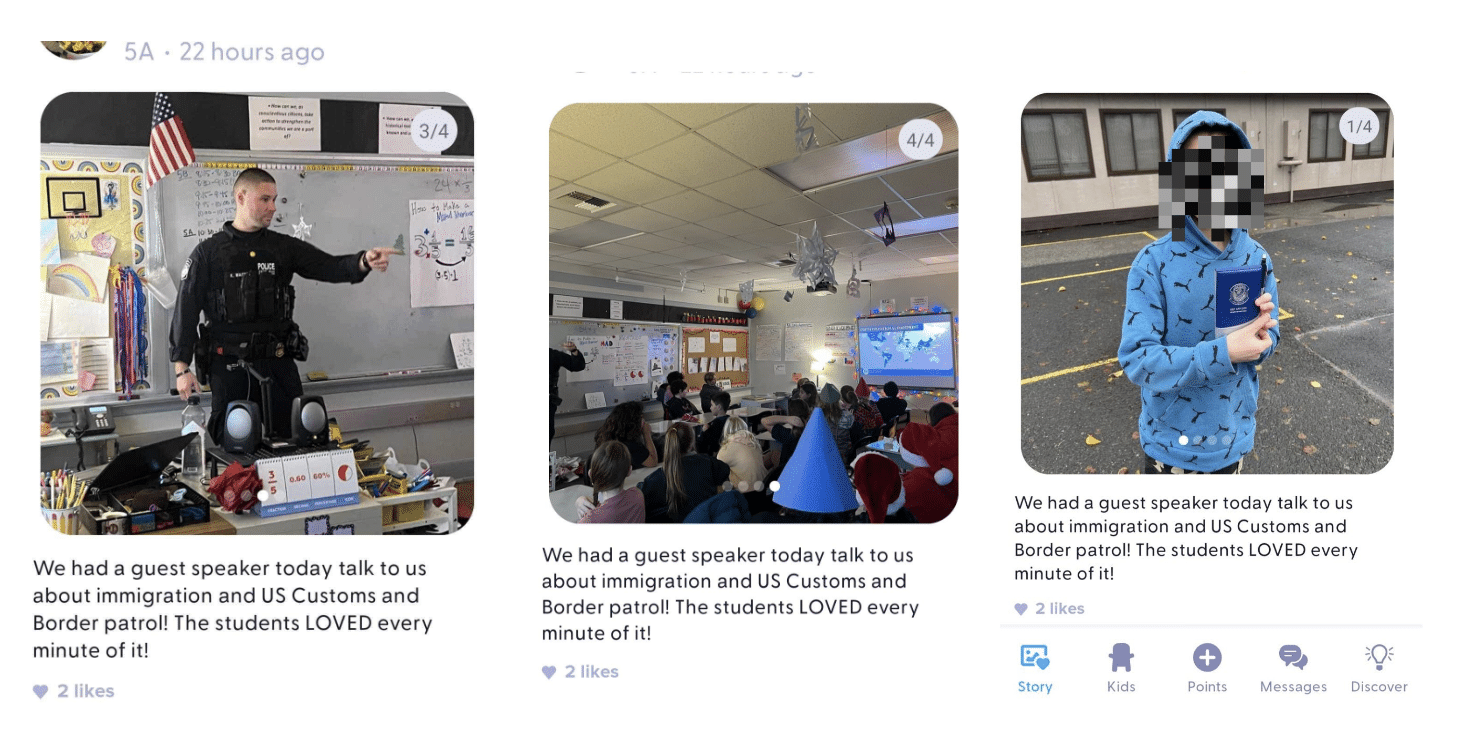
Not immediately obvious from the post: the classroom he visited was the Spanish Immersion Program at Libby Center, which is open to kids of all backgrounds, and contains children of immigrants from Spanish-speaking countries. As the images of the Dec. 7 presentation circulated and parents checked in with their kids, a different picture emerged for some of them. Parents RANGE spoke with told us their kids had found the presentation stressful and confusing.
“I was definitely concerned when I saw the pictures of officers who appeared to be fully armed, particularly because in our community, in the Latino community, we have always been very careful of Border Patrol,” said Pia Johnson Barreto, a parent of a fifth grader in the program. “There was a lot of confusion and also anxiety from my daughter … Particularly because [of] what she has known Border Patrol to do to friends in the community.”
The immediate concern was for the mental state of their children, several parents told us. The end of the semester is already a hectic time, and having a man in the uniform of the group known for separating families at the border and “[keeping] kids in cages,” as one parent put it, added additional stress for children from families with mixed immigration status.
For some, a secondary fear crept in. The students in the class were only about 10 years old, and families we spoke with wondered whether their children could have unknowingly shared details with the officer that could put undocumented friends or family members at risk.
For one parent, who spoke to RANGE on condition of anonymity, those fears were realized. “I have family who are mixed status,” the person said. “And my daughter shared information that I wish she had not.”
After screenshots from the app spread between families and on Facebook, Jennyfer Mesa, Executive Director and founder of Latinos En Spokane, and other concerned citizens quickly sent a letter of protest to Adam Swinyard, the superintendent of the Spokane Public School (SPS) District.
“The decision the Spanish Immersion teachers made to invite an Immigration Law Enforcement agent to the school is tone-deaf to the lived experiences of Latino Immigrants,” Mesa wrote. “The Spanish Immersion program is actively trying to recruit native Spanish speakers but is clearly unaware of the experiences of Latino and immigrant families and the community trauma Border Patrol has created locally and nationally.”
Mesa’s email went on to detail the harms caused to local families targeted by immigration officers, and the statistical reality that Latino/e/x people are far more likely to be exposed to violence, detainment and family separation than their white peers.
Swinyard responded on the morning of Monday, December 11, thanking Mesa for bringing the situation to his attention and stating that he took the report “very seriously.”
“I share your concerns for student safety as we never want any students to feel uncomfortable or unsafe at school,” Swinyard wrote. “The initial understanding of district leadership is that district procedure 2331 was not followed by the classroom teacher and we are working closely with Mr. [Mauricio] Segovia [principal of the Spanish Language Immersion program] to conduct an investigation to learn additional details and take appropriate action.”
In an email to RANGE, Sandra Jarrard, Chief of Communications and Governmental Affairs for the school district, declined to comment on potential disciplinary action for the teacher who violated school policies, but said, “we will be investigating and want to make sure staff are following procedure 2331 controversial issues - guest speakers (spokaneschools.org).”
Jarrard also shared an email sent from Segovia to the Spanish Immersion program families acknowledging the community’s concerns and stating that it was not in line with the school’s policies.
Swinyard was not available to comment to RANGE, but has scheduled a conversation with Mesa and other community advocates for December 22.
Not the first time
This isn’t the first time SPS has angered community groups by inviting immigration officers into classrooms.
In November of 2018, uniformed Border Patrol agents had volunteered to read in Holmes Elementary School classrooms, which sparked a letter of concern coordinated by ACLU Washington and co-signed by organizations including NAACP Spokane. Amy McColm, an independent education advocate, wrote a separate letter, in support of ACLU Washington. Those letters voiced many of the same concerns as Mesa’s last week, asking district leaders to empathize with Latino/e/x students whose safety, emotional states and learning environments had been impacted by the presence of immigration officers.
“There is widespread fear in schools and communities that federal immigration officials will begin to conduct enforcement actions at school,” wrote McColm. “Having uniformed immigration agents in marked patrol cars at local schools makes students and parents afraid to attend and engage with schools and spreads fear beyond the school and into the community.”
At the time, Brian Coddington — who is currently Communications Director and acting chief of staff for Mayor Nadine Woodward — was Communications and Community Relations Director for SPS. According to Nikki Lockwood, who worked for the ACLU at the time, rather than respond to any of the organizations who cosigned the ACLU’s letter, Coddington reached out to McColm, inviting her to come to a meeting with Coddington and Kevin O’Neill, Human Resources director for SPS at the time.
“I honestly don't know why they offered me a meeting and not anyone else,” McColm told RANGE this week. “If I'm just being perfectly honest with you, the fact that my name is Amy McColm, M-C-C-O-L-M, I think it's a very white, Irish-looking name.”
Coddington did not respond to a call for comment.
McColm, who is a white woman, took the meeting with Coddington and O’Neill, but did not show up alone. Instead, she served as what Lockwood called “a Trojan horse,” bringing three Latina community advocates, including Lockwood and Mesa, with her to the meeting.
In the meeting, McColm said the advocates tried to help Coddington and O’Neill understand the impacts the border patrol officers had on students and families. The group told Coddington and O’Neill that some parents were so shaken, they took their kids out of school (a story Mesa retold in her letter to Swinyard last Friday).
“The thing about the meeting back then was that the only thing that the school district was interested to know was the names of the families that had been scared away by Border Patrol,” McColm said. She recalled telling Coddington that those frightened families wanted to remain anonymous, and that he should instead listen to the community advocates in the room sharing the realities of the harm that had been caused.
“It was a very different time,” Lockwood told RANGE this week, noting that the meeting took the school district weeks to set up. “The cultural responsiveness at the time just … there hadn’t been a lot of work.”
(Lockwood, who is now the president of the SPS School Board, ran for office in 2019 with a background in addressing systemic issues and years of parental advocacy on behalf of her daughter Risa who has autism.)
Despite McColm and Lockwood’s criticisms of the process, the advocates managed to secure some concrete promises from the school district: if Border Patrol agents chose to volunteer at the schools, they would do so as private citizens, no longer wearing their uniforms on campus or arriving in Border-Patrol-marked vehicles. In an email to McColm in 2018, Coddington told her the Border Patrol had agreed to these terms, as well, writing, in part, “After much discussion with school staff, the Border Patrol, Spokane Public Schools community partnership team members, and others, the Border Patrol offered to use non-uniformed volunteers with the reading program and discontinue the use of uniformed agents.”
“You can’t get the language without the people.”
Beyond the presentation itself, which parents characterized variously as confusing, stressful and traumatic, Mesa, in her letter, warned about possible longer-term effects on student mental health. “A growing body of research is continuously shedding light on how immigration enforcement can affect mental health, especially among children and youth,” she wrote. “Research has also found that youth who are not themselves likely to be the target of immigration enforcement may still experience mental health symptoms because of enforcement fears.”
That sentiment, and concerns about the impacts to the students’ quality of education, was also echoed by the parent that spoke with RANGE on condition of anonymity.
“When children are anxious and fearful and worried about what this could mean for their families, their learning goes out the window,” the person said. “If they're anxious or worried about it, how is that showing up? And how is that impacting their learning and their relationships with their teachers?”
Johnson Barreto hopes that the scheduled conversation with Swinyard will encourage the district to recommit to the promise they made nearly 5 years ago, and to provide teachers with additional cultural competency training, especially if the district intends to continue putting an emphasis on recruiting Latino/e/x students to the Spanish Language Immersion program.
“We just want to ask the school to take more responsibility and engage teachers in much training and conversation, especially when doing a unit on refugees and immigrants and the way that it impacts young people,” Johnson Barreto said. “This is a much bigger conversation of creating a space where young people can belong and feel safe prior to us bringing more kids into the school, right?”
Mesa’s letter asked the school district to go a step beyond their 2018 promise, and prevent staff from collaborating with federal immigration officers altogether. She told RANGE that she will also be recommending ongoing training, and for teachers to watch the documentary created by Latinos en Spokane that highlighted the ways immigration issues impacted local families in Spokane and eastern Washington.
“How is it that they're getting prepared to understand these realities and understand the Latino experience?” Mesa said. “It's not only the language. You can't just get the language and not the people.”
Johnson Barreto told RANGE she still supports her daughter’s teacher, and wants the district to provide all teachers with more support.
“In an ideal world, I would love acknowledgment of the data and the impact that this has on our immigrant and refugee community,” said Johnson Barreto. “I would love for this school to take action and engage professionals in equity training that centers the lived experiences of immigrants and refugees.”
A previous version of the story identified Lockwood as the vice president of the school board. She recently became the president. The story has also been edited to correct the spelling of Johnson Barreto's last name.


